Record 10-Minute X-Ray Flash Points to Colliding Neutron Stars Giving Birth to a Magnetar
The Einstein Probe saw bright X-rays for about ten minutes after a half-second gamma-ray burst from over 6 billion years away, with no supernova to explain it.
The physics desk
Physics from the quantum to the cosmos: particle physics, quantum computing, astrophysics, cosmology and the discoveries that change what is possible.

The Einstein Probe saw bright X-rays for about ten minutes after a half-second gamma-ray burst from over 6 billion years away, with no supernova to explain it.

University of Colorado Boulder theorists adapted a classic statistical-mechanics argument to quantum systems, settling a long-standing conjecture about the random-bond Ising model.

A University of Surrey team proposes a device built on frictionless helium-3 that is immune to the electromagnetic noise that plagues today's qubits. No one has built it yet.

Using laser-trapped strontium atoms as a quantum simulator, the team directly measured energy levels in two theories describing matter at a tipping point.

A Romanian team used a high-power laser to build an artificial muon beam and captured the shadow of a pile of lead bricks behind a 2-meter concrete wall.

Physicists saw the wake a fast quark or gluon leaves behind in the primordial liquid of the early universe, using millions of lead-lead collisions at the LHC.

A team measured 15 pristine galaxies over 130 hours at the Large Binocular Telescope. Their uncertainty is three times smaller than the previous standard.

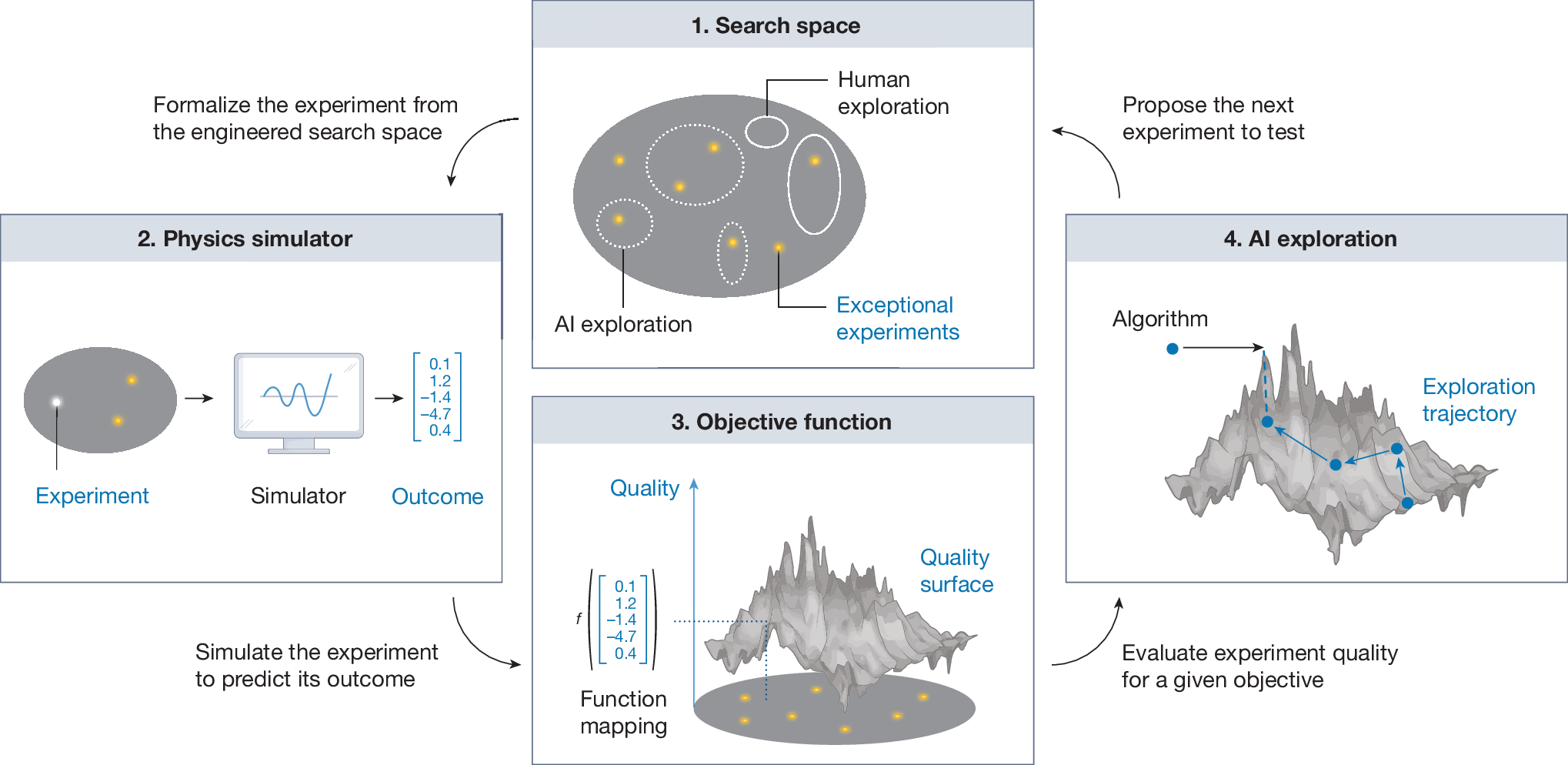
Instead of a chatbot, the method treats lab design as a search problem over lasers, lenses and detectors. It has produced better designs for gravitational-wave detectors, fusion reactors and microscopes.

A new framework published in Science overturns the assumption that networks work best when every part is identical. A moderate amount of variation helps, and too much hurts.

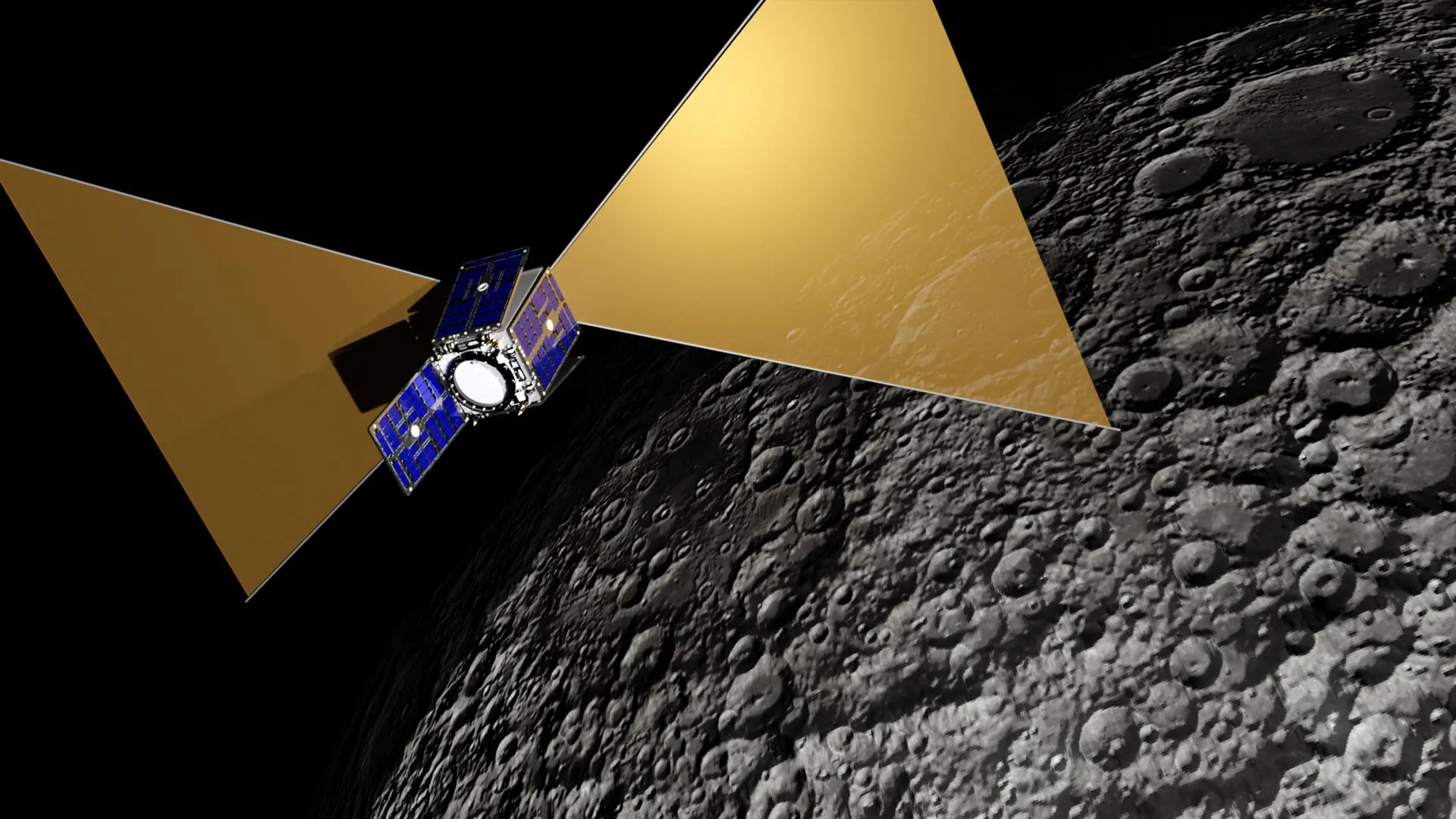
Cambridge-led researchers plan a lunar orbiter to catch a faint hydrogen radio signal from before the first stars, a window Earth's radio noise blocks.

Duke-led physicists recreated 'string breaking,' the process that turns stretched-out energy into particle pairs. Google and QuEra teams reached similar results on different hardware.

Calculations from Chinese teams show scandium's 3d electrons drive a predicted superconductor that would work at 43°C, though only under crushing pressure.

University of Vienna physicists report that a light-based quantum processor survived launch on a Falcon 9 and produced photon pairs and interference in space.

For the first time the radio telescope detected the cosmic hydrogen signal using only its own data. That opens a cheaper, faster route to testing what dark energy really is.

The DarkSide-50 detector under Italy's Gran Sasso mountain found no ultraheavy composite dark matter, but ruled out a wide range of its possible properties.

By stacking data on hundreds of galaxies, Arizona State astronomers found hydrogen glowing along jet paths deep into the gas halos that feed star birth, but not in other directions.

Scientists at Berkeley Lab heated two NASA-type ablators to 900 degrees Celsius and imaged them in 3D as they decomposed, finding one riddled with pockets and the other laced with channels.

Astronomers in India found four nested pairs of radio hotspots around a galaxy 3.9 million light-years across, each one older the farther it sits from the core. The jets' direction has also swung by 24 degrees, a sign the black hole's spin axis is wobbling.

The new allotrope, Imma-B60, was predicted on paper for more than a decade. Researchers finally built it by baking the sodium out of a boron crystal.

Brookhaven's STAR detector found temperature-linked fluctuations bottoming out in its densest gold-ion collisions, the kind of suppression theory predicts near a long-sought phase-diagram landmark.

A Portsmouth-led model shows that a quantum field's constant contact with its surroundings can all but shut off the tunneling that would carry it into a deeper, radically different energy state.

IRAS 18293-0941 pairs a 10-solar-mass black hole with a hot star. Its jet slams into a gas cloud 100 light-years away, where particles may reach energies about 100 times the Large Hadron Collider's.

In Physics of the Dark Universe, Shin'ichi Nojiri and Sergei Odintsov find that objects with negative mass can arise consistently in a universe filled with negative-pressure fluid or extra scalar fields, and could bend light the wrong way.

EPFL and Weizmann physicists measured e/4 charges in a special quantum state of gallium arsenide, a result that strengthens the case for a route to error-proof quantum computers.

In 195 simulated star deaths, adding neutrino 'flavor' changes flipped many stars between 16 and 30 solar masses from supernovae to silent black holes, which could explain why astronomers see fewer explosions than expected.

Two Khalifa University mathematicians computed how black holes 'ring' in five to 26 dimensions and found two very different waves that share exactly the same notes, until a string-inspired correction is added.

Radio images of WISPIT 2b, a planet five times Jupiter's mass still pulling in gas 430 light-years away, show swirls that simulations predicted for decades but no one had seen next to a known planet.

NIMS physicists found that tiny whirlpools of current in an ultrathin superconductor glide along rows of atomic steps like trains on rails, a possible route to lower-power superconducting devices.

UC San Diego physicists built a way to separate detector errors from a real rotation of the cosmic microwave background's polarization. Applied to Planck data, it recovers a twist of 0.37 degrees, which could point to new physics.

A Paris team shook the top of a draining whirlpool and filmed its core with a high-speed camera. Energy cascaded from large ripples to ones 100 times smaller, exchanged six waves at a time, exactly as theory said.