Canada's CHIME Telescope Catches the Faint Glow of Hydrogen From 5 Billion Years Ago
For the first time the radio telescope detected the cosmic hydrogen signal using only its own data. That opens a cheaper, faster route to testing what dark energy really is.

A Canadian radio telescope has picked up the faint radio glow of hydrogen gas from when the universe was about 5 billion years old, and it did so using only its own observations. The result, published in two papers in The Astrophysical Journal, gives astronomers a new and much cheaper way to study dark energy, the unknown force that appears to be speeding up the expansion of the universe.
The instrument is the Canadian Hydrogen Intensity Mapping Experiment, or CHIME, a set of half-pipe-shaped antennas near Penticton, British Columbia, hosted by the National Research Council of Canada. It scans the entire northern sky every day. It was built specifically to map how hydrogen is spread across the cosmos. Scientists at the University of British Columbia, McGill University, the University of Toronto, the Dominion Radio Astrophysical Observatory and Arizona State University run the project.
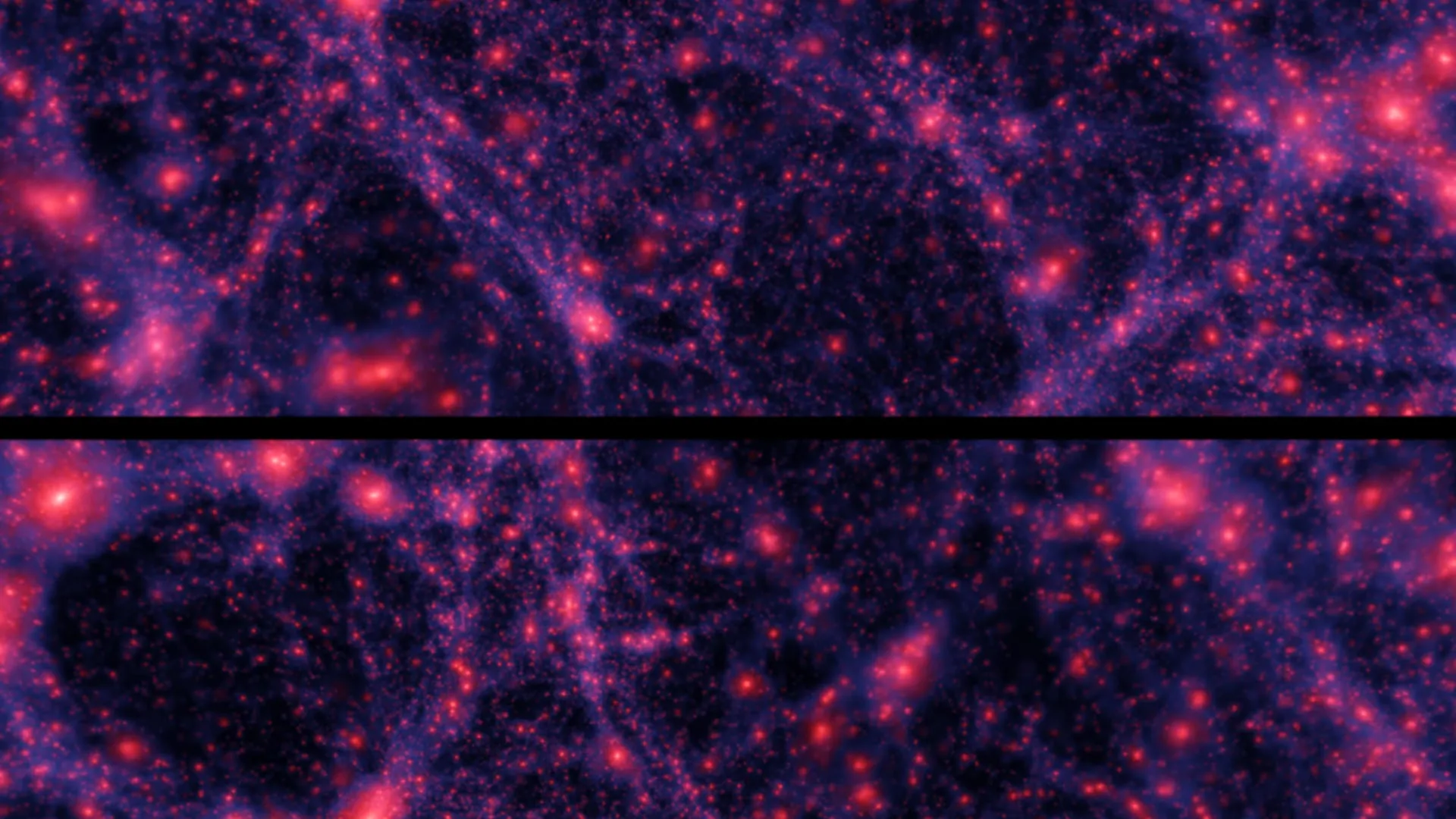
"Hydrogen is the most common element in the universe and the raw material from which stars form," said Arnab Chakraborty, a University of Toronto postdoctoral fellow who first proposed the finding. "Its faint radio emission acts like a cosmic tracer, revealing how matter is distributed across space." Neutral hydrogen gives off radio waves at a wavelength of 21 centimeters. As the universe expands, that signal stretches to longer wavelengths, so the amount of stretching tells astronomers how far back in time they are looking. The papers measure the signal at a redshift of about 1.
Until now, CHIME could only pull the hydrogen signal out by cross-matching its data with maps from optical galaxy surveys, which cost millions of dollars more and only see the parts of the universe dense enough to form stars. This time the team found it in CHIME's data alone, a method called autocorrelation. That was hard. The signal is buried under noise from our own galaxy, from human radio technology and even from the telescope itself. The researchers built new processing methods and then spent more than a year testing the result to make sure it was real. The detection uses 94 nights of observations from 2019.
"We worked very hard to convince ourselves that this wasn't a false alarm," Chakraborty said. "After all the tests, the signal remained." The companion paper found that about 2% of the universe's hydrogen was in neutral atomic form at that time, which fits other measurements, according to Shabbir Shaikh of Arizona State University.
The stakes are high. Recent results from other surveys have hinted that dark energy may be weakening over time rather than staying constant, a possibility that would upend the standard model of cosmology. Hydrogen maps track the same large-scale patterns in matter that galaxy surveys use to measure the expansion of the universe, but they can cover far larger volumes of space. "This is a completely new technique for probing the cosmos," said Mark Halpern, CHIME's principal investigator at UBC. "It's a bold new step in the global cosmology program."
The current result uses only a small slice of CHIME's archive. The team now has nearly seven years of data and plans to push the analysis back to when the universe was just 3 billion years old. "By actually showing that the technique works in practice, we've opened up a whole new window on the universe," said Simon Foreman, an assistant professor at Arizona State.