Physicists Propose the Universe 'Remembers,' Offering a New Path to Dark Matter and Dark Energy
A Leiden University team's 'Quantum Memory Matrix' theory suggests spacetime stores an imprint of every interaction, a single framework its authors say could also resolve the black-hole information paradox.
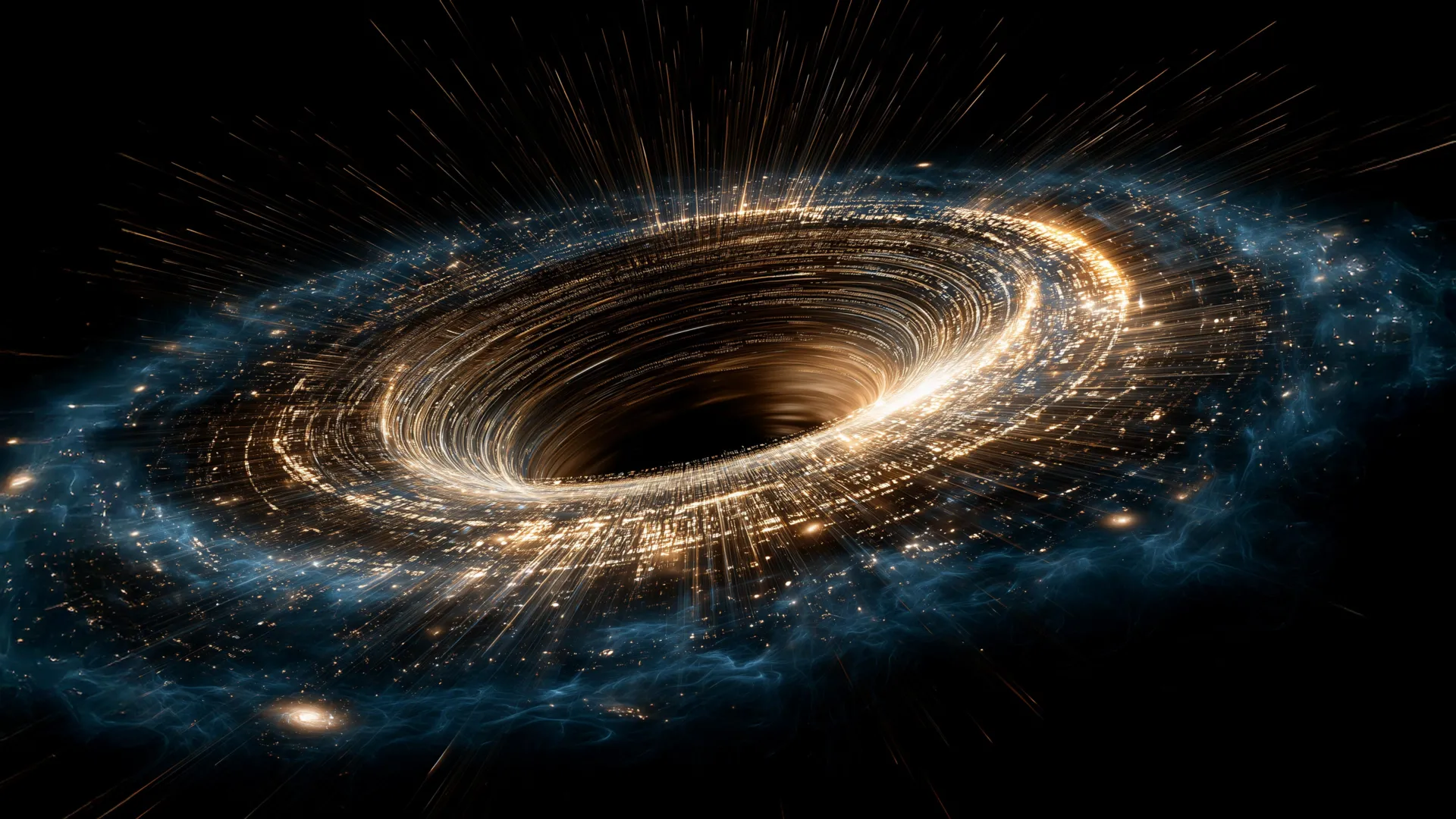
A team of physicists has proposed a provocative idea: that spacetime itself keeps a record of everything that happens within it. Their theory, which they call the Quantum Memory Matrix, holds that the universe "does not just evolve — it remembers," and they argue that a single such mechanism could address several of the deepest puzzles in modern physics at once.
The framework, developed by Florian Neukart, an assistant professor of physics at Leiden University in the Netherlands, and his colleagues, treats spacetime not as a smooth, featureless backdrop but as a fabric woven from discrete "cells." Each cell, the theory proposes, stores a tiny quantum imprint of every interaction that passes through it, so that the history of the cosmos is encoded into the geometry of space itself.
That premise leads directly to one of physics' most stubborn problems: the black-hole information paradox. For decades, physicists have wrestled with whether information that falls into a black hole is destroyed — a possibility that would violate the rules of quantum mechanics. In the Quantum Memory Matrix picture, that information is never lost; instead it is preserved in spacetime's memory through what the authors call an "imprint operator," sidestepping the paradox entirely.
The same idea, the researchers suggest, may bear on the mysteries of dark matter and dark energy, which together account for roughly 95% of the universe's contents yet have never been directly identified. Clumps of accumulated spacetime imprints, they argue, could gravitate in a way that mimics dark matter, helping explain why galaxies rotate faster than their visible mass should allow — without invoking undiscovered particles. And as spacetime cells approach saturation, the theory holds, a residual energy emerges that matches the observed cosmological constant driving the universe's accelerating expansion, the phenomenon attributed to dark energy.
The authors go further, sketching a cyclic cosmos with a finite informational capacity. By their accounting, the universe has completed several cycles and has fewer than ten remaining before it reaches maximum information saturation. To test their mathematics, the team simulated the model's core operations on quantum computers and reported recovering encoded quantum states with better than 90% accuracy.
Outside experts are likely to greet the proposal with healthy skepticism, as is typical for sweeping theoretical claims that aim to explain many things at once. The Quantum Memory Matrix remains a theoretical framework rather than an established result, and confirming it would require observational signatures that distinguish it from rival explanations. Still, its authors argue that tying black holes, dark matter and dark energy to one underlying principle — memory baked into spacetime — is a hypothesis worth taking seriously.
Originally reported by ScienceDaily.