Physicists Recreate a Black Hole's Energy-Stealing Trick in the Lab for the First Time
A CUNY team built a spinning system out of engineered metamaterials that amplifies passing waves — reproducing the half-century-old Penrose-Zel'dovich process once thought possible only around a rotating black hole.
For the first time, physicists have recreated in a laboratory the strange process by which energy can be stolen from a spinning black hole — a phenomenon dreamed up more than half a century ago and long confined to the realm of theory and telescopes.
The experiment, carried out at the Advanced Science Research Center at the CUNY Graduate Center and published in Nature, demonstrates a new way to amplify waves by bouncing them off a rapidly rotating system. It brings a piece of exotic astrophysics down to a benchtop, where it can be measured and controlled.
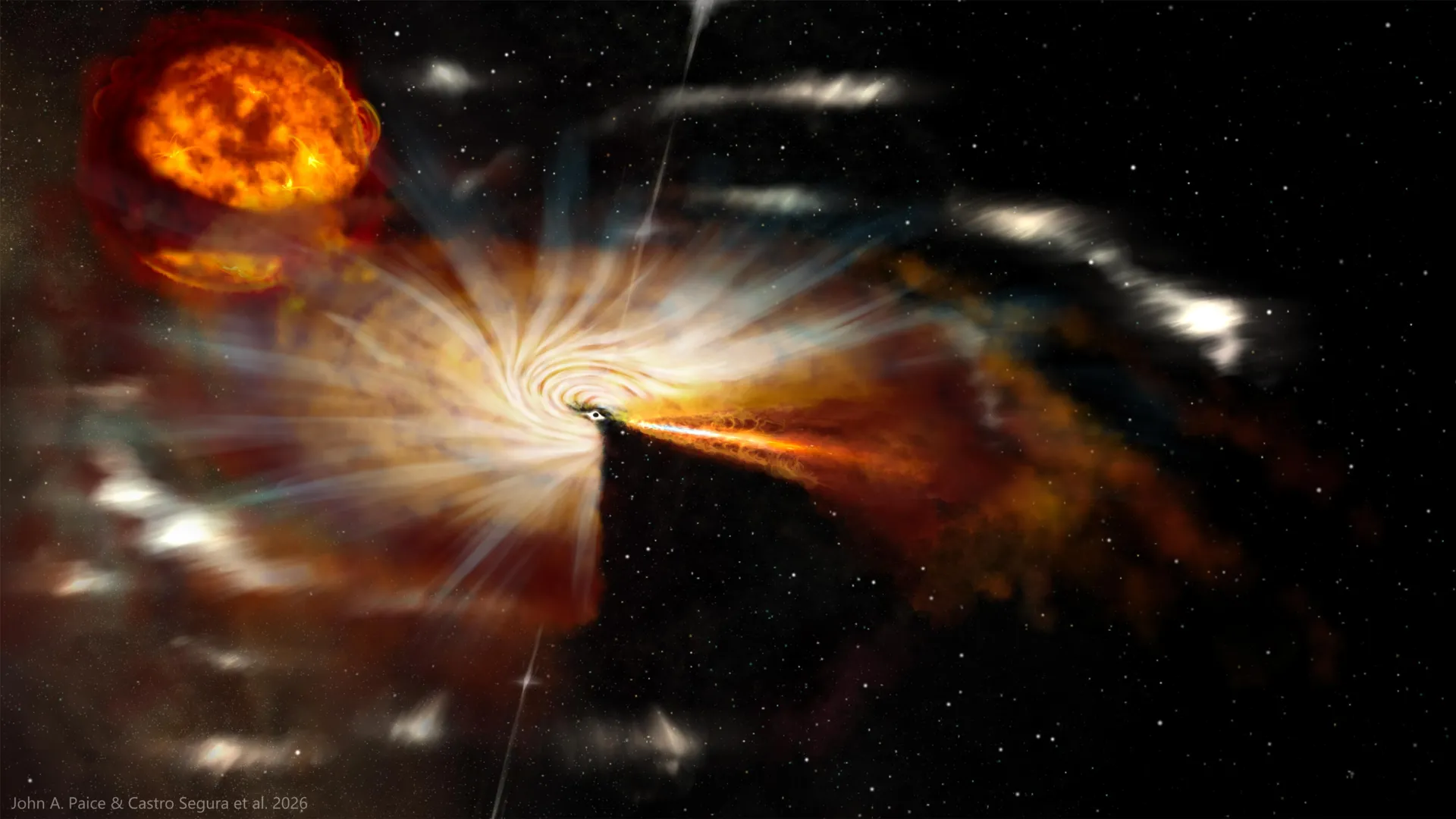
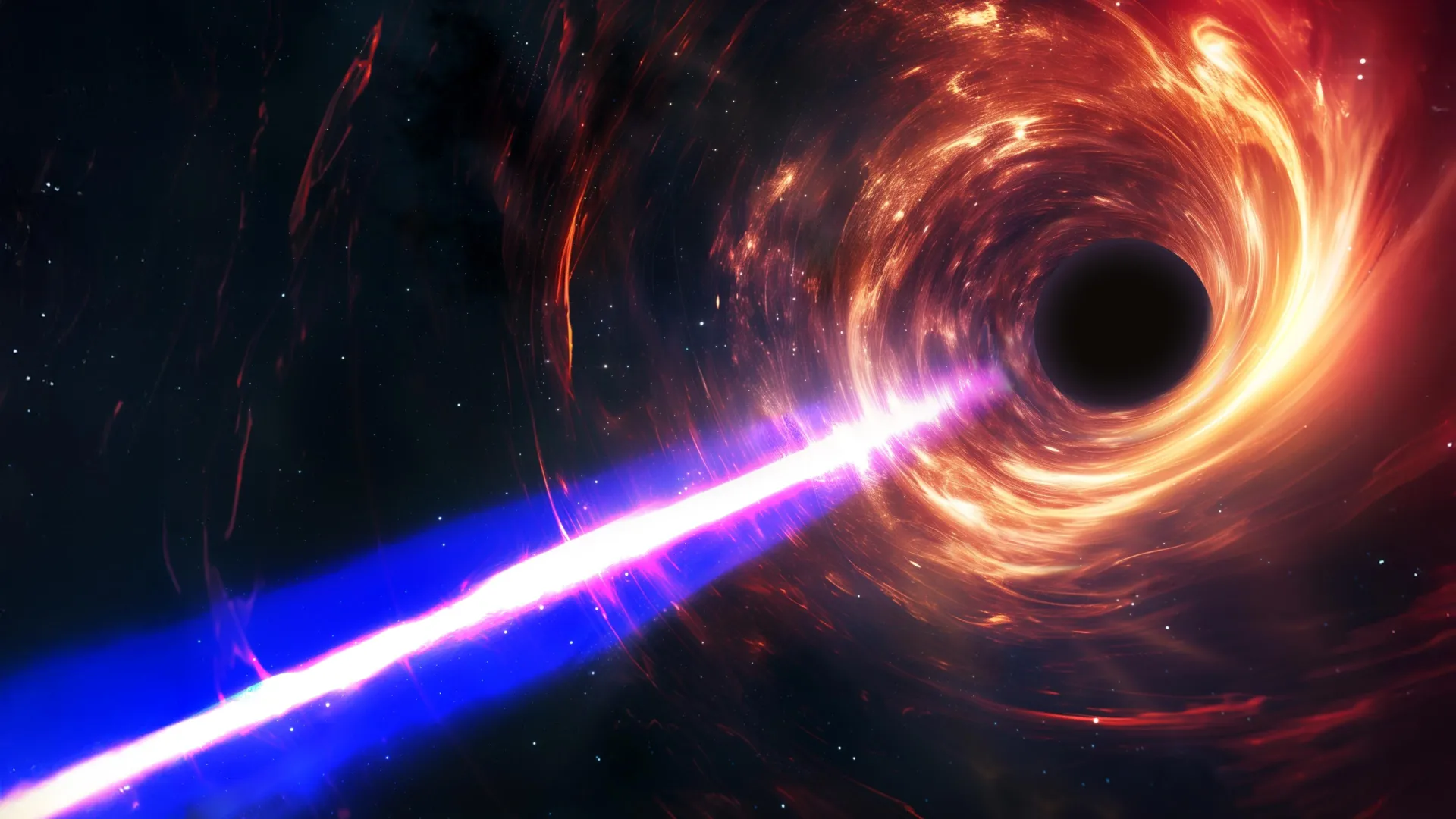
The idea traces to 1969, when the mathematical physicist Sir Roger Penrose imagined a particle drifting into the ergosphere — the region around a spinning black hole where space itself is dragged along. Penrose showed that if the particle split in two, with one piece falling in, the other could escape carrying more energy than the original, effectively siphoning rotational energy from the black hole. The physicist Yakov Zel'dovich later predicted that a wave, not just a particle, striking a fast-enough rotating body could likewise be amplified.
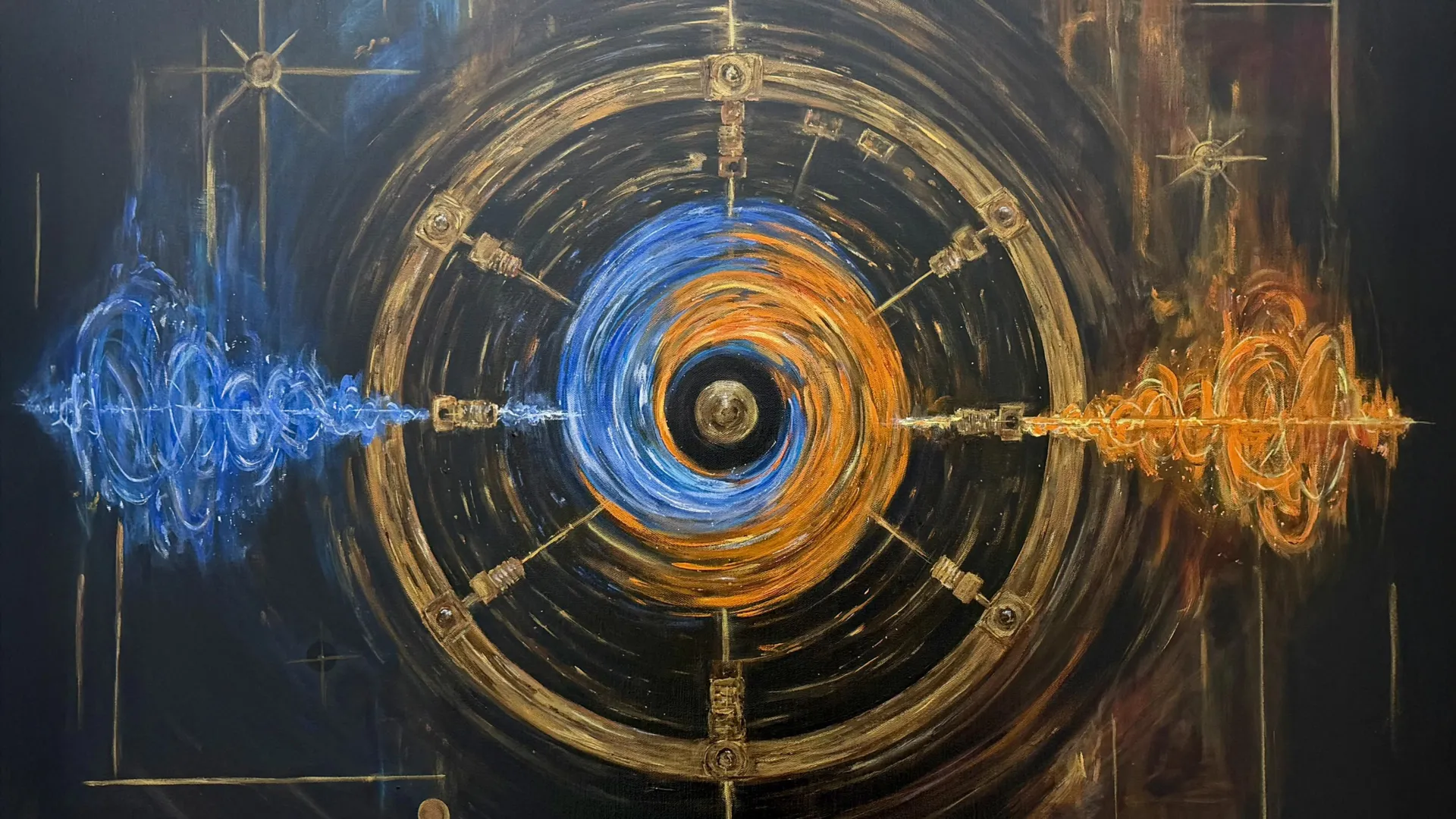
The CUNY team reproduced that effect using engineered materials called metamaterials, which are structured to precisely control how waves travel through them. By creating a "synthetic rotation" within the system, the researchers sent in waves with the right rotational characteristics and watched them come out amplified — extracting energy from the spinning system exactly as the Penrose-Zel'dovich picture predicts.
Crucially, the synthetic approach can mimic rotation faster than light could physically travel around a real object, giving scientists a controlled platform to probe regimes that would otherwise be impossible to reach. That turns a thought experiment about black holes into a repeatable tabletop tool, letting researchers test predictions about wave amplification, energy extraction and the physics of rotating spacetime.
The researchers say the work could ripple outward into practical wave engineering — from novel amplifiers to devices that harvest energy from rotation — while deepening the connection between condensed-matter physics and gravitation. More broadly, it is a striking example of how carefully designed materials can stand in for the most extreme objects in the universe, letting physicists study black-hole physics without ever leaving Earth.
The experiment joins a growing field of "analog gravity," in which laboratory systems — from flowing fluids to ultracold atoms and optical fibers — are used to mimic phenomena thought to occur near black holes, including the faint glow of Hawking radiation. What sets the new work apart, the team says, is that it directly reproduces energy extraction from rotation, a process that had resisted laboratory demonstration for decades. Having a controllable stand-in on the bench means predictions once testable only through astronomical observation can now be checked, refined and repeated at will.