Physicists Built a 24,000-Atom 'Mini Universe' — and Watched Time Emerge Without a Clock
A University of Birmingham experiment shows the flow of time can arise from a quantum system's own behavior, no external clock required. The setup could let scientists test ideas about the Big Bang in the lab.

In a laboratory in England, physicists have built a "mini universe" out of 24,000 ultracold atoms and used it to demonstrate something profound: the flow of time can emerge naturally from the inner workings of a quantum system, with no external clock needed to mark its passage.
The experiment, led by Professor Giovanni Barontini at the University of Birmingham and published in Physical Review Research, tackles one of the deepest questions in physics — what time actually is. In everyday life we measure time against something external, whether a wristwatch or the swing of a pendulum. Barontini's work shows that a version of time can instead be read off directly from how a self-contained quantum system evolves.
To do it, the team trapped a cloud of about 24,000 atoms cooled to just a few billionths of a degree above absolute zero, creating a hermetically sealed system isolated from the outside world. A thin barrier formed by a laser beam split the cloud into two regions — an observed "bright" region and an unobserved "dark" one. Atoms were free to move between the two, and by watching how the population shifted, the researchers could track the system's evolution and effectively let time "grow" inside it.
The significance goes well beyond a clever trick of measurement. Because the sealed atomic cloud mimics a simple, self-contained universe, it offers an experimental test bed for ideas in quantum cosmology and gravity — fields where theorists have long grappled with how time behaves in a universe that, taken as a whole, has nothing outside itself to be measured against.
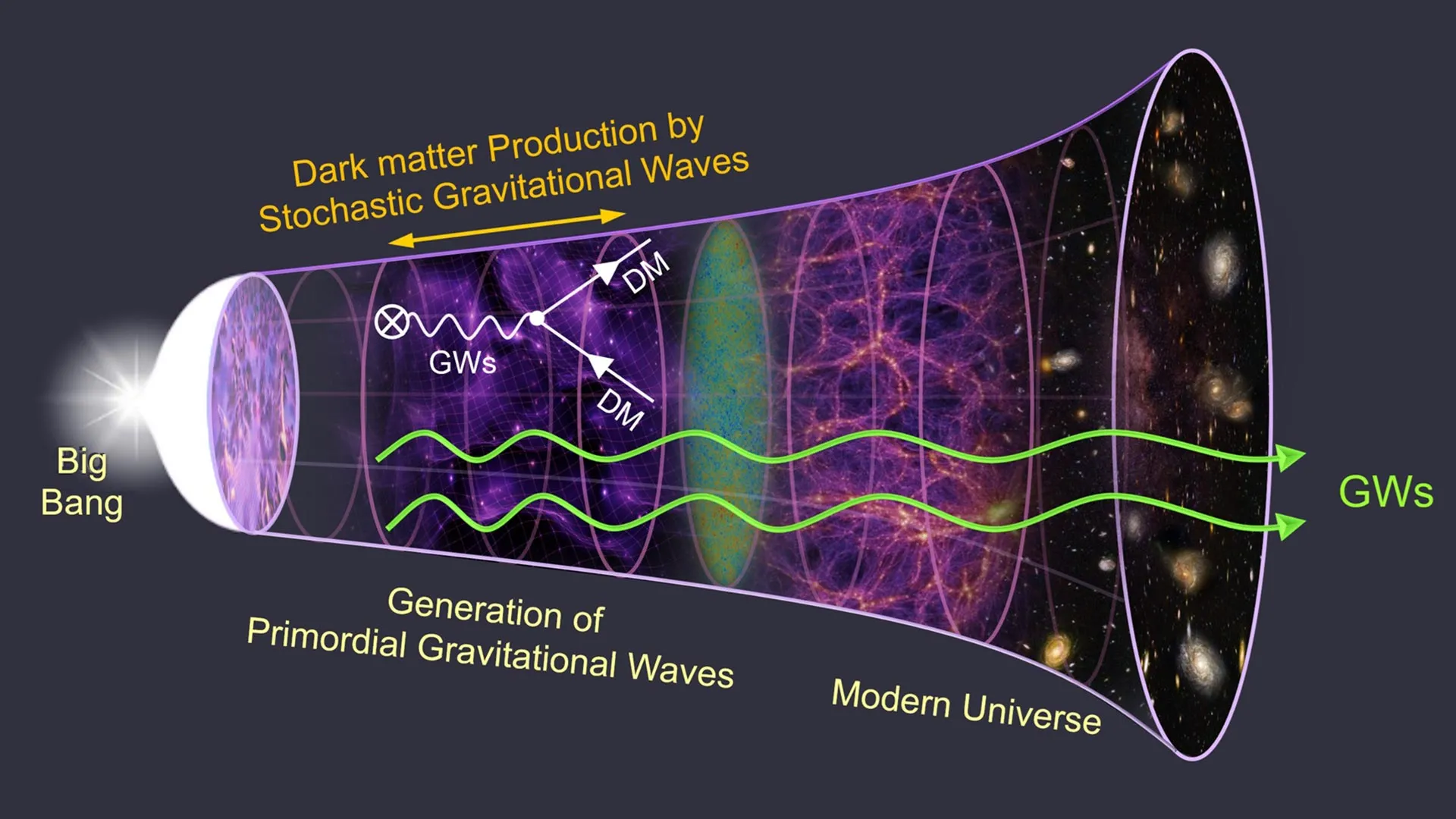
That opens a tantalizing door. The approach could in principle be scaled up to more complex systems, allowing physicists to probe scenarios once confined to blackboard mathematics: the violent expansion of the early universe after the Big Bang, or the theorized reverse collapse sometimes called the "Big Crunch." Being able to recreate aspects of those regimes in a controlled tabletop experiment would give cosmologists a rare chance to check their theories against real data.
For now, the mini universe is a proof of concept — a few tens of thousands of atoms behaving as a closed world unto themselves. But by showing that time need not be imposed from the outside and can instead bubble up from a quantum system's own dynamics, the Birmingham team has offered a striking new handle on one of the oldest puzzles in science.