Scientists Taught an AI to Watch Neutron Stars Collide — and Forge the Universe's Gold
A neural network called RHINE lets physicists simulate the violent nuclear furnace of a neutron-star merger in a fraction of the time, sharpening the story of where the heaviest elements come from.
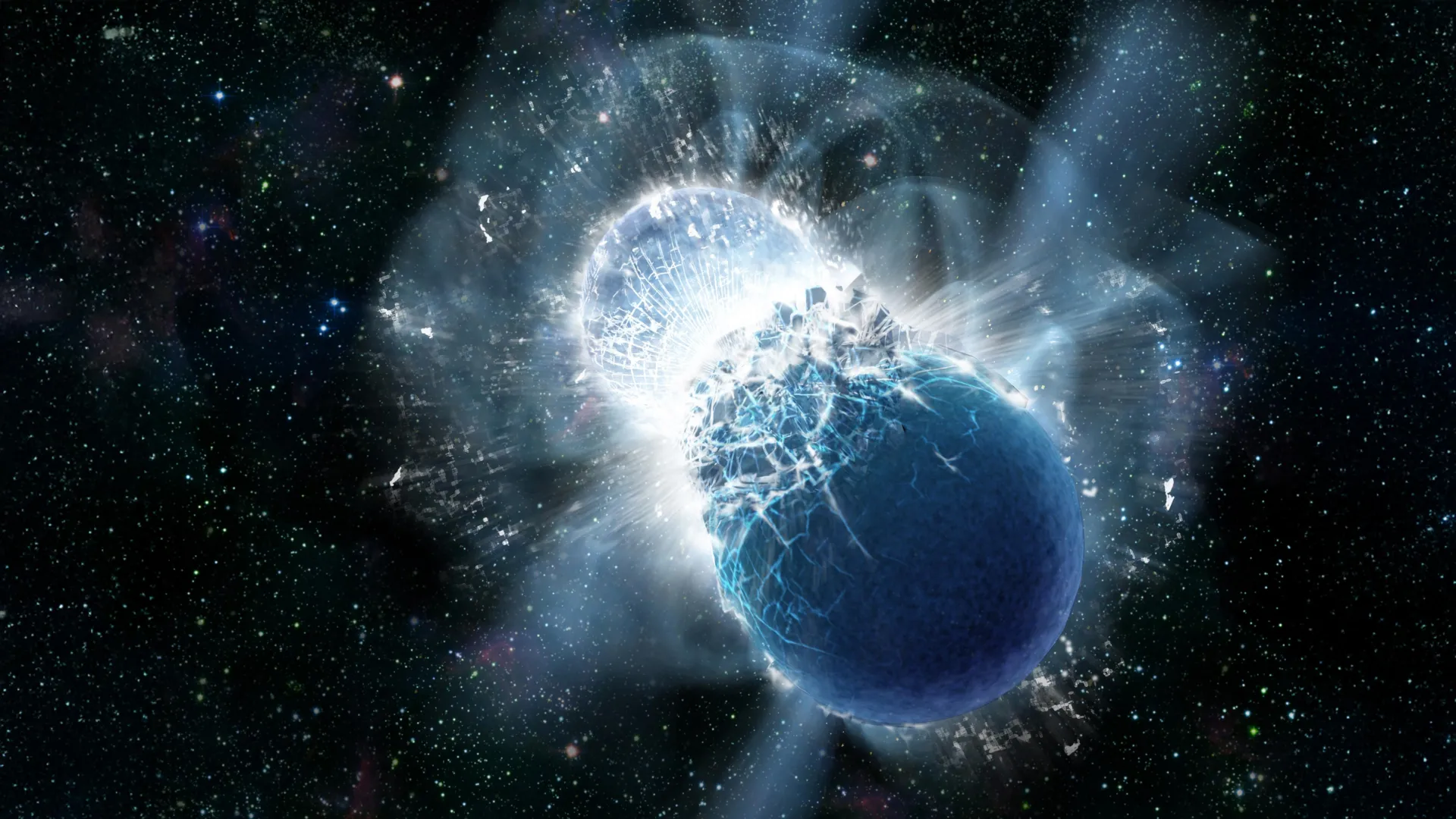
When two neutron stars slam into each other, the collision unleashes one of the most extreme environments in the cosmos — a maelstrom hot and dense enough to manufacture gold, platinum, lead and uranium in an instant. Now an international team has trained an artificial intelligence to model that chaos far faster than before, giving scientists a sharper view of how the universe builds its heaviest elements.
The new model, developed by researchers at the GSI Helmholtz Center for Heavy Ion Research and its partner FAIR facility in Germany, is called RHINE, short for a system that folds the physics of nuclear reactions into hydrodynamic simulations using neural networks. The work, published in the journal Physical Review D, tackles one of the field's most stubborn bottlenecks: capturing the energy released by the so-called r-process, or rapid neutron-capture process, in which atomic nuclei greedily swallow free neutrons and transmute into ever-heavier elements.
Simulating that process the traditional way is punishing. Each of the countless nuclear reactions releases heat that in turn shapes how the merger's debris expands and cools, and calculating all of it directly demands enormous computing power. RHINE sidesteps the problem by letting a trained neural network estimate the energy release on the fly, as the simulation runs. "Our new model RHINE, which uses artificial intelligence, offers an efficient alternative," the researchers said, describing a tool that slashes the computational cost while preserving the underlying physics.
The team behind the work included first author Dr. Oliver Just and machine-learning developer Dr. Zewei Xiong from GSI's nuclear astrophysics group, along with co-author Gabriel Martínez-Pinedo. Their approach means that simulations which once strained supercomputers can be run more quickly and in far greater detail, allowing scientists to explore many more scenarios of how neutron-star mergers evolve in the crucial seconds after impact.
That matters because neutron-star collisions are now believed to be a primary cosmic factory for the elements beyond iron. The 2017 detection of gravitational waves and light from a merging pair of neutron stars gave astronomers direct evidence that such events forge heavy elements, but modeling exactly which elements are produced, and in what quantities, has remained difficult. Faster, more accurate simulations help connect the telescope observations to the underlying nuclear physics.
By dramatically reducing the computing resources required, RHINE could enable the kind of high-resolution modeling that has been out of reach, letting researchers test their theories against future observations of these rare cataclysms. In effect, the AI acts as a shortcut through an impossibly complex calculation — one that traces the origin of the gold in a wedding ring back to the collision of two dead stars billions of years ago.