Physicists Make Magnetic Waves Live 100 Times Longer, Clearing a Path to Penny-Sized Quantum Computers
By cooling ultra-pure crystals to a fraction of a degree above absolute zero, a Vienna-led team stretched the lifetime of magnons to 18 microseconds — long enough to turn them into a 'quantum bus' linking hundreds of qubits.
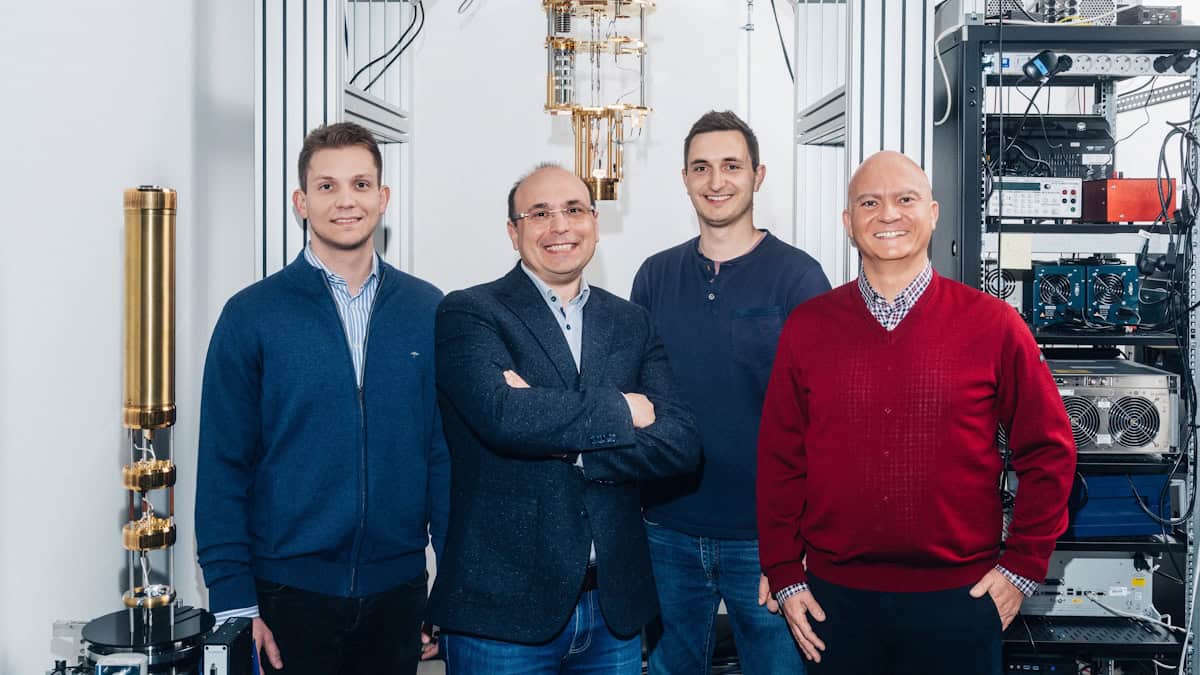
Physicists have extended the lifetime of magnons — tiny ripples of magnetism once dismissed as too fleeting to be useful — by roughly a hundredfold, a leap that could help shrink quantum computers to the size of a coin.
Magnons are collective waves of electron spins rippling through a magnetic material, and physicists have long eyed them as a way to shuttle quantum information around a chip. The problem was that they died out almost instantly, making them lossy and impractical. In the new work, an international team led by Andrii Chumak at the University of Vienna pushed magnon lifetimes to as much as 18 microseconds — long enough to transform them from a liability into a resource. The results were published in the journal Science Advances.
The gain came from two moves. First, instead of the conventional uniform magnons that most experiments use, the researchers generated short-wavelength magnons that are naturally less sensitive to the tiny surface defects that had been draining their energy. Second, they cooled ultra-pure spheres of yttrium iron garnet, a synthetic crystal known as YIG, to just 30 millikelvin — thirty thousandths of a degree above absolute zero. At those temperatures, in that pristine material, the waves persisted far longer than anyone had achieved before.
Perhaps the most striking finding was not the number itself but what set it. The team concluded that the limit on magnon lifetime is not some fundamental law of physics but simply the purity of the material. That distinction matters enormously: it means future improvements could come from better crystal manufacturing rather than from waiting on some new discovery in the underlying science.
With lifetimes of 18 microseconds, magnons stop being lossy intermediate links and start behaving like robust quantum memories and low-loss communication channels on a chip. The researchers envision using them as a "quantum bus" — a shared pathway that could connect hundreds of qubits along a single line. Such a bus has been a long-sought missing piece for building quantum computers that can scale up rather than remain laboratory curiosities.
The payoff the team dangles is provocative: a quantum computer no bigger than a one-cent coin. Today's leading machines fill rooms with cabling and cooling hardware, and connecting large numbers of qubits without introducing errors remains one of the field's central obstacles. If magnons can reliably carry quantum information across a chip, they could compress much of that architecture — and turn the magnetic waves once written off as too short-lived into a foundation for the next generation of computing.