The Team That Says the Universe Is Not Accelerating Just Answered the Nobel Laureates
The Dark Energy Fight Is Not Over.
Yonsei University researchers say the June rebuttal to their work contains a methodological flaw that flattens the very effect it was measuring. Their corrected supernova results now line up with DESI.
The argument over whether the universe is still speeding up went another round this week, and it did not end the way the defenders of the standard model expected.
The dispute started when a group at Yonsei University in South Korea published an analysis of Type Ia supernovae, the exploding stars used as cosmic distance markers, arguing that their brightness depends on the age of the stellar population they come from. Correct for that age bias, the Yonsei team said, and the evidence for accelerating expansion largely evaporates. In June, an international collaboration led by the University of Southampton and including two Nobel laureates published a rebuttal concluding that the acceleration measurement holds up fine.
Now the Yonsei group has published a response in Monthly Notices of the Royal Astronomical Society, and it makes three specific technical charges rather than a general defense.
The first concerns how the rebuttal measured the age-bias slope, the number that determines how much correction is needed. Lead author Dr. Chul Chung says the Southampton analysis pooled supernovae across an unusually broad range of redshift, which mechanically flattens the slope. The Yonsei team demonstrated the effect directly: as progressively higher-redshift supernovae are added to a sample, the recovered slope becomes systematically shallower, and they reproduced the same behavior in simulated data where the true answer was known. "The shallow age-bias slope reported in the rebuttal is therefore the result of a clear methodological problem in the analysis," Chung said.
The second is about dust. Supernova cosmology depends on modeling how much light is absorbed and reddened by dust in the galaxy hosting the explosion, and the Yonsei group argues the rebuttal's dust-extinction assumptions contradict what large galaxy samples show about how extinction varies with host-galaxy mass. The third is a bookkeeping point: the rebuttal emphasized that progenitor ages decline with redshift, which would weaken the correction, but the Yonsei team says it omitted a compensating mathematical term that cancels the effect. Treat both consistently, they report, and the correction and its cosmological consequences are unchanged.
Professor Young-Wook Lee, who leads the project, put the stake plainly. "Supernova cosmology rests on the key assumption that the luminosity calibration relation, the Phillips relation, does not change with supernova age," he said. "Our results consistently show that this assumption is not valid."
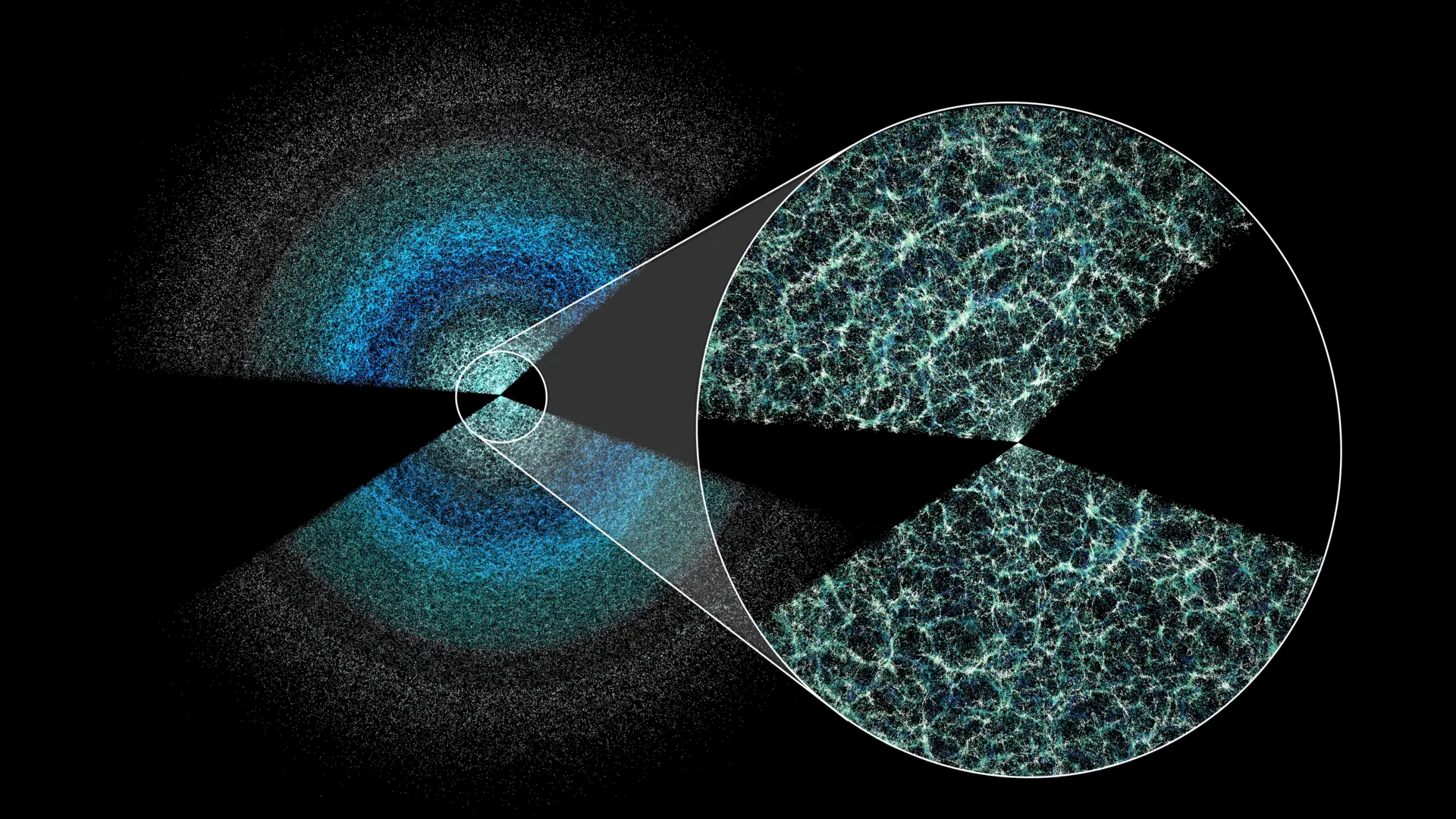
What makes this more than an academic exchange is that the Yonsei age-corrected results agree with something entirely independent. The Dark Energy Spectroscopic Instrument, measuring baryon acoustic oscillations rather than supernova brightness, has also reported evidence that dark energy is not a constant but evolves with time. Two very different methods pointing at the same unusual conclusion is harder to dismiss than either one alone.
The Yonsei team has proposed a cleaner test that sidesteps the whole dispute: use only supernovae in young host galaxies of similar age across the full redshift range, so there is no age evolution left to correct for. Early results, they say, match their earlier findings. The Vera C. Rubin Observatory, which will catalogue supernovae by the hundreds of thousands, should be able to settle it.