A New Sky Map Runs to 5.6 Trillion Pixels and Catalogues Almost 4 Billion Objects Out to 11 Billion Light-Years
The DESI Legacy Imaging Surveys released their 11th data set on Monday, covering roughly three-quarters of the sky. More than 160 scientists and four telescopes built it, and anyone can open it in a browser.

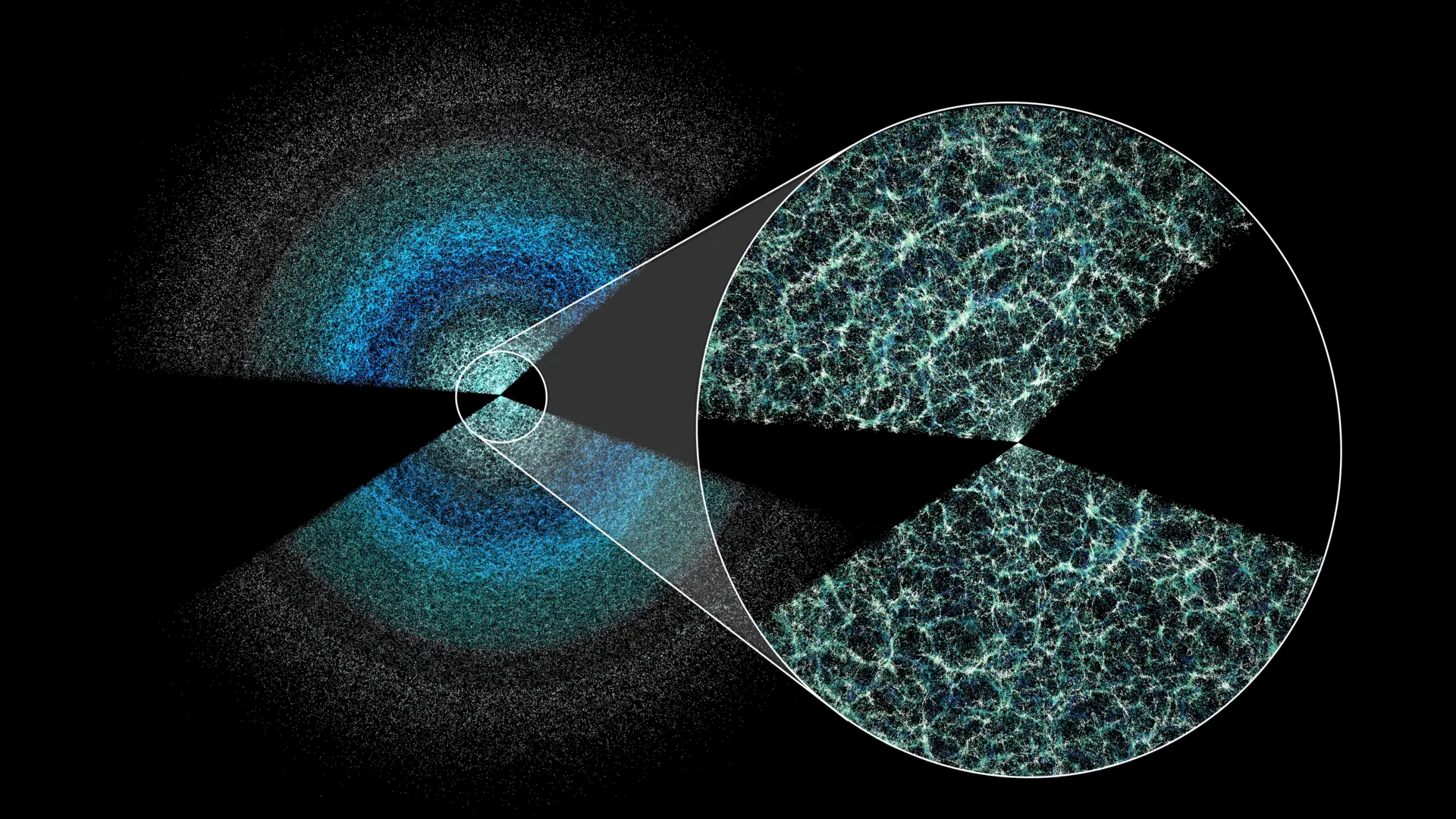
The largest two-dimensional map of the universe ever assembled went public on Monday. It contains 5.6 trillion pixels, catalogues close to 4 billion objects and reaches out to 11 billion light-years, which means the faintest things in it were shining when the universe was roughly a fifth of its present age.
The map is the 11th data release from the DESI Legacy Imaging Surveys, the imaging campaign that underpins the Dark Energy Spectroscopic Instrument. It covers about 75% of the sky in visible and near-infrared light. The catalogue does not sort by glamour: stars, galaxies, black holes and asteroids all appear as entries, because the survey's job is to find every point of light bright enough to be measured and record what it is and where.
Four instruments did the observing. The Dark Energy Camera, mounted in Chile, supplied the southern imaging. The Nicholas U. Mayall 4-meter Telescope at Kitt Peak National Observatory in Arizona and the University of Arizona's Bok 2.3-meter Telescope at Steward Observatory covered the north. NASA's Wide-field Infrared Survey Explorer, WISE, contributed infrared data from orbit. Those observations were stitched together by more than 160 scientists working across three separate surveys — the Dark Energy Camera Legacy Survey, the Mayall z-band Legacy Survey and the Beijing-Arizona Sky Survey.
The point of building a catalogue this large is that spectroscopy is expensive. A telescope can only put a fiber on a target if someone has already found the target and decided it is worth the exposure. The imaging surveys are the finding step: DESI's main mission has used them to select tens of millions of galaxies and quasars for spectra, which is how the instrument measures distances and reconstructs the expansion history of the universe.
That main mission completed its original five-year run earlier in 2026, having taken spectra of more than 47 million galaxies and quasars. Improved cosmology results from those five years are expected in 2027, with observations continuing through 2028. DESI's earlier data releases produced the tension that has made the project famous — hints that dark energy may not be a constant, and may have weakened over cosmic time.
The new release is open. The data can be browsed through the Legacy Survey Sky Viewer, which loads in an ordinary web browser and lets a user pan across the sky at full resolution, and queried through a searchable database at Astro Data Lab. Amateur astronomers have already used earlier versions to hunt for gravitational lenses and unusual galaxy shapes.
Nearly 4 billion objects is more than one for every two people alive. Almost all of them have never been looked at individually by anyone.