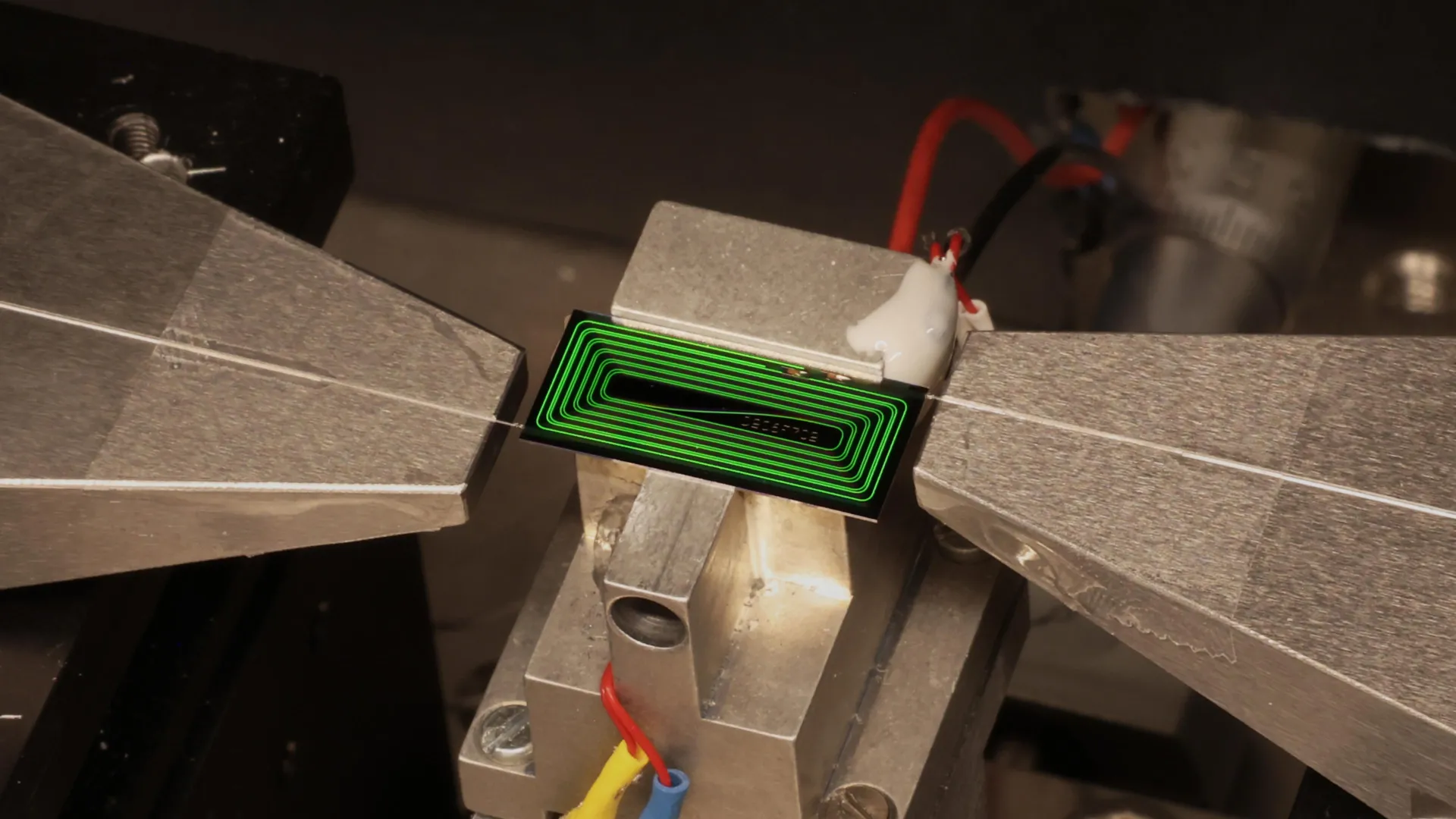
Tokyo Camera Captures Laser Damage in 11 Frames Spanning 100 Femtoseconds to 10 Nanoseconds
Instead of spacing frames evenly, a new 'logarithmic' imaging method packs them close at the start and spreads them out later, tracing five orders of magnitude in time in a single shot.

Researchers at the University of Tokyo have built a camera that can follow an event from 100 femtoseconds to 10 nanoseconds in a single shot, a span of about five orders of magnitude in time, using just 11 frames. The method is described in the journal Optica in a paper titled "Logarithmic ultrafast photography with band-resolved individual delay generation."
Conventional ultrafast cameras work on microsecond or millisecond timescales and space their frames roughly evenly. That wastes frames: the interesting action in a violent event often happens in the first instants, while the later aftermath changes slowly. The Tokyo team instead spreads a fixed number of frames logarithmically, placing them close together at early times and farther apart later, timed to the moments that matter.
The system builds on a technique called sequentially timed all-optical mapping photography, or STAMP, using a new scheme the team calls BRIDGE, short for band-resolved individual delay generation. BRIDGE pulls out wavelength bands one after another and adjusts the delay of each band independently, so every color band maps to a specific instant in the process.
To test it, the group fired an ultrashort laser pulse at samples of glass and hydroxyapatite, a major mineral in bone and teeth. The 11-frame sequences captured the earliest changes, the later shock waves, and the ejection of material.
"We wanted to find a way to connect these very different timescales in a single measurement," said Keitaro Shimada, a postdoctoral researcher and lead author. Associate professor Keiichi Nakagawa, who leads the Department of Bioengineering group, said, "We are particularly interested in phenomena that are difficult to reproduce exactly." Single-shot imaging matters for exactly those events, because they cannot be repeated for a second look.
The logic is similar to filming a firework. A film with evenly spaced frames either misses the flash or wastes thousands of frames on the slow fall of the embers. Spacing frames logarithmically gives dense coverage when the change is fastest and sparse coverage when it slows, so a handful of frames can follow the whole event.
Glass and hydroxyapatite are useful test materials because both respond to intense laser light in complicated ways, with rapid heating, pressure waves and the throwing off of material happening on very different timescales. Seeing all of those stages in one sequence is what the logarithmic spacing is designed for.
The technique is all-optical, meaning the timing is set by how the light itself is split and delayed rather than by electronic shutters, which are far too slow to follow events measured in femtoseconds. A femtosecond is one millionth of a billionth of a second.
The team proposes uses in laser processing, material dynamics, plasma and shock-wave research, and biomedical applications. The paper's DOI is 10.1364/optica.610944. The Phys.org report does not give laser parameters or frame-rate specifics.