Two Feeding Black Holes Found Just 570 Light-Years Apart in the Early Universe
Astronomers using a gravitational lens say the galaxy MG B2016+112 hosts the most tightly paired black holes yet confirmed at such a distance, seen when the universe was about 2 billion years old.

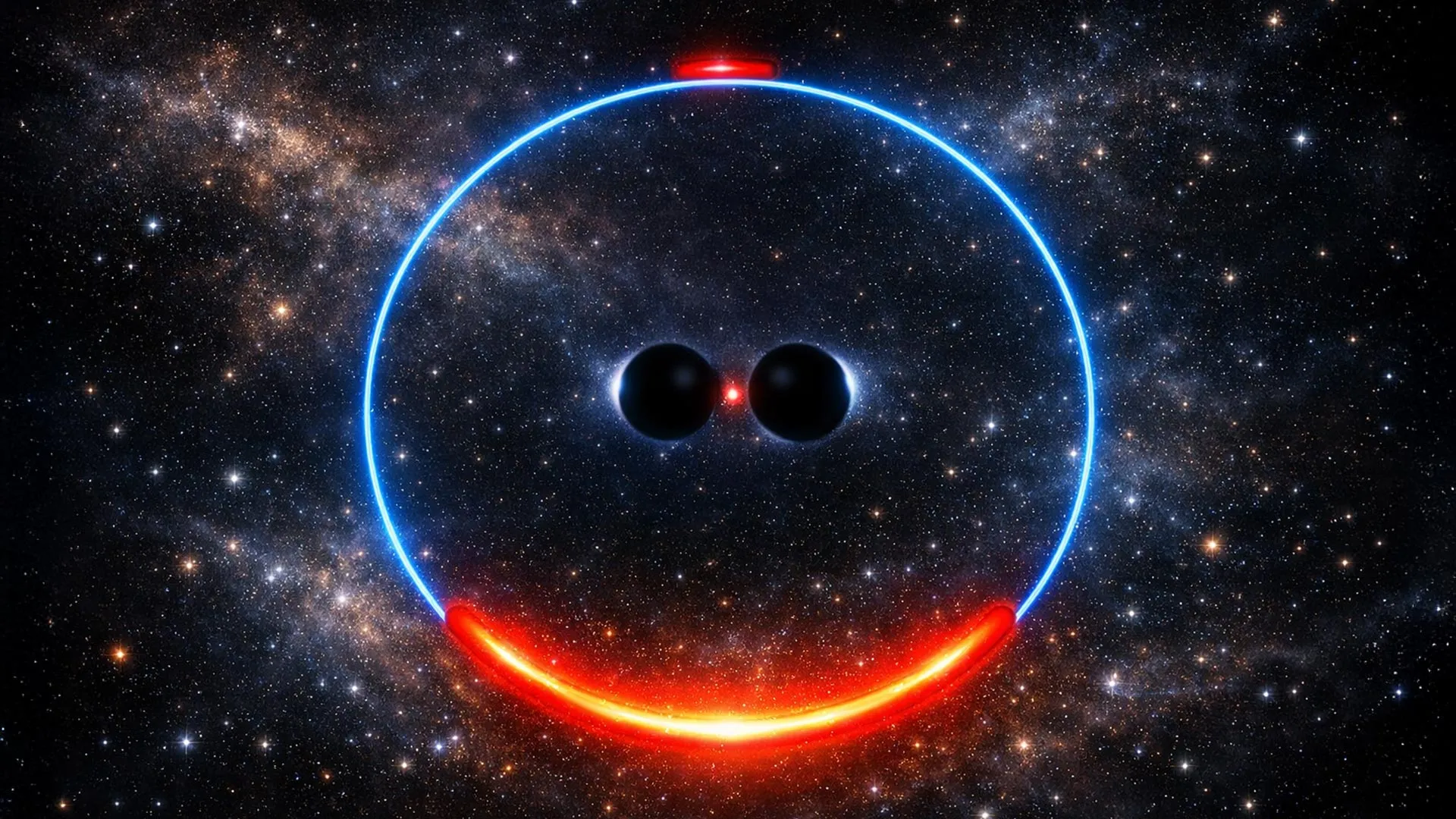
Astronomers have found two actively feeding supermassive black holes separated by just 175 parsecs, or about 570 light-years, in a galaxy seen when the universe was only about 2 billion years old. The system, called MG B2016+112, sits at a redshift of 3.273 and is the most compact dual active galactic nucleus known at that distance, according to a study posted to the arXiv preprint server on Sept. 25.
Models of galaxy evolution predict that when galaxies merge, gas is driven onto the supermassive black holes at their centers, so merging galaxies should sometimes host two glowing nuclei at once. Finding close pairs is hard, because at great distances it is difficult to tell two nearby bright spots apart.
This system gets help from gravitational lensing. A massive foreground galaxy warps spacetime so strongly that light from the background object is bent and magnified, splitting it into multiple images. In this case the lens produces three images of the source, labeled A, B and C. Earlier radio and X-ray work had suggested two black holes. The new study, led by Jianghao Huyan and Júlia M. Sisk-Reynés, set out to test that independently using archival spectra from the MUSE instrument on the Very Large Telescope, taken in 2018.
The team measured the strength of prominent emission lines from hydrogen, nitrogen, carbon and helium in each of the three images. Most lines were too affected by absorption to compare, but one ratio worked. It matched between images A and B, while image C showed a much lower value. That strongly suggests C is lit by a different ionizing source from the one producing A and B.
Estimates of the black holes' masses, drawn from the width of a carbon emission line, came out in a similar range. The black hole behind images A and B has a mass of at least 20 to 23 million suns, and the one behind C at least 15 million. Similar masses fit the picture of a major merger in which two comparable galaxies each brought a black hole to the collision, a reading the researchers call consistent with the data.
The feeding rates differ sharply. The A and B black hole appears to be accreting at about 47% to 51% of its maximum rate, while C manages only about 4%. That challenges simulations in which the lighter black hole of a pair feeds faster, since C is the lighter one and is eating more slowly. The authors caution that C's rate depends on the lens magnification, and they used only an average figure that may be off. They are calling for near-infrared observations to check the masses independently.
For now, the researchers conclude that MG B2016+112 is a dual AGN, and that at a projected separation of 175 parsecs at redshift 3.273, it is the closest-separation confirmed pair identified to date at such a high redshift. The system offers a rare look at black hole growth during what may be a major galaxy merger in the early universe.