Webb's Brightest Baby Star Clusters May Be Factories for Giant Black Hole Seeds
Models of dense, metal-poor clusters seen in two lensed galaxies suggest they could birth black holes of up to 4,000 Suns, a possible head start for supermassive ones.

Astronomers may have found where the universe built its first heavy black hole seeds. A new study finds that compact young star clusters spotted by the James Webb Space Telescope could have formed black holes of hundreds to thousands of solar masses, the kind of head start needed to explain supermassive black holes so early in cosmic history. No black hole was directly observed. The work is a modeling study.
The paper, led by Viola Bocchi of Sapienza University of Rome, is published in Astronomy & Astrophysics. It examines two galaxies magnified by gravitational lensing. The Cosmic Gems arc, at redshift about 10.2, is seen roughly 460 million years after the Big Bang and holds five young massive clusters. The Firefly Sparkle, at redshift about 8.3, is seen about 600 million years after the Big Bang and holds 10. The clusters range from 100,000 to 10 million solar masses, with half-mass radii between about 0.4 and 15 parsecs.
The team used an analytic model that combines runaway collisions between stars with mass lost to stellar winds, and checked it against direct simulations of compact clusters. In the Cosmic Gems clusters, the model gives intermediate-mass black holes of about 1,600 to 2,700 solar masses. In the larger Firefly Sparkle clusters, the estimates are lower, about 180 to 810 solar masses. Overall the black holes range from about 100 to 4,000 solar masses, formed at efficiencies of a few percent.
Two properties do the work. The first is compactness. "The extreme compactness of the Cosmic Gems clusters facilitates the formation of black hole seeds with high masses," the authors write. The second is low metal content, at or below about 2 percent of the Sun's, which limits how much mass stellar winds strip away. The authors call such clusters "viable factories for heavy seeds."
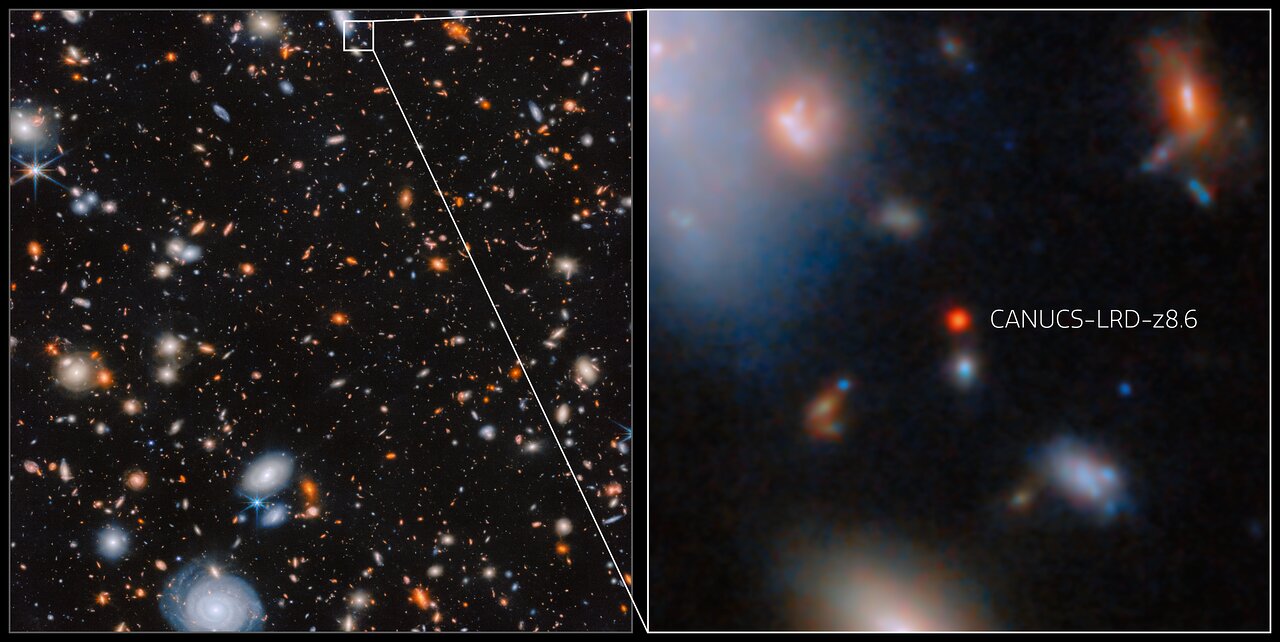
The upper end of the range reaches what astronomers call the heavy-seed regime. That helps with a puzzle Webb has sharpened: very massive black holes appear to exist when the universe was only a few hundred million years old, and growing them from stellar-mass black holes in that time is hard. The authors say the clusters could also seed the black holes thought to power the "little red dots," a class of compact, red early objects Webb keeps finding.
The study is careful about its limits. Intermediate-mass black holes are generally defined as 100 to 100,000 solar masses, and only a few candidates are known nearby, including a possible 8,200-solar-mass black hole in the globular cluster Omega Centauri proposed in 2024. The model leaves out the clusters' rotation and internal structure, which could lower the masses. The stellar mass distribution is also uncertain and might favor more massive stars than assumed.
The result does not prove the seeds exist. It narrows where to look: dense, metal-poor clusters in the first few hundred million years. Future Webb observations of lensed galaxies will test whether those clusters really are as compact as the models require.