JWST Spots Fully Formed, Dust-Packed Galaxy Just 400 Million Years After the Big Bang
Catalogued EGS-z11-R0 contains carbon, multiple stellar generations and thick interstellar dust at a redshift of 11 — features that current cosmological models say should require a billion years or more to assemble.
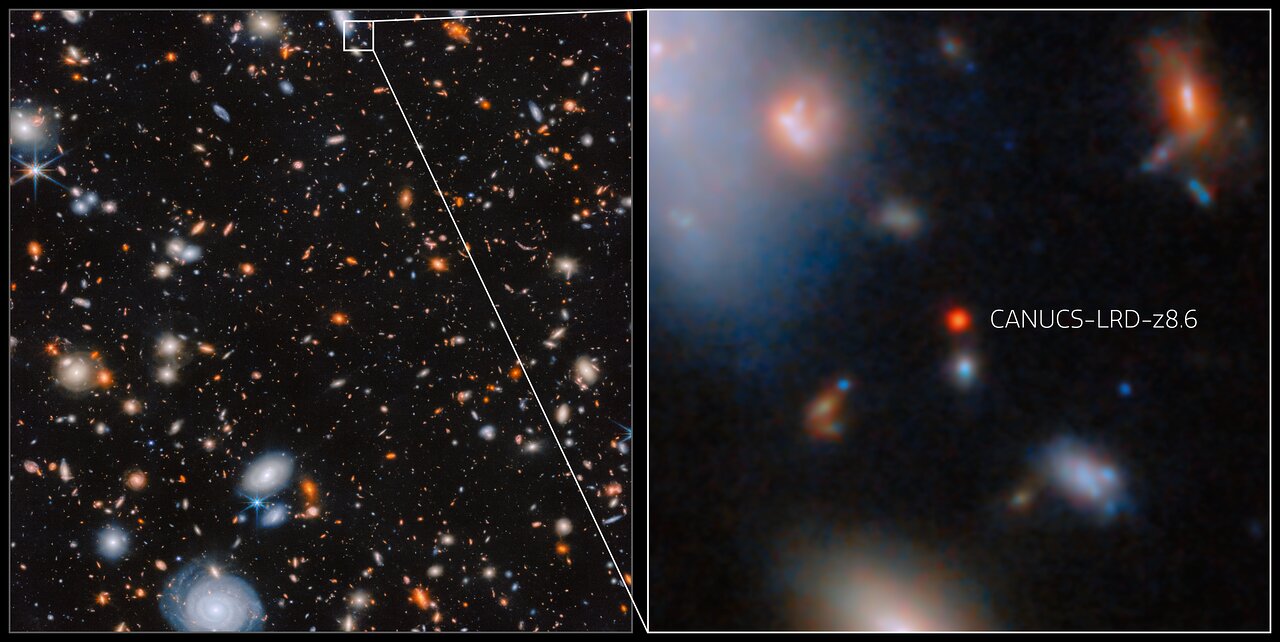
Astronomers using NASA's James Webb Space Telescope have identified a fully formed, dust-shrouded galaxy whose light left it just 400 million years after the Big Bang, an object so unexpectedly mature that it threatens to upend leading models of how galaxies assemble in the early universe. The galaxy, catalogued as EGS-z11-R0, sits at a redshift of approximately 11 and shows the spectroscopic fingerprints of multiple generations of stars, abundant carbon, and thick clouds of interstellar dust — features that current theory says should require a billion years or more to develop.
The discovery, led by Giulia Rodighiero of the University of Padua and reported in a preprint posted to arXiv on May 2, came from a targeted reanalysis of public JWST CEERS and PRIMER survey data hunting specifically for dust-obscured systems at extreme redshift. After filtering 38 candidate objects, only EGS-z11-R0 met the team's full spectroscopic threshold for a confirmed early-universe "dusty starburst." "What we're seeing simply should not exist this early," Rodighiero said in a statement accompanying the preprint. "It's as if the galaxy had been baking for several billion years longer than the universe has existed at the moment we're observing it."
The object is faint and exceptionally red, characteristics that explain why it eluded detection during the early years of JWST operations. NIRSpec spectroscopy revealed strong carbon emission lines and a 2.0-micron Balmer break consistent with an evolved stellar population, while MIRI imagery confirms a substantial dust component reradiating in the mid-infrared. Pieter van Dokkum, a Yale astrophysicist not involved in the work, called the timeline "astonishing," telling the journal Nature that EGS-z11-R0 "forces us to ask whether the very first generations of stars were vastly more efficient at producing heavy elements and dust than we ever assumed."
The leading theoretical explanation, advanced in a companion paper by a team at the Max Planck Institute for Astrophysics, posits that population III stars — the first generation of stars composed only of hydrogen and helium — were systematically more massive than current models allow, perhaps approaching 1,000 solar masses on average. Such stars would explode as pair-instability supernovae within just a few million years, seeding the early universe with carbon, oxygen and dust at a pace fast enough to assemble objects like EGS-z11-R0 by 400 million years after the Big Bang. Critics of the model argue the inferred initial mass function is implausibly top-heavy and want independent confirmation from ALMA millimeter-wavelength observations.
ALMA director Sean Dougherty announced Wednesday that follow-up Cycle 12 director's discretionary time has already been allocated to image EGS-z11-R0 in the rest-frame far-infrared, and a second JWST campaign with NIRSpec's integral-field unit is scheduled for next month. Whatever those observations reveal, the broader implication is that JWST is now consistently finding objects in its first three years of science operations that strain or break the standard cosmological picture — a pattern that includes ultra-massive galaxies, supermassive black holes far heavier than expected, and now a dust-rich galaxy seemingly out of step with the age of the universe itself.