Oxford Physicists Achieve First-Ever Quadsqueezing, Unlocking a Fourth-Order Quantum Interaction
Using a single trapped ion and two precisely tuned, non-commuting laser drives, the team produced an interaction more than 100 times faster than conventional squeezing — and switchable between squeezing, trisqueezing and quadsqueezing in real time.
Physicists at the University of Oxford have demonstrated a fourth-order quantum interaction known as quadsqueezing for the first time, a long-sought feat that opens a new tool for quantum computing, sensing and simulation. The result, published this week in Nature Physics, was achieved with a single trapped ion and represents the cleanest experimental access yet to the kinds of nonlinear interactions that have eluded laboratories for decades.
In quantum mechanics, "squeezing" refers to a procedure that suppresses uncertainty in one variable, such as position, at the cost of increasing it in another, such as momentum. Standard squeezing, sometimes called second-order squeezing, has become a workhorse of quantum optics and is the foundation of the Laser Interferometer Gravitational-Wave Observatory's recent sensitivity upgrades. Higher-order squeezing — trisqueezing at third order and quadsqueezing at fourth order — produces wave packets with even more exotic shapes and offers control knobs that ordinary squeezing cannot deliver. Until this week, those higher-order interactions had only ever been glimpsed indirectly, because the underlying coupling is so weak that ambient noise drowns it out long before it produces a measurable effect.
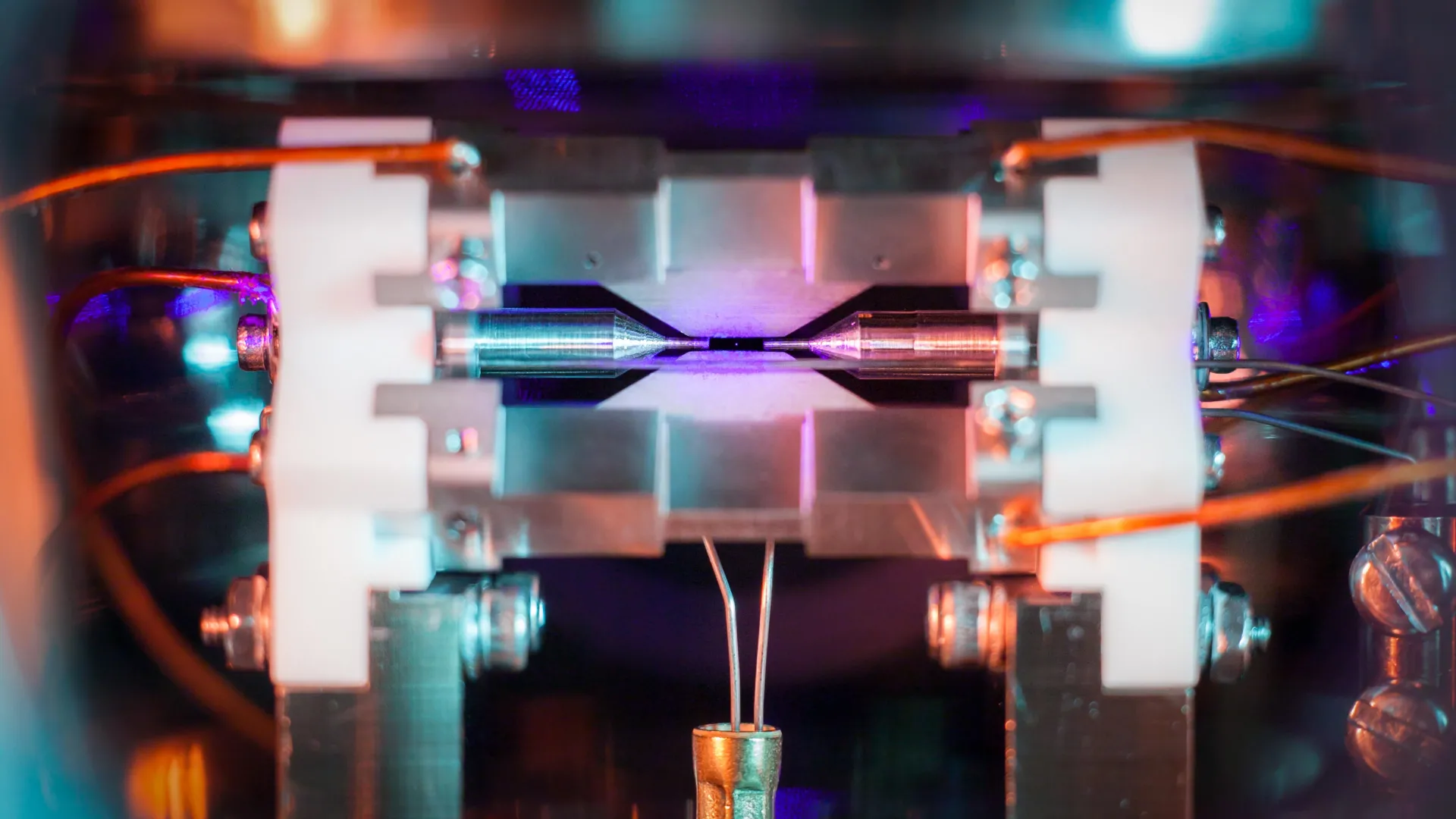
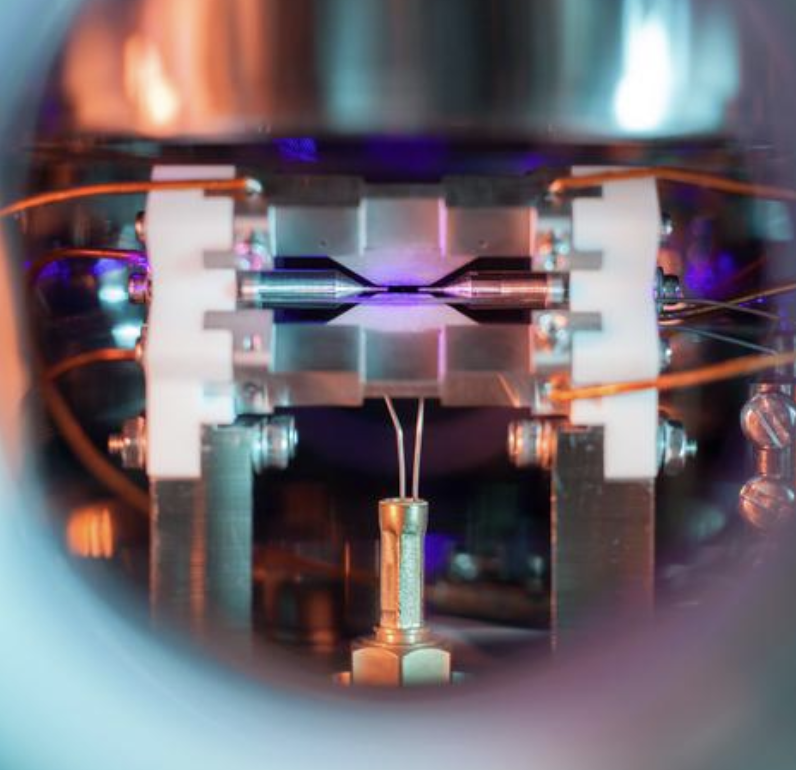
The Oxford group, led by Christophe Valahu and Professor David Lucas of the Department of Physics, generated quadsqueezing by subjecting a single ytterbium ion held in a Paul trap to two precisely tuned laser drives whose frequencies and phases were arranged so that the resulting force does not commute with itself in time. That non-commutativity, which has no classical analogue, allowed the two drives to amplify each other into an effective quartic potential, producing the desired fourth-order coupling. The researchers reported that the interaction strength was more than 100 times faster than what conventional squeezing techniques would yield in the same setup, allowing the higher-order behavior to outrun decoherence.
Crucially, the team showed that the same architecture can be switched continuously between ordinary squeezing, trisqueezing and quadsqueezing simply by reprogramming the relative phases of the two drives. "For the first time, we can dial in the order of the interaction we want, in real time, on the same hardware," Valahu told a press briefing in Oxford. Co-author Professor Lucas described the result as "opening up a kind of quantum operation that the rest of the field will now want to use." The team has already filed a patent on the protocol with Oxford University Innovation and is in discussions with two quantum-hardware startups about licensing.
The potential applications are wide. Higher-order squeezing is the natural language for simulating exotic field theories, including the quartic and sextic interactions that appear in models of phase transitions and early-universe physics. It also offers improved sensitivity for gravitational-wave detectors, optical atomic clocks and dark-matter searches, where the noise floor at very small frequencies is set precisely by the kinds of higher-order quantum fluctuations the Oxford team can now control. In quantum computing, quadsqueezing provides a route to bosonic codes — error-correcting codes built into the modes of a harmonic oscillator — that are more compact than current implementations.
Independent quantum-information theorists were quick to praise the work. Mile Gu of Nanyang Technological University in Singapore, who reviewed the paper, called it "the cleanest demonstration of higher-order non-Gaussian operations the field has produced." Hanns-Christoph Nägerl at the University of Innsbruck said the technique should generalize quickly to other trapped-ion platforms and could be adapted to superconducting circuits within a year or two. The Oxford team plans to extend the protocol to two-ion systems in coming months, where the same non-commutativity trick should allow them to engineer entirely new entangling gates with no static counterpart.