Lenz-Lens NMR Cracks Open Superhydrides, the Closest Thing to a Room-Temperature Superconductor
A Helmholtz-Zentrum Dresden-Rossendorf team has captured the first-ever atomic-resolution view inside lanthanum superhydrides, ending a decade of theoretical guessing about how they superconduct.

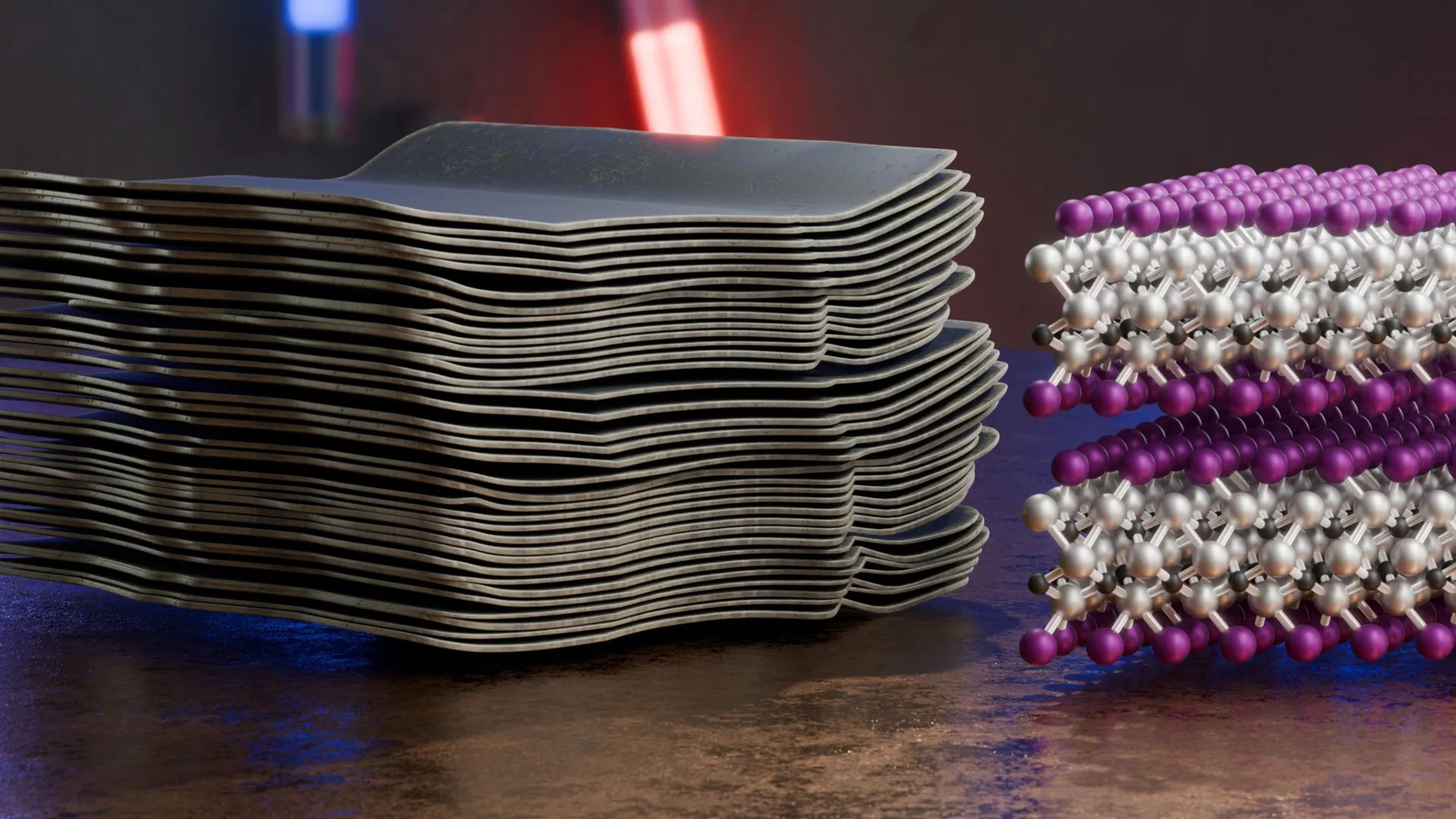
Physicists at the Helmholtz-Zentrum Dresden-Rossendorf in Germany have for the first time taken nuclear-magnetic-resonance measurements inside lanthanum superhydrides — the family of materials that holds the world record for highest-temperature superconductivity — clearing what had been a decade-long roadblock to understanding why these compounds carry electricity without resistance at temperatures within striking distance of room temperature. The result, announced this week, was made possible by miniature "Lenz lenses" that focus high-frequency magnetic fields onto a sample roughly the size of a grain of sand.
Lanthanum superhydrides such as LaH₁₀ become superconducting at about minus 23 degrees Celsius — practically balmy by superconductor standards — but only when squeezed under pressures around 1.5 million atmospheres, equivalent to those near Earth's core. Because the samples have to live inside diamond-anvil cells barely a tenth of a millimeter across, every standard probe of their internal structure has either failed to fit or returned signals too faint to interpret. NMR, the technique that powers MRI machines and underpins much of modern materials science, was thought to be effectively impossible.
The Dresden team, working with collaborators at the Max Planck Institute for Chemistry in Mainz and the High Magnetic Field Laboratory in Grenoble, France, solved the problem by depositing pairs of microscopic copper coils — Lenz lenses — directly onto the diamond culet to amplify the radiofrequency signal exactly where the sample sits. "With the use of Lenz lenses, we were able to amplify the high-frequency signal to such an extent that, for the first time, meaningful NMR data became accessible for superhydrides," said Dr. Florian Bärtl of HZDR's Dresden High Magnetic Field Laboratory.
The data already promise to settle long-running disputes about how superconductivity in these compounds actually arises. Theorists have argued for years over which hydrogen vibrational modes pair the electrons that flow without resistance, and the new measurements give an atom-by-atom view of those modes for the first time. "You finally see the material from the inside," said Mikhail Eremets of the Max Planck Institute, whose group has held the high-pressure-superconductivity record for much of the last decade. "That changes the conversation from inference to evidence."
The practical stakes are large. Room-temperature, ambient-pressure superconductors would transform energy transmission, MRI, magnetic confinement fusion, and quantum computing — but no such material has been demonstrated and several recent claims have collapsed under scrutiny. Detailed mechanistic understanding of the superhydrides, the closest known approach to that goal, is widely seen as the route to designing materials that work at lower pressures. The HZDR group said it now plans to apply the Lenz-lens NMR technique to other hydrogen-rich compounds, including yttrium and cerium superhydrides, where theoretical predictions suggest superconductivity may persist at still higher temperatures.