Webb's Brightest Baby Star Clusters May Be Factories for Giant Black Hole Seeds
Models of dense, metal-poor clusters seen in two lensed galaxies suggest they could birth black holes of up to 4,000 Suns, a possible head start for supermassive ones.
Topic
27 stories from Planck Standard. Latest: November 3, 2026.

Models of dense, metal-poor clusters seen in two lensed galaxies suggest they could birth black holes of up to 4,000 Suns, a possible head start for supermassive ones.

If the preprint holds up, EBG-1 would be an unusually efficient source of the radiation that cleared the early universe's fog, but it is one object and the estimate rests on model assumptions.

Harvard-Smithsonian astronomers modeled a cube 1.5 billion light-years wide, capturing helium reionization for the first time, to give JWST and Roman a map of what to expect.

Four papers from an international team tie JWST's views of the earliest galaxies to the elements preserved in the Milky Way's oldest stars, and show simpler models underestimated how starlight shaped gas.

TOI-1355 b gave itself away when its secondary eclipse arrived early, a sign the orbit is not circular. The University of Tokyo team says the planet was probably flung inward by other giants and is now being slowly reeled into a circle by its star's tides. They are already writing a JWST proposal.

David Kipping's search of LP 890-9c is by far the most sensitive exomoon hunt ever done. It rules out anything the size of Europa, Rhea or Umbriel, and it shows JWST has no noise floor stopping it from finding moons that small.

The first stellar occultation ever planned and observed with JWST shows Chariklo's inner ring getting denser while its outer ring thins out. Rings around small bodies were supposed to be stable.

Manganese piles up in a galaxy over time, so the amount of it says how old the place is. The hard part was knowing what its light should look like.

A survey of 1,428 galaxies in James Webb Space Telescope spectra finds that cosmic reionization was driven by a minority of extreme 'leakers,' not by the crowd.

A massive, chemically mature spiral with a 14,700-light-year central bar existed just over a billion years after the Big Bang — a structure astronomers thought could not form so early.

Astronomers argue the universe's X-ray-silent, seemingly overmassive black holes are actually smaller objects feeding at furious rates — a finding that could defuse one of cosmology's freshest crises.

The galaxy M1149-BSG-z5 already had a central bar of stars less than 1.2 billion years after the Big Bang — a structure astronomers assumed couldn't exist so early, and one that rewrites the timeline for how galaxies grow up.

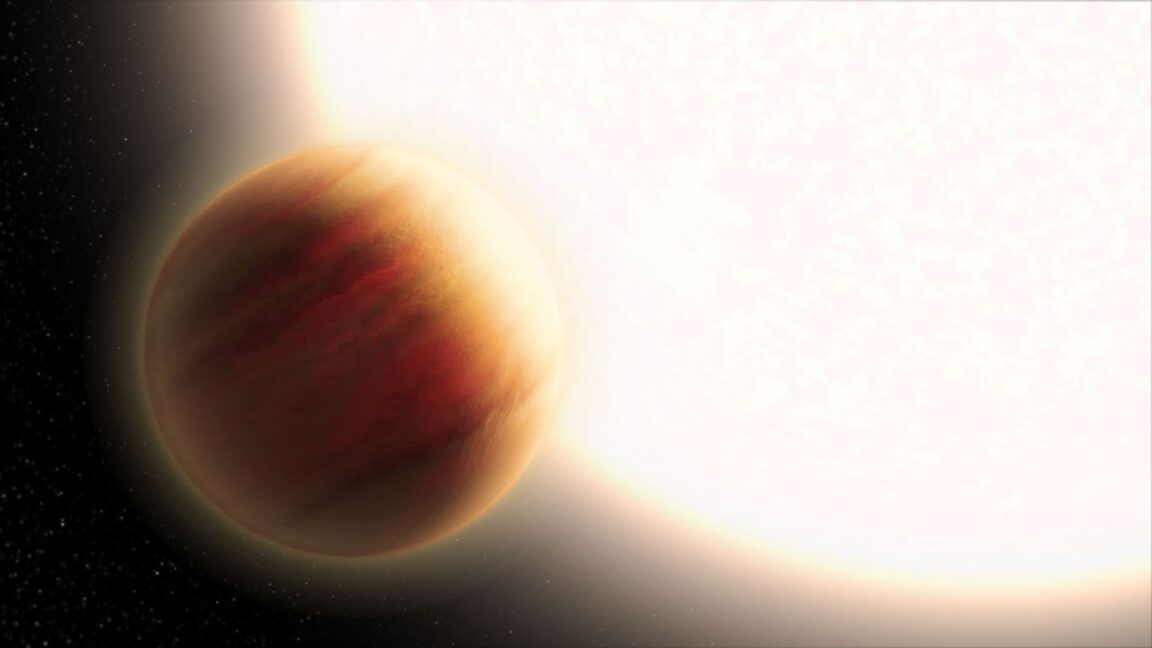
Astronomers detected sharply different conditions at the dawn and dusk edges of an ultra-hot gas giant, a feat made possible only by the space telescope’s sensitivity.

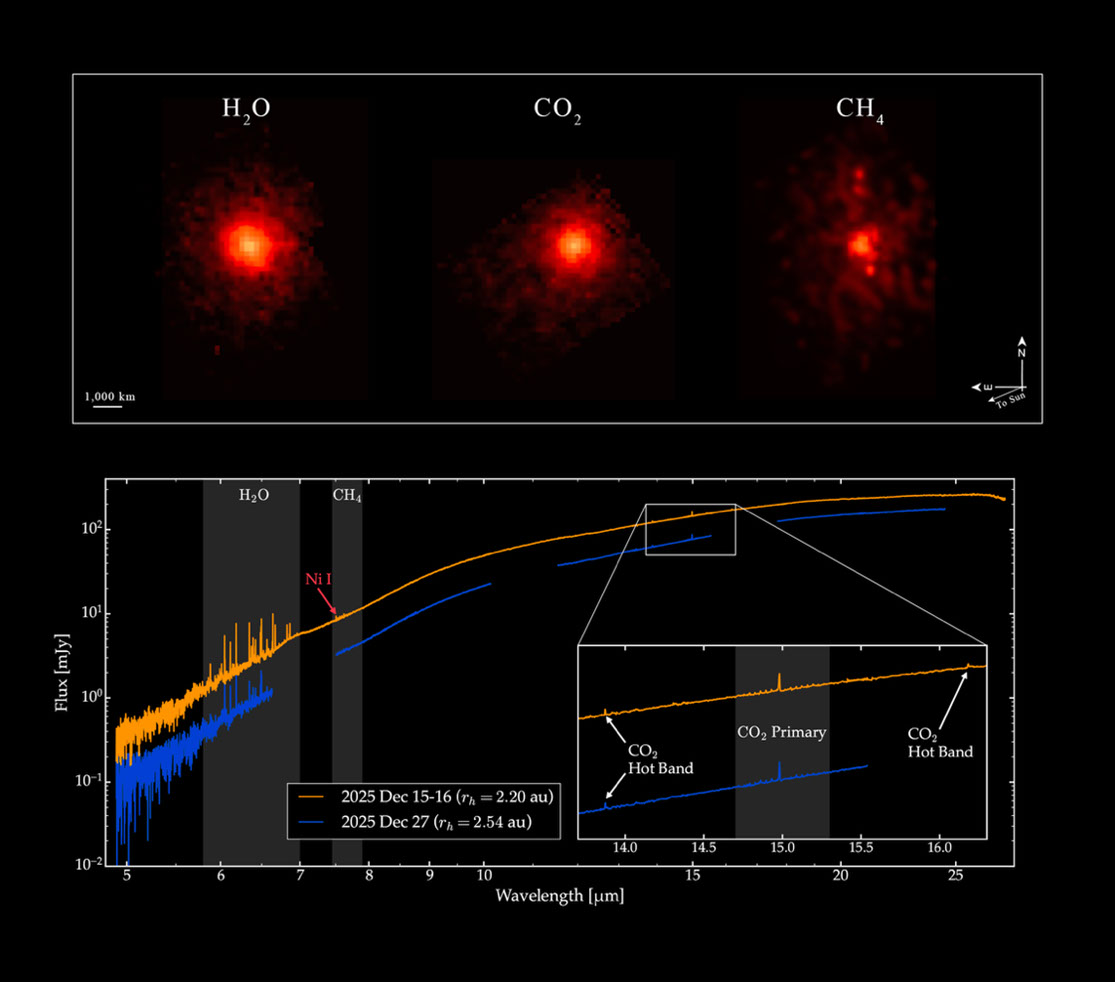
NASA's James Webb Space Telescope has directly detected methane gas streaming from 3I/ATLAS, revealing that the rare interstellar comet formed in a chemical environment unlike anything in our solar system.
Conflicting measurements from NASA's Cassini mission made Saturn appear to change its rotation rate — something thought impossible. A new study finds the culprit is a self-sustaining 'planetary heat pump' driven by the giant's aurora.

XMM-VID1-2075, identified by a UC Davis–led team using JWST's NIRSpec integral-field spectrograph and published in Nature Astronomy on May 4, has a rotation-to-dispersion ratio below 0.3 — making it dynamically indistinguishable from fossil galaxies that should not exist for another five billion years.

Penn State astronomers used a seven-hour transit and 20 hours of baseline observations with the Webb telescope to detect methane at an unprecedented 11-sigma confidence level, with hints of ammonia and carbon dioxide, opening the first clean window into a planet class that fills the gap between hot Jupiters and our own solar system.

A six-Earth-mass exoplanet found by Italian and Brazilian astronomers using HARPS-N data orbits one of the calmest M-dwarf stars within 30 light-years, making it a prime atmospheric-spectroscopy target for the James Webb Space Telescope.

James Webb Space Telescope provides unprecedented view of atmospheric conditions on distant exoplanet.

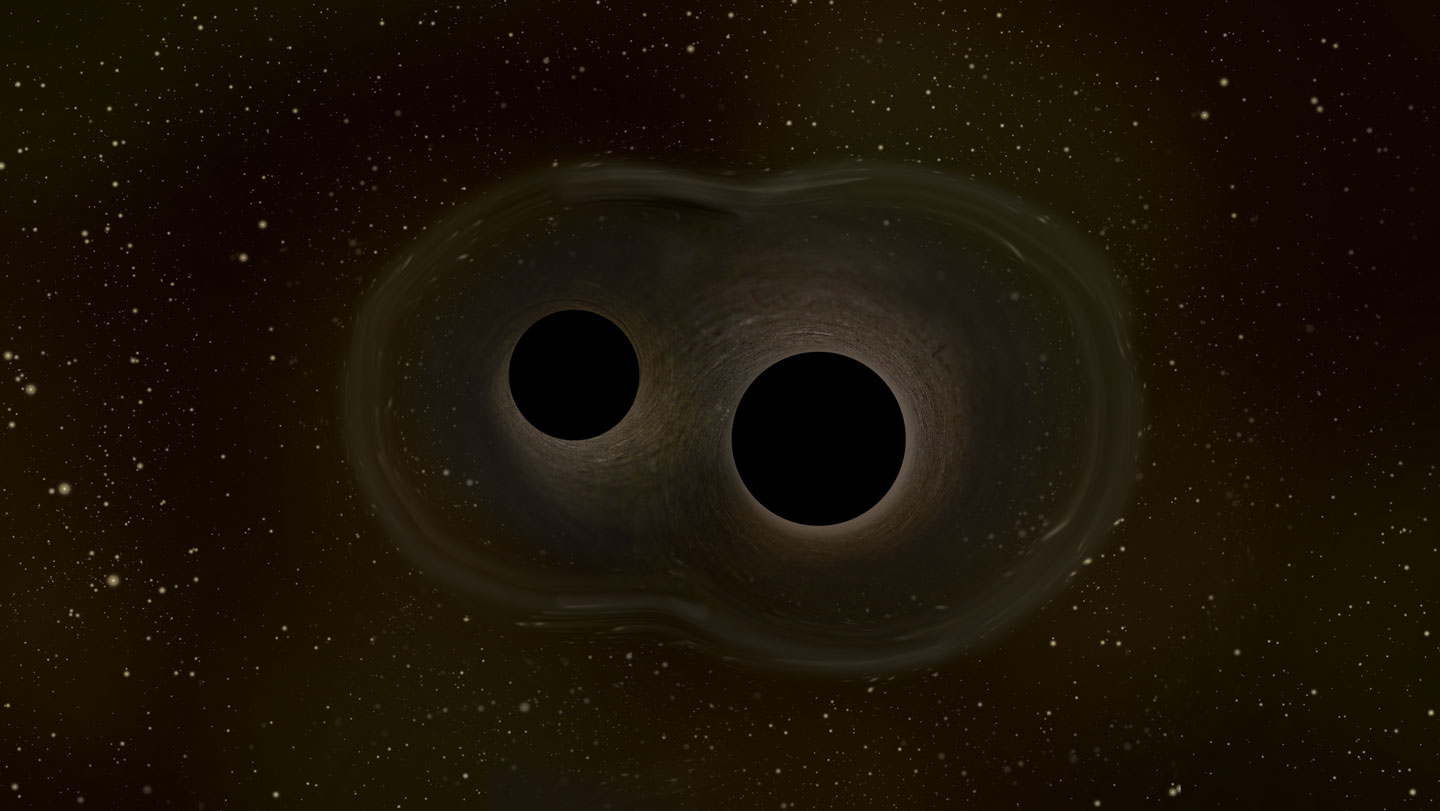
A starless gulf 3,200 light-years across at the heart of galaxy Abell 402-BCG turns out to be a gravitational scar carved by two ultramassive black holes, together weighing 60 billion suns and headed for an eventual merger LISA may one day hear.

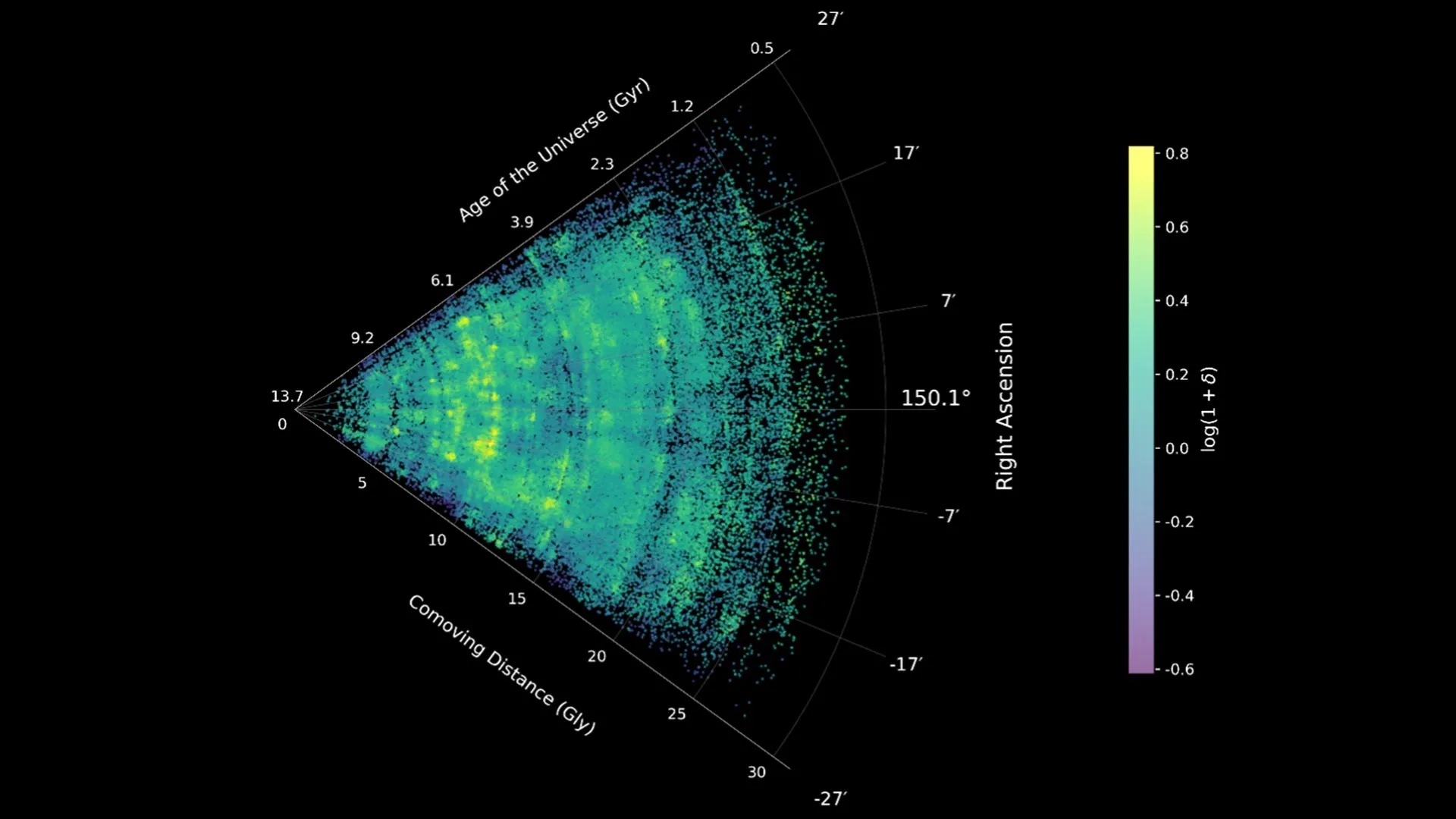
UC Riverside-led COSMOS-Web survey resolves filaments and voids that earlier maps smeared together, revealing that galaxy clusters were assembling much faster than the leading dark-matter simulations predict.

Catalogued EGS-z11-R0 contains carbon, multiple stellar generations and thick interstellar dust at a redshift of 11 — features that current cosmological models say should require a billion years or more to assemble.

Direct imaging by the James Webb Space Telescope of a 7.6-Jupiter-mass world 12 light-years away revealed thick patchy clouds of water ice and far less ammonia than predicted, forcing astronomers to revisit decades-old atmospheric models.

Webb mapped polycyclic aromatic hydrocarbons in tiny pockets of the chemically primitive dwarf galaxy four million light-years away, rewriting models of how early-universe dust forms.

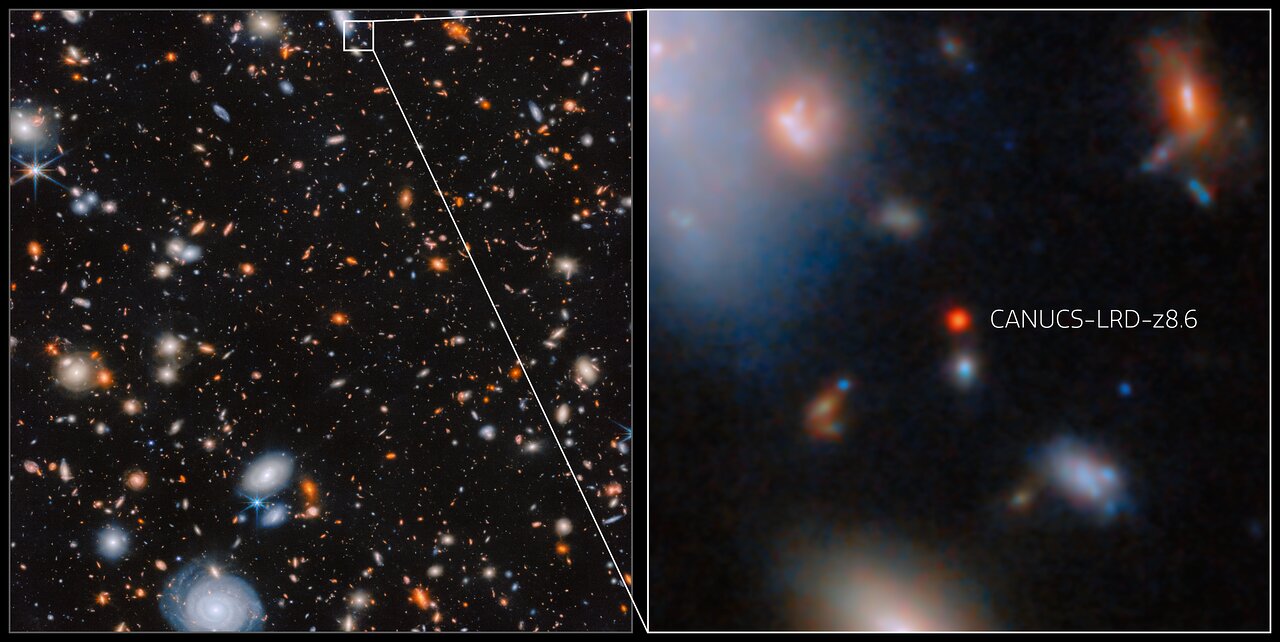
A new Nature paper from the Niels Bohr Institute slashes black-hole mass estimates 100-fold and finally explains the strange crimson points scattered across Webb's deep-field images.

EGS-z11-R0 is large, regular and chemically enriched at a moment when galaxies are supposed to be small, blue and primordial — defying leading models of structure formation.

Johns Hopkins astronomers used JWST to detect 150 Earth masses of heavy elements in the 15-Jupiter-mass exoplanet's atmosphere — a chemical signature of disk accretion that definitively separates it from brown dwarfs formed by stellar collapse.