Astronomers Crack a Decades-Old Saturn Mystery: The Planet Isn't Speeding Up After All
Conflicting measurements from NASA's Cassini mission made Saturn appear to change its rotation rate — something thought impossible. A new study finds the culprit is a self-sustaining 'planetary heat pump' driven by the giant's aurora.

For decades, Saturn has confounded the scientists trying to answer a deceptively simple question: how long is a day on the ringed giant? Measurements taken by NASA's Cassini spacecraft suggested that the planet's rotation rate was actually changing over time, appearing to speed up or slow down — a possibility that should be physically impossible for a world of Saturn's size. Now researchers say they have finally solved the riddle.
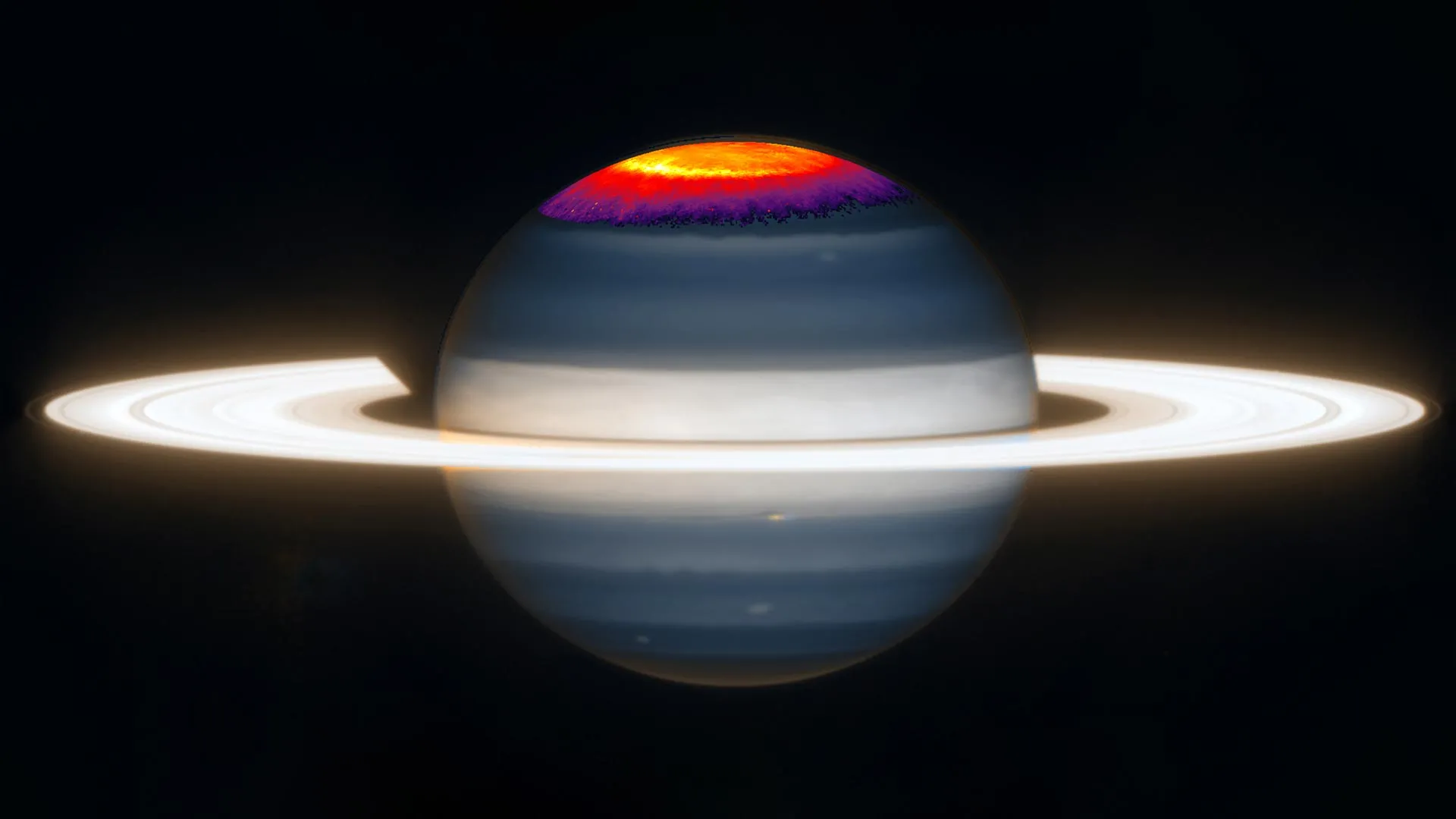
The answer, published in the Journal of Geophysical Research: Space Physics, is that Saturn was never really changing speed at all. Instead, the apparent shifts trace back to the planet's spectacular auroras. Because Saturn lacks a solid surface and its magnetic field is almost perfectly aligned with its axis, scientists have long relied on auroral radio and infrared signals to clock its spin. Those signals, it turns out, are being distorted by the planet's own weather.
The study, led by Professor Tom Stallard of Northumbria University, describes a self-reinforcing cycle in Saturn's upper atmosphere. The aurora heats specific regions of the atmosphere, generating powerful winds. Those winds drive electrical currents, and the currents in turn help power the aurora — a loop that subtly alters the very signals used to measure the planet's rotation. "What we are seeing is essentially a planetary heat pump," Stallard said. "The system feeds itself."
To untangle the effect, the team turned to the James Webb Space Telescope, whose observations of Saturn proved roughly ten times more precise than earlier efforts. Previous measurements had carried temperature uncertainties of around 50 degrees Celsius, blurring the picture; Webb's sharper infrared vision allowed researchers to map the atmospheric structure and confirm that the variations came from atmospheric dynamics, not from the deep interior where the true rotation is set.
The work draws on data and expertise from a broad international collaboration, including Boston University, the University of Leicester, Imperial College London and the Johns Hopkins University Applied Physics Laboratory, among others. Beyond settling a stubborn debate about Saturn itself, the findings carry a broader lesson for planetary science: for giant planets without a visible surface, the glow of an aurora can be a treacherous clock, and disentangling a world's atmosphere from its deep rotation may require exactly the kind of precision instruments now coming online.
The puzzle has dogged researchers since the Voyager flybys of the early 1980s first pegged Saturn's day at roughly ten and a half hours, only for later spacecraft to return figures that drifted by minutes — an eternity in the precise bookkeeping of planetary rotation. Pinning down a gas giant's spin is more than a curiosity; it anchors estimates of the planet's internal structure, the depth of its winds and the shape of its powerful magnetic field. By showing that the wobble lived in Saturn's atmosphere rather than its core, the new analysis lets scientists treat the deep rotation as steady once more, clearing away years of confusing data. The same approach, the team notes, could be turned on Jupiter, Uranus and Neptune, as well as the growing catalog of giant planets being discovered around other stars, where a misread aurora could just as easily masquerade as a changing day.