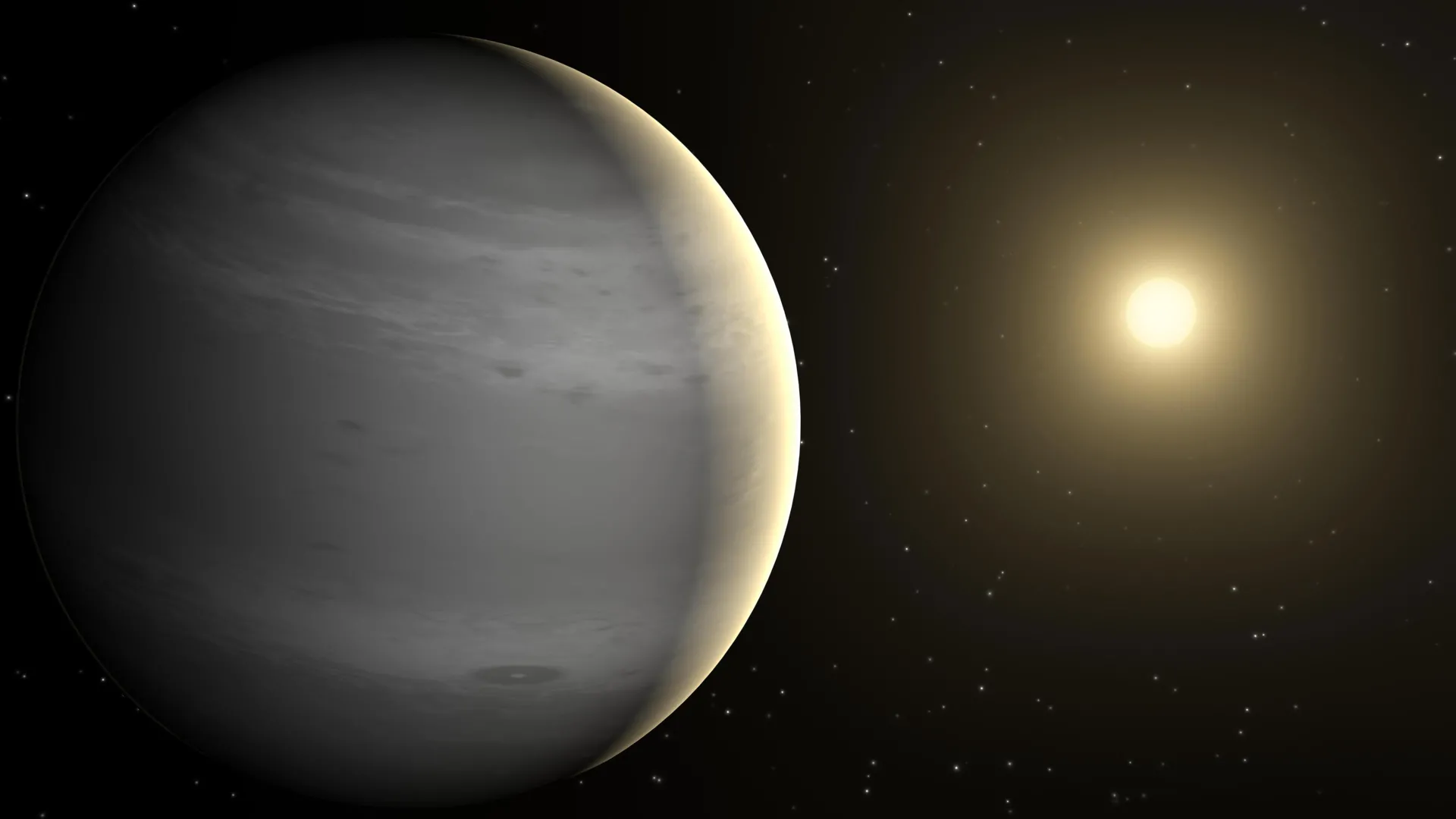
Webb Telescope Settles the Planet-Star Debate: 29 Cygni b's Atmospheric Chemistry Reveals It Formed Like a Planet, Not a Star
Johns Hopkins astronomers used JWST to detect 150 Earth masses of heavy elements in the 15-Jupiter-mass exoplanet's atmosphere — a chemical signature of disk accretion that definitively separates it from brown dwarfs formed by stellar collapse.
NASA's James Webb Space Telescope has delivered a decisive answer to one of astronomy's most persistent debates: how do the most massive gas giant planets form, and where exactly does the dividing line between a planet and a failed star lie? New observations of the exoplanet 29 Cygni b, published Tuesday in The Astrophysical Journal Letters, provide the strongest evidence yet that super-massive gas giants form through the gradual accretion of material in a protoplanetary disk — not through the collapse of a gas cloud as stars and brown dwarfs do.
The discovery was led by William Balmer of Johns Hopkins University and the Space Telescope Science Institute, who used Webb's NIRCam coronagraphic imager — an instrument that physically blocks the blinding light of the host star — to study the atmosphere of 29 Cygni b in unprecedented detail. The planet, located approximately 340 light-years from Earth in the constellation Cygnus, weighs in at 15 times the mass of Jupiter, placing it squarely in the murky zone that has historically been difficult to classify as either a very massive planet or a very low-mass brown dwarf, the class of cosmic objects sometimes called "failed stars" that never ignited nuclear fusion.
What made the answer possible was atmospheric chemistry. Balmer's team detected clear signatures of heavy-element enrichment — or "metallicity" in astronomical terms — in 29 Cygni b's outer layers. The planet's atmosphere contains what the team estimates to be approximately 150 Earth masses' worth of heavy elements, including carbon dioxide and carbon monoxide at concentrations that substantially exceed what would be expected if the object had simply collapsed from a primordial gas cloud. This level of metal enrichment is a chemical fingerprint of planetary formation: when planets build themselves through core accretion in a protoplanetary disk, they accumulate rock and ice rich in heavy elements before eventually sweeping up vast quantities of surrounding gas. Stars and brown dwarfs that form through direct gravitational collapse lack this enrichment signature.
"Put together, this evidence strongly suggests that 29 Cygni b formed within a protoplanetary disk through rapid accretion of metal-rich material, rather than through gas fragmentation," Balmer said. The finding supports what astronomers call the "hot start" formation pathway, in which the planet accumulated solid material quickly before the protoplanetary disk dissipated. It has broader implications for understanding the formation of super-Jovian planets throughout the galaxy and for calibrating models of planetary system evolution.
The discovery helps clarify a classification debate that has occupied astronomers for decades. Brown dwarfs — objects too massive to be considered planets but too small to sustain the hydrogen fusion that powers stars — typically span a mass range of roughly 13 to 80 Jupiter masses. The dividing line between the most massive planets and the lightest brown dwarfs has been theoretically murky because both types of objects can have similar masses, surface temperatures, and even atmospheric compositions when observed from afar. The key physical question — how an object formed, rather than simply how heavy it is — had previously been impossible to answer observationally because no telescope was sensitive enough to distinguish formation-history chemical signatures in distant atmospheres.
James Webb's infrared capabilities, combined with its coronagraphic instruments that allow direct imaging of planets orbiting at wider separations from their host stars, have opened exactly this window. The same techniques that revealed 29 Cygni b's origin can in principle be applied to the hundreds of directly imaged giant planets already catalogued by earlier surveys using the Hubble Space Telescope and ground-based adaptive optics systems. Astronomers are now developing a systematic program to survey the atmospheres of objects near the planet-brown dwarf boundary across a range of ages and host-star types, with the goal of building a comprehensive picture of how these massive worlds come into being.
The findings are expected to reshape catalogues of giant exoplanets discovered by missions such as Kepler and TESS and to inform the design of future planet-finding missions. They also carry philosophical weight: the question of what distinguishes a planet from a star has been contested since astronomers first discovered massive companions orbiting other stars in the 1990s. Webb's atmospheric chemistry now provides a definitive physical criterion — not mass, but origin — for answering it.