Scientists Observe Antimatter 'Atoms' Acting Like Waves for First Time in Groundbreaking Experiment
Researchers capture wave-particle duality in positronium, strengthening quantum mechanics while opening new antimatter research possibilities.
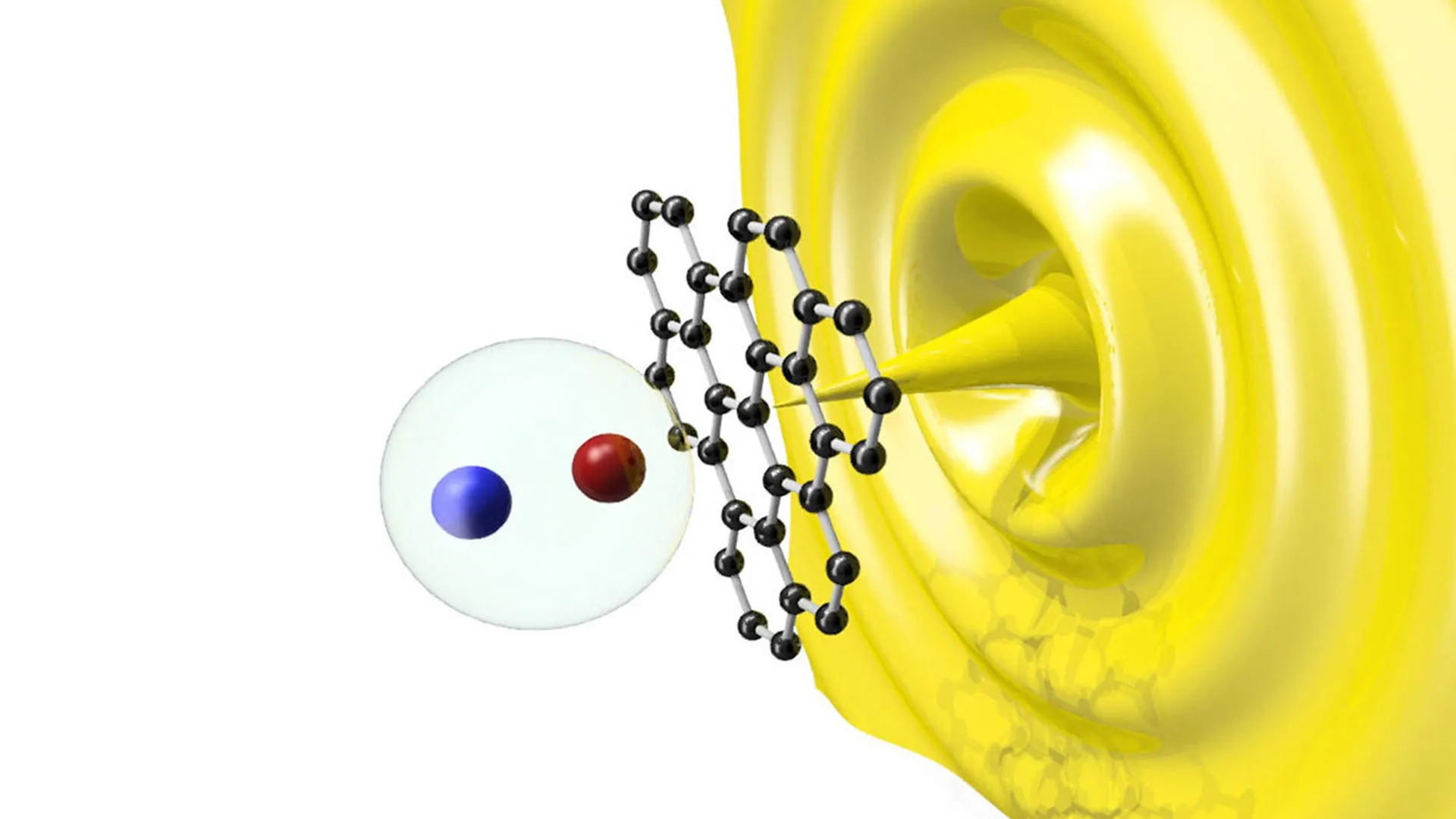
Scientists have achieved a historic breakthrough by directly observing wave-like interference in positronium, an exotic "atom" composed of an electron and its antimatter partner, a positron, marking the first time this fundamental quantum behavior has been demonstrated in antimatter systems. The groundbreaking experiment, conducted by researchers at Tokyo University of Science and published in Nature Communications, provides compelling new evidence for wave-particle duality while opening unprecedented opportunities for antimatter research, including potential tests of how gravity affects antimatter.
The research team, led by Professor Yasuyuki Nagashima along with Associate Professor Yugo Nagata and Dr. Riki Mikami, successfully created a coherent beam of positronium atoms and directed it through a graphene sheet with atomic spacing that matched the particles' de Broglie wavelength. When the positronium atoms passed through the graphene, they produced a clear diffraction pattern characteristic of wave behavior, demonstrating that even antimatter systems obey the strange rules of quantum mechanics. "Positronium is the simplest atom composed of equal-mass constituents, and until it self-annihilates, it behaves as a neutral atom in a vacuum," Nagashima explained. "Now, for the first time, we have observed quantum interference of a positronium beam, which can pave the way for new research in fundamental physics using positronium."
The achievement required overcoming significant technical challenges, as positronium exists for only a brief moment before the electron and positron annihilate each other. The researchers first generated negatively charged positronium ions, then used precisely timed laser pulses to strip away the extra electron, creating a fast-moving, neutral, and coherent stream of positronium atoms. This technique produced a beam with the necessary energy range and coherence properties to generate clear interference effects when interacting with the graphene's atomic lattice.
The discovery extends the fundamental principle of wave-particle duality, first established through classic experiments with electrons and photons, into the realm of antimatter. Previous experiments had confirmed wave behavior in various particles including neutrons, helium atoms, and even large molecules, but positronium's unique properties as an equal-mass two-body system had made such observations technically impossible until now. The successful demonstration strengthens our understanding of quantum mechanics while providing a new experimental platform for testing fundamental physics.
Beyond its significance for quantum mechanics, the breakthrough opens exciting possibilities for antimatter research that could address some of physics' most fundamental questions. Scientists hope to use similar techniques to test whether antimatter responds to gravity in the same way as normal matter, a question that has never been directly answered experimentally. Such measurements could provide crucial insights into the matter-antimatter asymmetry that characterizes our universe and potentially reveal new physics beyond the Standard Model.