Antimatter 'Atoms' Caught Acting Like Waves in Groundbreaking Quantum Experiment
Scientists observe wave-particle duality in positronium for the first time, opening new frontier for antimatter research and gravity tests.
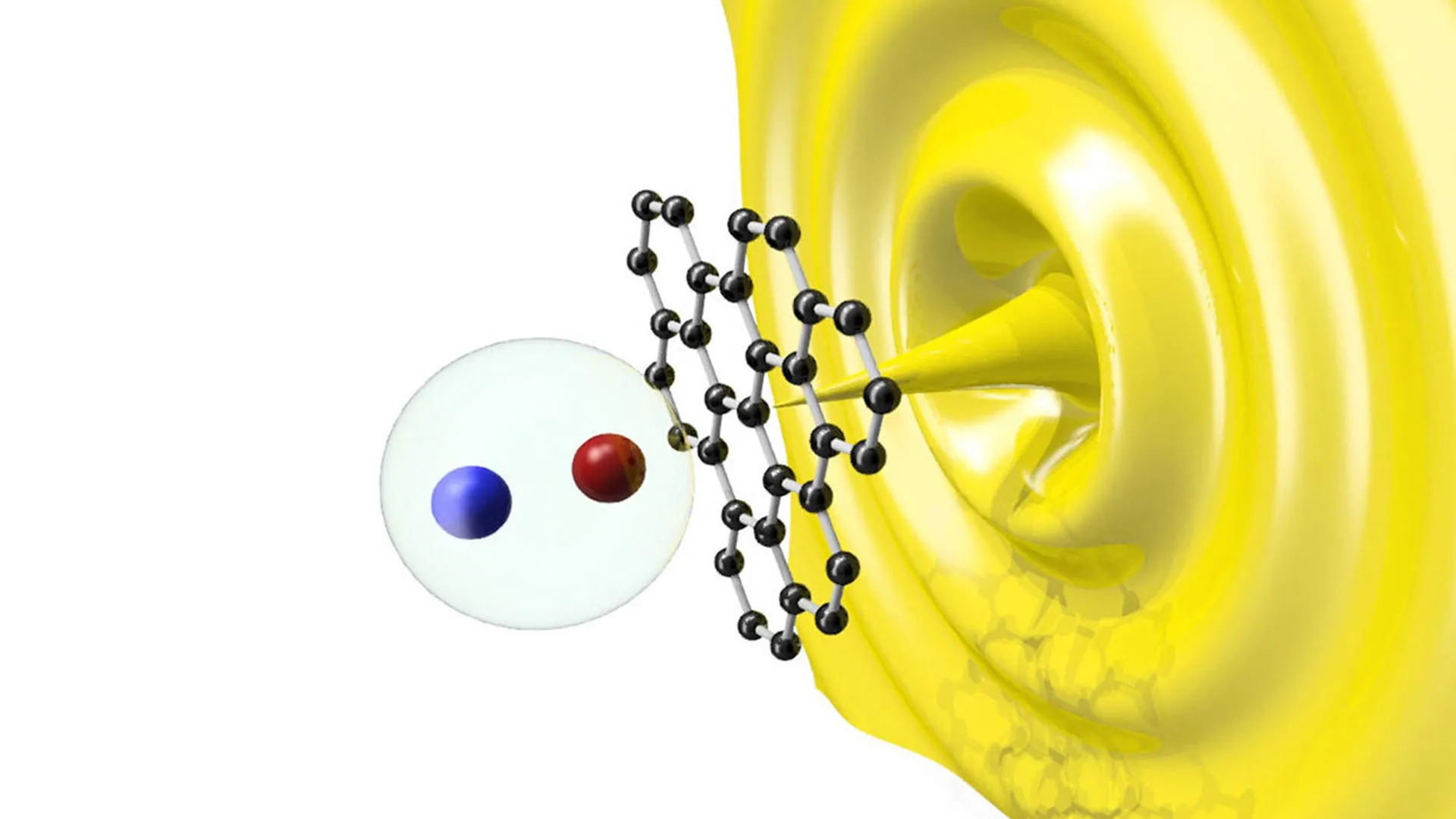
Scientists have achieved a remarkable breakthrough by observing wave-like behavior in positronium, an exotic 'atom' composed of an electron and its antimatter counterpart, a positron. This marks the first time researchers have directly demonstrated matter-wave diffraction in this unique antimatter system, extending one of quantum physics' most fundamental principles to previously unexplored territory. The achievement not only reinforces the strange reality of quantum mechanics but also opens exciting possibilities for new antimatter experiments, including potential tests of how gravity affects antimatter.
The research team from Tokyo University of Science, led by Professor Yasuyuki Nagashima, successfully created a coherent beam of positronium atoms and demonstrated their wave-like properties through diffraction experiments. Positronium represents one of the simplest possible atoms, consisting of two particles with equal mass orbiting their shared center of mass before eventually annihilating each other. The short-lived nature of this system, combined with the technical challenges of working with antimatter, had previously made such experiments extremely difficult to perform.
To create the necessary conditions for observing wave behavior, the researchers developed an innovative approach using negatively charged positronium ions. They employed precisely timed laser pulses to strip away extra electrons, producing a fast-moving stream of neutral positronium atoms with the coherence required for quantum interference effects. This beam was then directed through a graphene sheet, where the atomic spacing closely matched the de Broglie wavelength of the positronium particles at the experimental energies.
The resulting diffraction pattern provided clear evidence that positronium exhibits the same wave-particle duality that has been observed in other quantum systems. Professor Nagashima noted that positronium behaves as a neutral atom in vacuum until it self-annihilates, and the quantum interference observations open pathways for fundamental physics research using this unique system. The experiment required overcoming significant technical hurdles related to producing sufficient quantities of positronium while maintaining the quantum coherence necessary for wave-like behavior.
This breakthrough has important implications for future antimatter research and fundamental physics tests. The ability to create coherent beams of positronium atoms could enable new experiments exploring how antimatter interacts with gravitational fields, a question that has never been directly measured. Such tests could provide crucial insights into the fundamental symmetries of the universe and potentially reveal new physics beyond our current understanding of matter and antimatter interactions.