Positronium 'Antimatter Atoms' Caught Acting Like Waves in Quantum Physics Breakthrough
Scientists observe wave-particle duality in exotic positronium for the first time, opening new paths for antimatter research and fundamental physics tests.
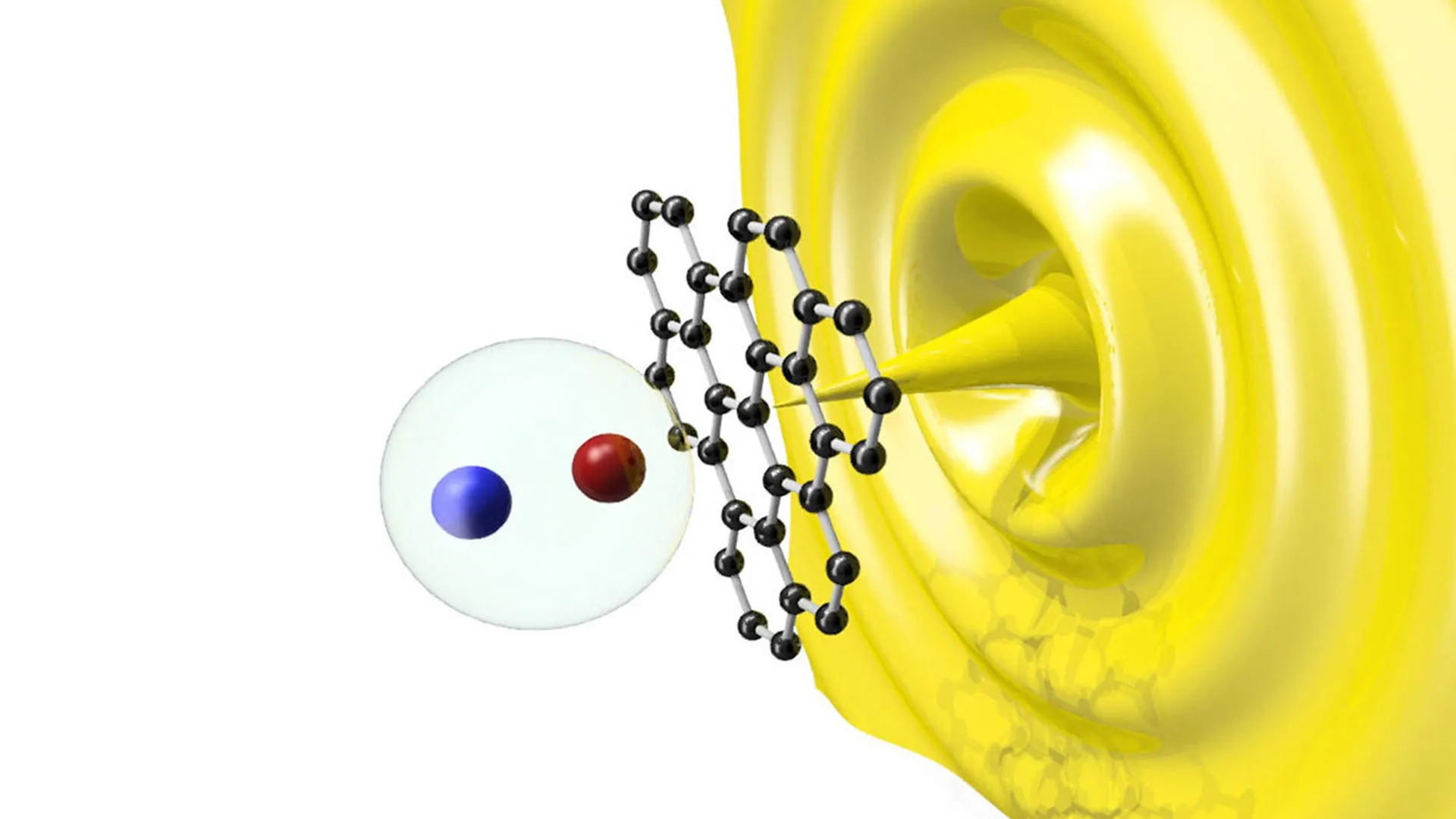
Scientists from Tokyo University of Science have achieved a groundbreaking demonstration of wave-particle duality using positronium, an exotic "atom" composed of an electron bound to its antimatter counterpart, a positron. The research team, led by Professor Yasuyuki Nagashima, successfully created interference patterns by passing a beam of positronium through graphene sheets, marking the first time this fundamental quantum behavior has been observed in this unique matter-antimatter system.
Positronium represents one of the simplest atomic systems possible, consisting of two particles of equal mass orbiting their shared center of mass before eventually annihilating each other. The achievement required developing sophisticated techniques to create a coherent beam of these short-lived atoms, which exist for only nanoseconds before their constituent particles destroy each other in a burst of gamma radiation. The research team overcame this challenge by first generating negatively charged positronium ions, then using precisely timed laser pulses to strip away the extra electron and create neutral, fast-moving positronium atoms.
"Positronium is the simplest atom composed of equal-mass constituents, and until it self-annihilates, it behaves as a neutral atom in a vacuum," explains Professor Nagashima. "Now, for the first time, we have observed quantum interference of a positronium beam, which can pave the way for new research in fundamental physics using positronium." The successful demonstration confirms that even matter-antimatter systems follow the same quantum mechanical principles that govern ordinary matter.
The experimental setup involved directing the positronium beam toward sheets of graphene, where the atomic spacing closely matched the de Broglie wavelength of the positronium atoms at the energies used in the study. As the positronium atoms passed through the two-to-three-layer graphene sheets, they created the characteristic diffraction patterns that serve as the signature of wave-like behavior, similar to the famous double-slit experiment that helped establish quantum mechanics.
This breakthrough opens exciting possibilities for future experiments involving antimatter, including potential tests of how gravity affects antimatter systems—something that has never been directly measured. The ability to create coherent beams of positronium could enable precision measurements of fundamental physics principles and provide new tools for probing the deepest mysteries of matter and antimatter interactions. The findings, published in Nature Communications, represent a significant step forward in antimatter research and could contribute to our understanding of why the universe contains more matter than antimatter.