Hungarian Team Finds Statistical Sign That Black Holes Get Kicked Out of Their Galaxies
An analysis of about 100,000 quasars shows faster-moving black holes are redder and dustier, as general relativity's recoil prediction implies; the authors say it could mean about half the sample recently merged.

Some of the universe's biggest black holes may be getting thrown out of the galaxies that made them, according to a statistical study of about 100,000 quasars.
Researchers at Eötvös Loránd University, known as ELTE, in Budapest reported the finding in Monthly Notices of the Royal Astronomical Society. The lead author is Bence Bécsy, an ELTE graduate who is now an assistant professor at the University of Birmingham and a member of the NANOGrav collaboration. His co-authors include Peter Raffai and Zsolt Frei of ELTE, Zoltán Haiman of the Institute of Science and Technology Austria and Columbia University, and Andor Budai.
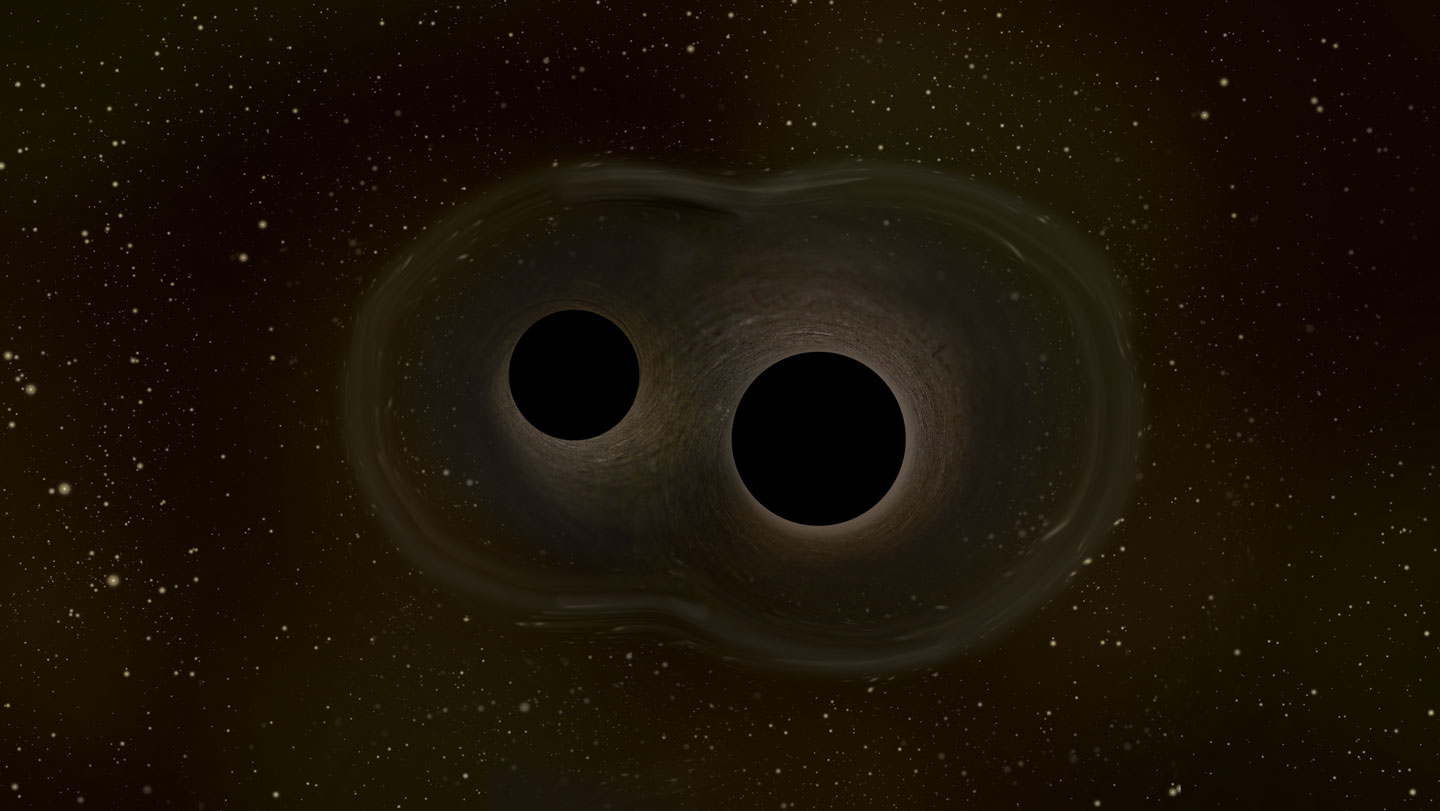
The idea behind the work comes from general relativity. When two galaxies merge, their central black holes can pair up, spiral together, emit gravitational waves and finally combine. If the waves are sent out unevenly, the merged black hole gets a recoil, or "kick." A kick too weak to eject it from the galaxy sends it swinging through the center like a pendulum, moving fastest where the dust is thickest. The recoils are predicted by Einstein's theory but have never been unambiguously observed, and earlier candidates had other explanations.
The team did not hunt for one dramatic case. Instead they used two properties of quasar light, which comes from black holes actively feeding on gas. The first is velocity: gas near the black hole moves with it, so its light is shifted relative to gas farther away, revealing how fast the black hole is moving compared with its host galaxy. The second is dust, which makes a quasar look redder. A quasar redder than comparable objects likely sits behind more obscuring dust.
Across the sample, quasars with faster-moving black holes were, on average, redder, matching a prediction published in 2016 by Raffai, Haiman and Frei. Among the dustiest quasars, heavily obscured objects were three times more common among the fastest-moving black holes than among the slowest. The result held up under different data-selection and measurement procedures. When the team looked at gas clouds that do not follow the black hole's motion, the correlation vanished, which supports the link to the black hole's own movement.
If the interpretation is right, roughly half of the quasars studied contain black holes that merged relatively recently, though the authors say that estimate is uncertain.
Raffai said, "We have now detected in real observational data the relationship we predicted years ago." Bécsy was more cautious: "It is very difficult to prove that the black hole in a single quasar has been ejected." The authors stress that other physical processes could mimic the signal and call for more observations and more detailed models.
The finding matters for the European Space Agency's LISA mission, planned for launch in 2035, which will use three spacecraft about 2.5 million kilometers apart to detect gravitational waves from supermassive black hole mergers directly. Frei said that if the signal is caused by ejected black holes, such mergers are common, which "directly determines how many such events LISA may be able to detect."