Hubble Sees the Dark 'Cat's Tail' of a Young Star for the First Time in Visible Light
University of Arizona astronomers say the 1,000-AU dust streamer around Beta Pictoris is carbon-rich and fluffy, likely debris from a collision between Pluto-sized bodies.

A faint streamer of dust trailing a young star 63 light-years away has been spotted in visible light for the first time, and astronomers say it is the wreckage of a collision between giant bodies.
The structure, nicknamed the Cat's Tail, sits in the debris disk around Beta Pictoris, a star in the small southern constellation Pictor. The system formed only a few million years ago and is seen edge-on from Earth. The James Webb Space Telescope first picked out the feature in infrared light about two years ago, but it had never shown up in visible light, which puzzled researchers.
A new study led by Arin Avsar, a doctoral student at the University of Arizona, found it using the Hubble Space Telescope. It was published in The Astrophysical Journal Letters. Avsar works with Daniel Apai and Kevin Wagner at the university's Lunar and Planetary Laboratory and Steward Observatory. Wagner, a NASA Sagan postdoctoral fellow, is a co-author.
The team combined fresh Hubble images with earlier imaging that spans more than 14 years. They also merged Hubble's visible-light data with Webb's infrared data and used computer modeling to rebuild the structure's three-dimensional shape. The tail looks shorter in Hubble than in Webb because scattered light from the dust fades with distance from the star.
The reason it stayed hidden is its makeup. The tail is made almost entirely of organic refractory material, a carbon-rich substance. "These long chains of carbon atoms absorb visible light, so they're quite black," Avsar said. The dust grains are micron-sized and highly porous, or "fluffy." "How you can get dust grains that small that are as porous as we see here, no one really understands," Avsar said.
The structure may be as long as 1,000 astronomical units, where one unit is the average distance from Earth to the sun. The modeling suggests the tail may stretch sideways, roughly in the plane of the sky, rather than straight behind the star as earlier work assumed, though it may extend slightly behind it.
The leading explanation is that the tail is the aftermath of a collision between large bodies comparable in size to Pluto. Wagner suggested the impact velocities may have been high enough to vaporize carbon grains, which then recondensed into porous particles as they cooled. The team says that explanation remains speculative.
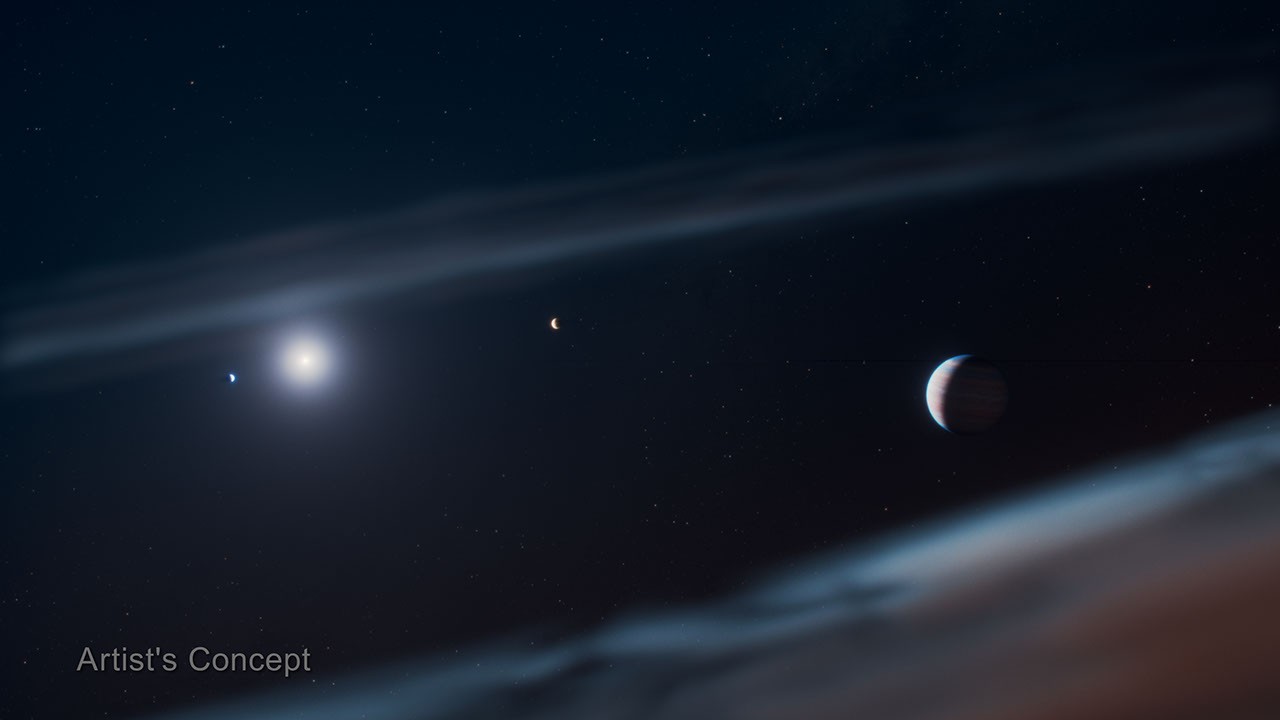
Using Hubble in a new configuration, the researchers also found a warp in the dust halo around Beta Pictoris. They think it is probably caused by the disk interacting with Beta Pic b, a gas giant roughly 10 times the mass of Jupiter. The star has three known planets. "It's a testament to how much these massive planets really influence their surrounding dust and icy bodies," Avsar said.
The findings may also say something about our own solar system. When the Kuiper Belt was about 20 million years old, it may have held hundreds of Pluto-sized bodies, and the outer giant planets probably cleared many of them by altering their orbits or flinging them out entirely.