Magma Can Hold Far More Oxygen Than Thought, Hinting at a Deep Source of Earth's Air
High-pressure experiments found molten basalt absorbed more than 5% oxygen by weight, suggesting oxygen from the interior may have helped oxygenate the atmosphere.
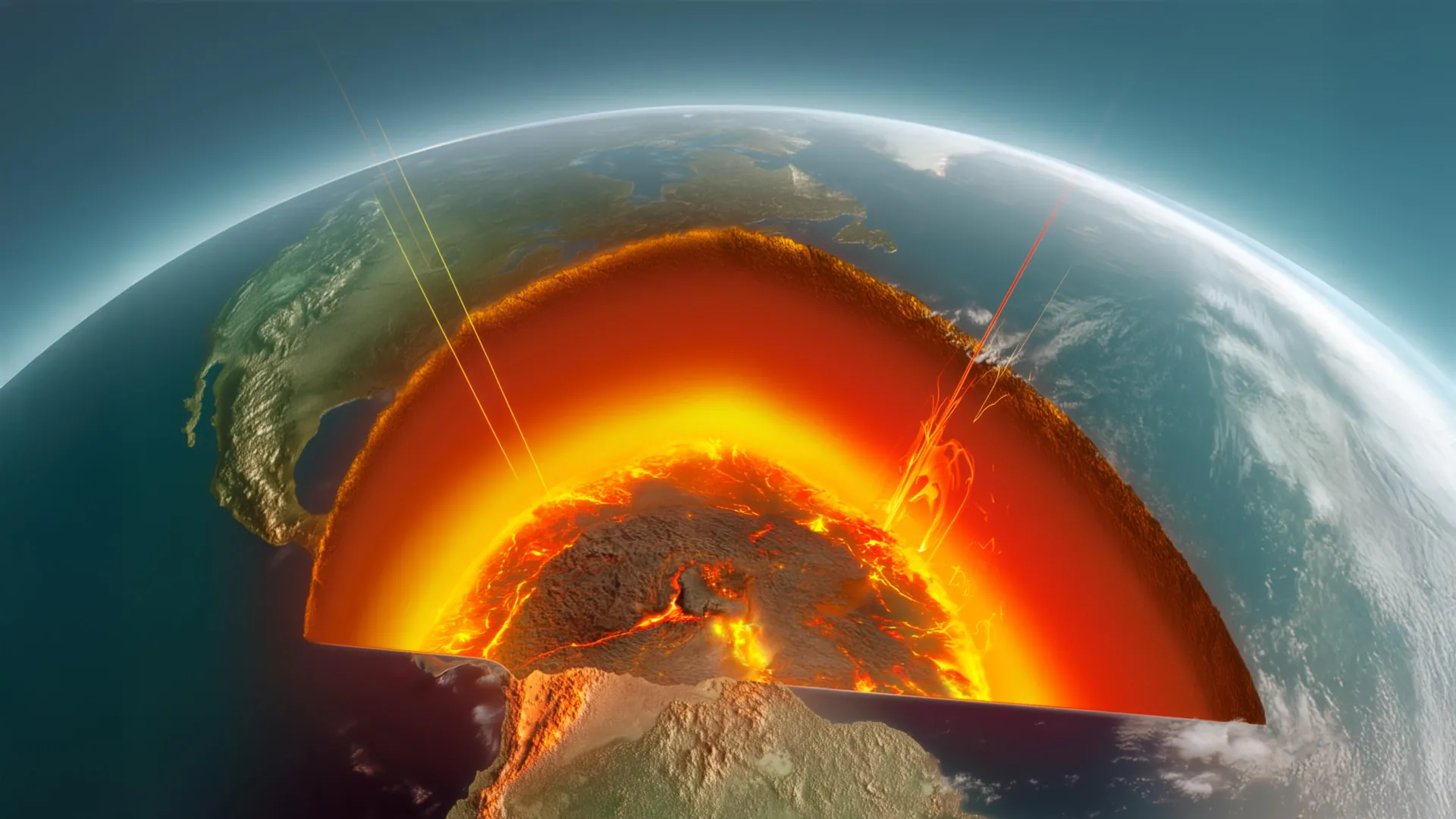
Molten rock deep inside Earth can store far more oxygen than scientists had assumed, according to high-pressure experiments and computer simulations published in National Science Review. The result raises the possibility that oxygen released from the planet's interior helped transform its atmosphere billions of years ago.
Oxygen makes up more than half of the atoms in Earth's silicate interior, the mineral-rich mantle and crust built mostly from silicon and oxygen. Yet researchers have traditionally treated the amount of oxygen in magma as fixed by its chemistry, set by the quantities and electrical charge states of elements such as silicon, magnesium and iron. Water and carbon dioxide are different: they dissolve in magma and escape as gases when pressure drops, helping drive volcanic activity. Oxygen has generally not been treated as a separate volatile that magma can absorb and release.
A team led by Dr. Yanhao Lin and Dr. Ho-kwang Mao of the Center for High Pressure Science and Technology Advanced Research tested that assumption. They worked with Prof. Haiyang Niu of Northwestern Polytechnical University and Prof. Wim van Westrenen of Vrije Universiteit Amsterdam. The group heated synthetic mid-ocean ridge basalt at pressures up to 7 gigapascals, about 69,000 times atmospheric pressure at the surface, and temperatures between 1200 and 1800 degrees Celsius, using piston-cylinder and cubic presses. They added platinum oxide to create an oxygen-rich environment, then cooled the melt quickly into glass that preserved its properties.
By subtracting the oxygen needed to balance the other elements and the oxygen already in water and carbon dioxide, the researchers estimated how much was left over, which they called "excess oxygen." At normal atmospheric pressure the glass held almost none. At 7 gigapascals, excess oxygen was more than 5% of the sample's weight. Similar runs without platinum oxide produced only 0.2% to 0.5%.
To make sure the oxygen was truly dissolved and not trapped in bubbles, the team used Raman spectroscopy, which identifies substances by how they interact with light. It found no signature of oxygen gas in the glass, so the extra oxygen had become part of the glass structure. The team noted that the measured values may understate magma's capacity, since some oxygen could have escaped as the samples cooled.
Niu led simulations using deep neural network models that approach quantum-mechanical accuracy. Even in a simplified system of magnesium, silicon and oxygen, the models reproduced the same pattern, with oxygen storage rising with pressure, though the numbers were lower than in the lab. The simulations also showed the oxygen atoms taking on more varied electrical charges, and a small share forming peroxide-like bonds in which oxygen atoms bond to one another. That pressure-dependent behavior resembles how water and carbon dioxide dissolve in magma, and the researchers propose that oxygen be recognized as an independent component of silicate melts.
The larger question is how this matters for Earth's history. The team suggests that magma produced in oxidized regions of the mantle could carry stored oxygen toward the surface and release it as the melt rose and pressure fell. If that happened at scale in the distant past, volcanic eruptions could have supplied oxygen to the atmosphere alongside the oxygen made by photosynthesis, linking the deep interior to the rise of an oxygen-rich sky.
The work is laboratory and simulation evidence, not a direct measurement of ancient volcanoes, and the simulated melts were simpler than real basalt. But it changes how geochemists should count oxygen in magma, and it gives researchers a concrete mechanism to test against the rock record of early Earth.


