Physicists Squeezed Blue Paint Pigment to 200,000 Atmospheres and Pulled Out Copper Wires One Atom Wide
Above 21 gigapascals, copper phthalocyanine crystals rearranged into single-atom copper chains over 4,000 atoms long, each sealed inside its own carbon sheath. Previous attempts topped out below 10 atoms.

Start with the pigment that makes phthalo blue. Put it in a diamond anvil cell. Squeeze past 21 gigapascals — roughly 200,000 times atmospheric pressure — and the crystal does not simply compress. It reorganizes itself into wires one copper atom across, running for micrometers.
The result, published Sunday in Science by Jie Zhang and colleagues, is a chain containing more than 4,000 copper atoms. The authors describe it as two to three orders of magnitude longer than any single-atom chain made before. That comparison is the whole story: chemists have been able to build single-metal-atom chains for years, but solution-phase methods have generally capped them below 10 atoms, which is long enough to study and far too short to use.
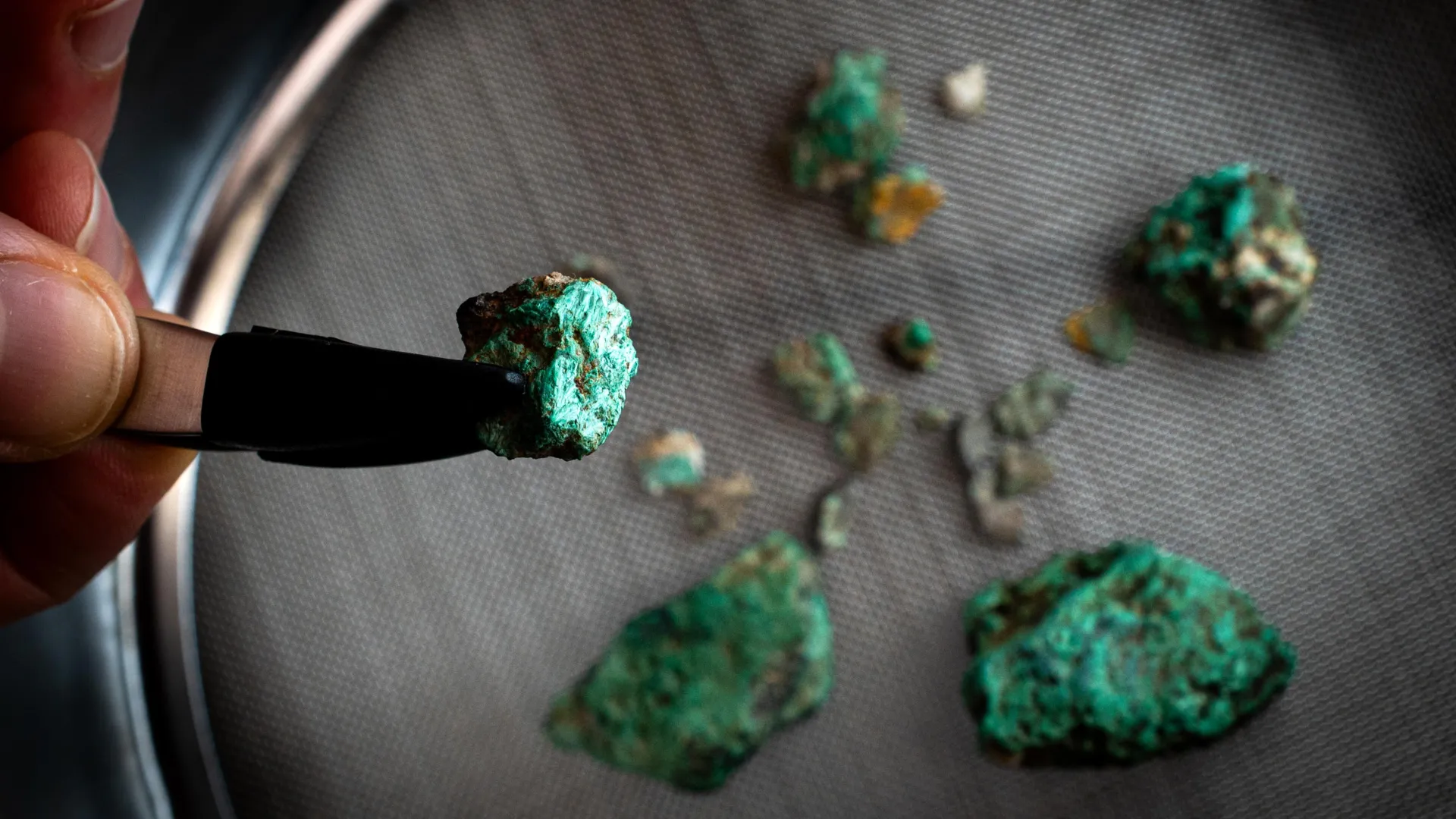
The starting material is copper phthalocyanine, or CuPc, an industrial pigment produced by the ton. Its molecules are flat, with a copper atom at the center of a nitrogen-and-carbon ring. Stack those molecules and apply enough pressure and the rings polymerize into a continuous framework while the copper atoms line up along the axis, one behind the next.
What comes out has three concentric layers, and the researchers call the structures sheathed single-metal-atom chains, or sSMACs. At the core is the copper. Around it sits a conductive carbon-nitrogen ring framework. Around that is a protective outer sheath of sp³-bonded carbon — the same bonding geometry as diamond. The sheath is what makes the material practical rather than fragile: the chains are stable in air and in acid, which is not usually true of anything one atom wide.
The electrical behavior contains a twist. The chains conduct more than 10 times faster along their length than sideways, the strong anisotropy you would expect from a wire. But the current does not run through the copper. It runs through the carbon-nitrogen framework wrapped around it. The copper atoms instead interact magnetically with one another, antiferromagnetically, meaning neighboring spins line up in opposite directions.
That combination — a one-dimensional magnetic chain threaded through a one-dimensional conductor, both stable at room conditions — is a laboratory for physics that is normally accessible only in theory. One-dimensional systems behave strangely. Electrons in them cannot pass each other, and their collective behavior departs from the ordinary rules that govern electrons in bulk metal.
The applied motivation is silicon running out of room. As conventional transistors approach hard physical limits, molecular wires are one of the routes being explored past them, and a wire that is genuinely one atom wide, thousands of atoms long, and chemically robust is a considerably more serious candidate than a 10-atom fragment in solution. The paper is published as DOI 10.1126/science.aeg0028.