Oxford Physicists Keep Entanglement Alive Between Two Distant Ion Traps for About 10 Seconds
A strontium ion carries the link and a calcium ion stores it, stretching entanglement across a fiber-connected network from milliseconds to more than ten seconds.

Physicists at the University of Oxford have kept quantum entanglement alive between two separate ion-trap modules for about 10 seconds, orders of magnitude longer than the milliseconds typical of the qubits that make the link. The work, led by Dougal Main and Gabriel Araneda, is published in Physical Review Letters under the title "Multipartite Mixed-Species Entanglement over a Quantum Network."
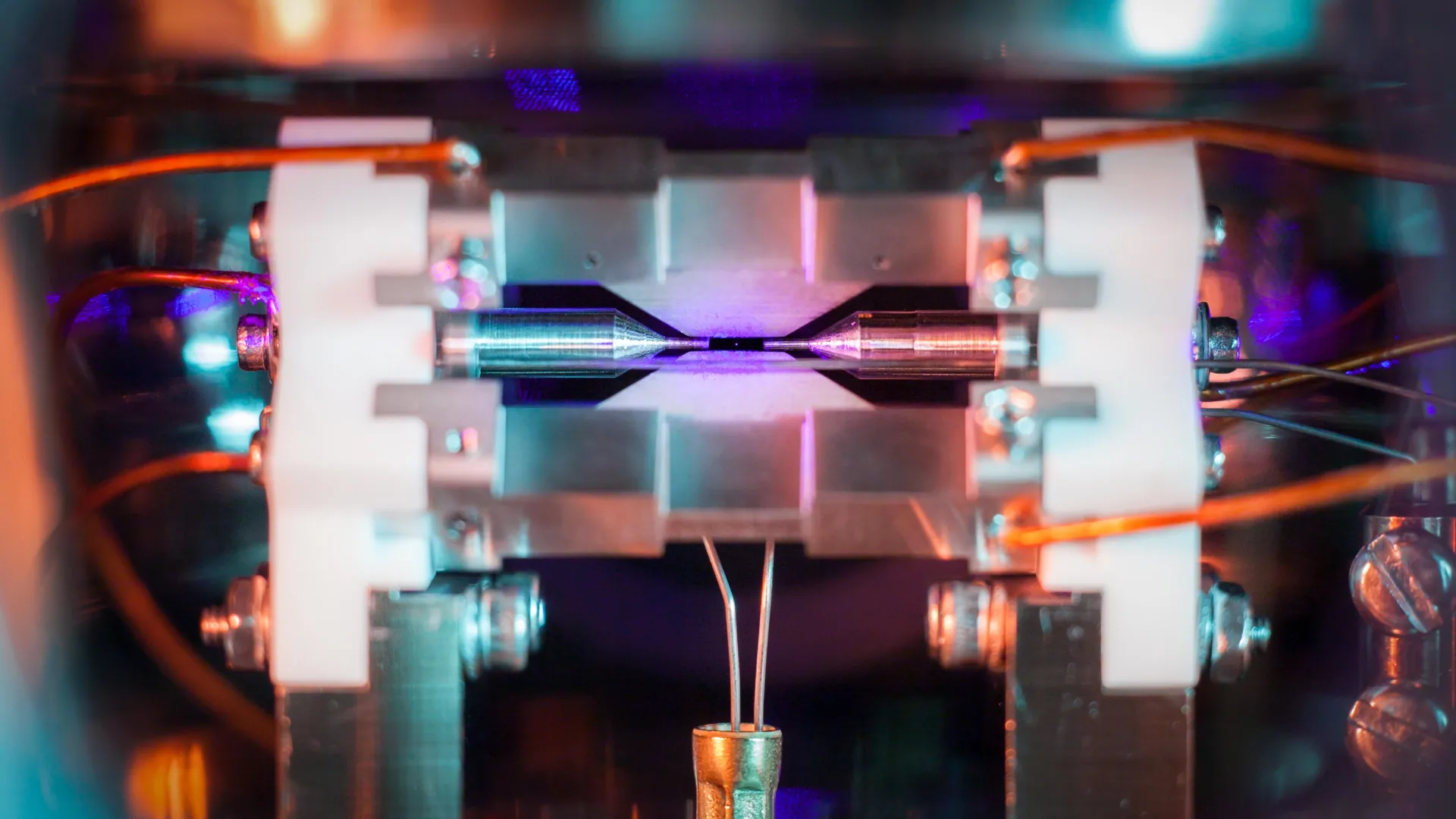
The setup has four qubits encoded in trapped ions spread across two nodes joined by optical fibers. Each node holds one strontium ion and one calcium ion. The two species do different jobs: strontium handles the connection between nodes, while calcium serves as the memory.
The process runs in steps. Each strontium ion emits a photon, and the two photons meet at a central station where a Bell-state measurement is performed. A particular detection pattern signals that the two distant strontium ions are entangled. Local operations inside each node then extend that entanglement to the calcium ions, producing entangled states involving three or four ions.
The entanglement is moved to calcium because the chosen calcium states are far less sensitive to magnetic-field noise, which is what destroys fragile quantum states. As a result, the entanglement stored in calcium lasts more than 10 seconds, while the network qubits themselves hold their states for only milliseconds.
"Each node contains one strontium atomic ion and one calcium atomic ion," Main said, describing the architecture. The long storage time matters because linking distant devices is probabilistic: the photon-based handshake often has to be retried, and the entanglement already established must survive until it succeeds.
"Remote entanglement could allow separate quantum processors to work together as a distributed quantum computer," Araneda said. The researchers also point to distant quantum sensors, comparisons between atomic clocks, and secure quantum communications as uses.
Entanglement is the link that lets two quantum systems share a joint state so that measuring one tells you about the other, no matter how far apart they sit. It is the resource behind quantum networks, and the hard part is keeping it intact long enough to be useful. Ten seconds is an eternity for a qubit that is only stable for milliseconds.
Using two different atomic species is the key design choice. An ion that is good at emitting photons for networking is usually poor at holding a state quietly, and the reverse is also true. By dedicating strontium to communication and calcium to storage, the Oxford group gets the best of each, and the entanglement can be handed from one to the other with local operations inside a node.
The result is a step toward scaling up. Building one enormous quantum computer is hard, so many groups are pursuing networks of smaller modules joined by light. Showing that the connection can be stored for seconds, not just created, is a requirement for that approach.
The paper's DOI is 10.1103/qpsf-nlp9. Phys.org reported the result on October 21, 2026.