Ice VII and Ice X Are the Same Phase, Physicists Show Using Magnetic 'Spin Ice'
A Hong Kong and Tokyo team recast high-pressure ice as a magnet, resolving a long-running question and predicting a rare sharp transition in spin-3/2 materials.

Physicists in Hong Kong and Tokyo have built a unified theory that predicts when two states of matter are truly distinct and when they are secretly the same, and used it to settle a long-standing argument about water ice under extreme pressure. The work, published in Physical Review X, was led by Haruki Watanabe of the Hong Kong University of Science and Technology, with Yukitoshi Motome and graduate student Sena Watanabe of the University of Tokyo.
The starting point is symmetry. Liquid water and steam look different, but they share the same underlying symmetries, because their molecules have no preferred position or direction. Past a certain critical point they can be transformed into one another continuously, so they count as a single phase. Ice is different. It forms a crystal lattice with molecules at fixed positions, breaking a symmetry that liquids and gases keep, so a genuine boundary must always separate ice from liquid.
The team applied that logic to high-pressure ice forms called ice VII, ice VIII and ice X. All share the same framework of oxygen atoms but differ in where hydrogen atoms sit. In ice VII the hydrogen atoms occupy random positions, in ice VIII they form an ordered pattern, and in ice X they sit midway between neighboring oxygen atoms. Averaged over time, ice VII and ice X preserve the same crystal symmetries, which left it unclear whether they are different phases or two faces of one.
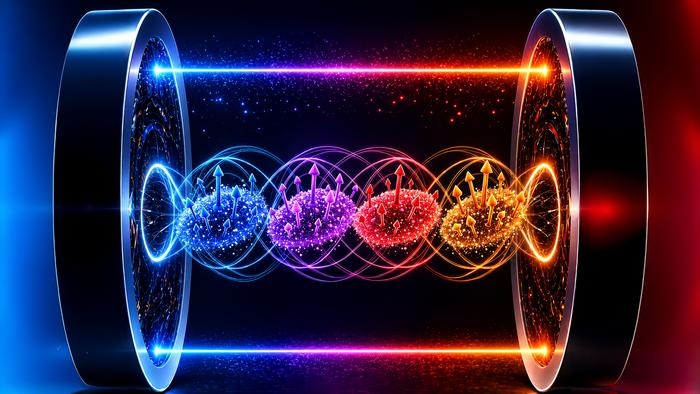
To answer that, the researchers recast the problem as magnetism. The midpoints of the bonds between oxygen atoms form a pyrochlore lattice, the structure behind "spin ice" magnets, and the three positions available to each hydrogen atom correspond exactly to the three states of a magnetic moment of spin 1. A companion study in Physical Review B found that in a simplified model, ice VII and ice X are separated by a sharp transition only at absolute zero. At any higher temperature, thermally excited defects act like magnetic monopoles and screen the field holding the two states apart, turning the sharp transition into a gradual crossover. Ice VII and ice X therefore belong to the same phase, while ice VIII stays distinct because its ordered hydrogen arrangement breaks a crystal symmetry.
The main paper generalizes this into a framework for classifying phases in pyrochlore spin-ice models with any spin value. What keeps two states apart, the authors show, is a network of string-like defects threading the crystal: as long as the strings close on themselves, the states remain genuinely different. Above absolute zero, thermally excited monopoles cut the strings open, and the distinction washes out, so almost every sharp boundary dissolves into a smooth crossover. The framework also reveals a divide earlier work could not see, between magnets whose spin is a whole number and those whose spin is a half-integer.
There is one exception. For spin 3/2, an abrupt transition between two distinct liquid-like magnetic states is predicted to survive at finite temperature and end at a critical point without any external magnetic field, which makes it an attractive target for experiments. The authors say the results bear on frustrated magnets, nanomagnet arrays and trapped cold-atom systems. "Our results ultimately support the conventional view that the phases of ordinary matter are classified by broken symmetry, and by nothing else," Haruki Watanabe said. "It would be far more interesting to discover a topological phase that genuinely survives at a finite temperature beyond this classification. That is what we are looking for now."