Harvard Team Makes Randomly Placed Spins in Diamond Move in Coordinated Spirals at Room Temperature
The technique could lead to diamond quantum sensors with less noise, and it maps spin patterns at a resolution finer than 20 nanometers.

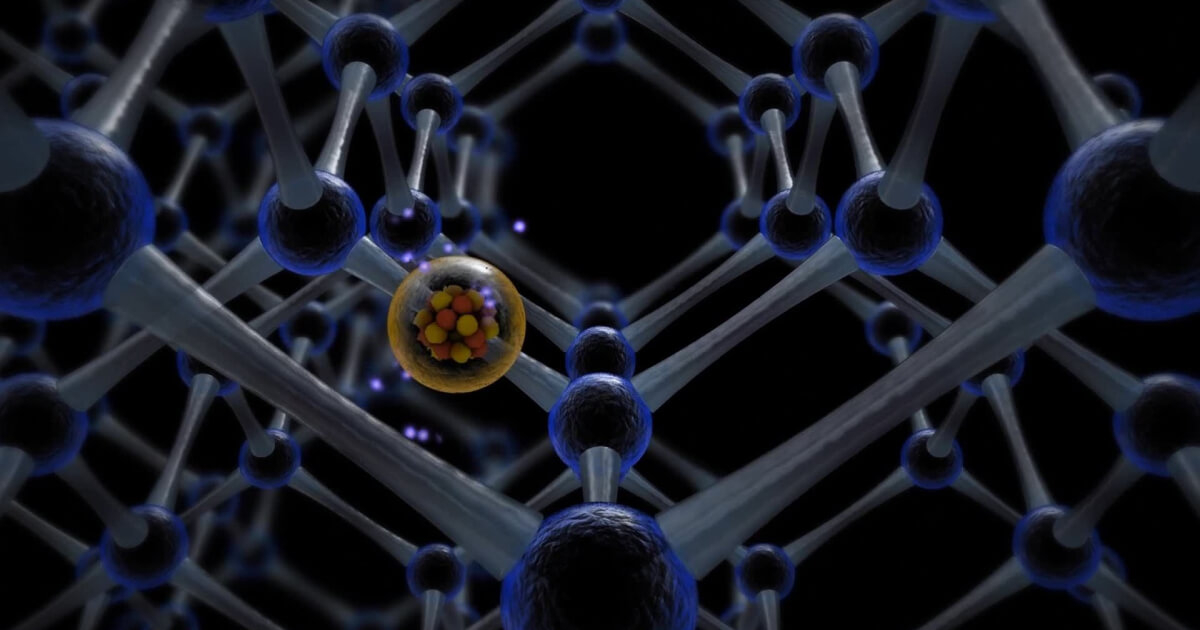
Inside certain diamonds sit tiny flaws called nitrogen-vacancy centers, where a nitrogen atom lies beside an empty spot where a carbon atom should be. Electrons trapped at these defects have quantum spin, so they act like tiny magnets, and that makes diamond a very sensitive detector of magnetic fields. A Harvard-led team has now gotten thousands of these spins to move together, at room temperature, without positioning any of them by hand.
The research, published in Physical Review X and led by Piotr Put at Harvard University, addresses a long-standing obstacle. If many spins could act as one, sensors would become more powerful. But in a dense diamond the spins are scattered at random, and each feels the magnetic pull of its neighbors. At room temperature those jumbled interactions quickly disrupt the group and destroy coordination. Earlier studies have shown collective behavior in ultracold atoms and trapped ions, and parallel diamond work has used spin interactions to amplify weak signals or reduce quantum noise in selected groups of spins. In those experiments, however, pairs of spins that happened to sit especially close together interacted so strongly that the collective behavior didn't last.
Put's team studied thousands of nitrogen-vacancy spins in both a thin diamond plate and a narrow diamond beam. Each sample sat on a custom chip that let the researchers precisely control the magnetic field around it. They used lasers to line up the spins in the same direction and, later, to read out their final states.
In between, magnetic fields that varied in strength across the sample wound the spin directions into spiral patterns, then unwound them again. Carefully timed microwave pulses reshaped how the spins interacted into a more balanced, symmetrical form. That protected the spirals from being wrecked by strongly coupled pairs. As a result, the coordinated motion built up more strongly before fading than it did under the spins' natural interactions. The team combined nanoscale magnetic imaging with computer simulations to explain what they saw.
The magnetic field gradients arranged the spins into spirals only nanometers across. How the motion depended on spin orientation resembled "one-axis twisting," a process in which interactions gradually twist a collection of spins together, and which can be used to reduce noise in quantum measurements. The method also let the team map patterns inside the spin ensemble with a resolution finer than 20 nanometers.
The researchers believe the approach could, with better readout and longer-lived spin states, create entanglement and spin squeezing, a technique that lowers measurement noise below normal limits. Such gains would matter for sensors that detect faint magnetic signals from materials, chips or biological samples.
The result is a lab demonstration, not a product. But showing that randomly placed spins can be steered into coordinated motion at room temperature, without cryogenic equipment, removes one of the main reasons collective effects have been hard to use in practical diamond devices.