Diamond Defects Let Physicists Map a Crystal Flaw's Stress Field, Confirming an 80-Year-Old Theory
Japanese researchers used nitrogen-vacancy centers as atomic-scale sensors to measure several components of the stress around a dislocation for the first time.

For the first time, researchers in Japan have directly mapped several components of the stress field surrounding an atomic-scale flaw in a diamond crystal, and the measurements match a theory written more than 80 years ago.
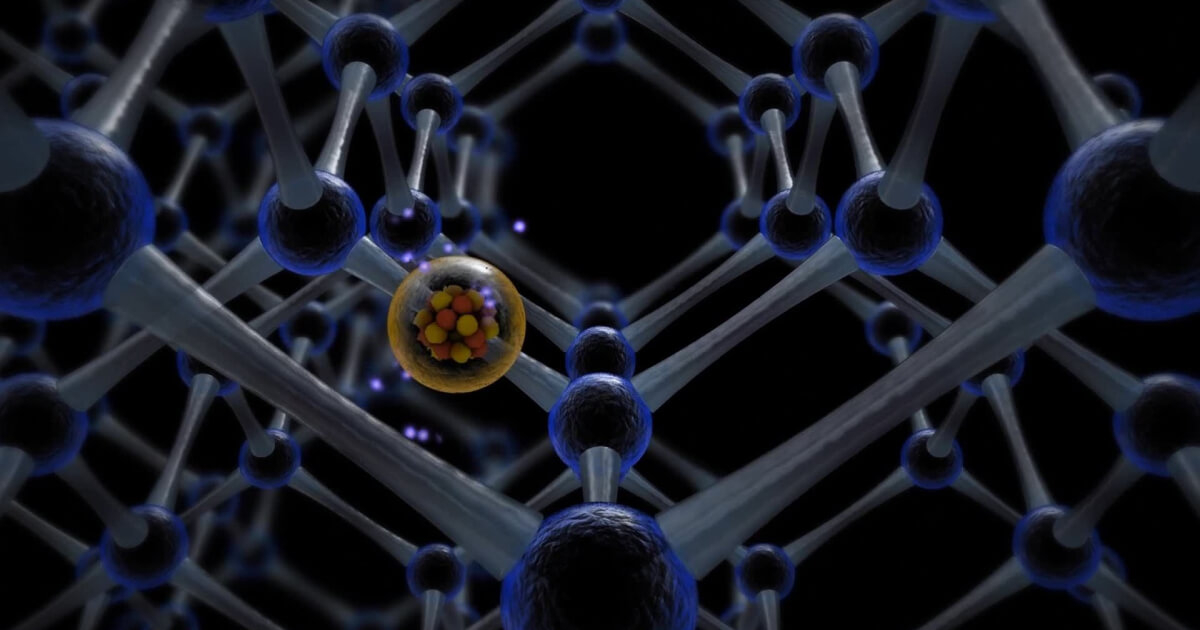
The team, led by Tokuyuki Teraji at Japan's National Institute for Materials Science, published the work in Applied Physics Letters. Their tool was the nitrogen-vacancy, or NV, center: a defect formed when a carbon atom in the diamond lattice is replaced by a nitrogen atom sitting next to an empty lattice site. The spin states of the unpaired electrons at these centers respond to their surroundings, including mechanical stress.
The flaws being studied are called dislocations, places where neighboring rows of atoms are misaligned. Even in a nearly perfect crystal such flaws are unavoidable, and each one sends a small stress field rippling through the surrounding atoms. Across a whole lattice, dislocations can strongly affect a material's mechanical, electrical and magnetic behavior.
More than 80 years ago, physicists used elasticity theory to derive a mathematical description of those fields, known as a stress tensor, which gives the stress at any point around a dislocation. It has underpinned understanding of how dislocations behave, from the energy they store to the forces they exert on one another. But existing measurement techniques capture only some aspects of the stress, so the full description had never been tested directly.
That gap has become more pressing as engineers design next-generation power and quantum devices that depend on growing high-quality crystals in the lab, a process that demands exquisite control. "We realized that 'stress imaging' within the diamond crystal is essential for achieving even higher crystal quality," Teraji said.
To get there, his team grew a thin, high-quality diamond film by chemical vapor deposition from carbon enriched in the carbon-12 isotope, which boosts the coherence of NV spin states. They also tuned the nitrogen concentration to maximize the brightness of the centers' fluorescence without sacrificing coherence. They then located a region where the stress field was dominated by a single 45-degree dislocation.
The readout relies on optics and microwaves. NV centers fluoresce more or less brightly depending on their spin state, and applying microwaves flips the spin only when the frequency matches the center's resonance, producing a measurable dip in brightness. Within diamond, NV centers sit in four possible orientations, and their resonant frequencies shift differently depending on the direction of stress relative to the axis from the nitrogen atom to the vacancy. Because centers in the same stress field shift by subtly different amounts, the team could untangle separate components of the stress tensor.
Comparing the experimentally measured stress maps with the calculated tensor, the researchers found they agreed, validating the 80-year-old theory. The technique could also help refine the processes used to manufacture the high-quality diamond that emerging technologies demand.