Counting Magnetic Vortices in a Superconductor Could Reveal Exactly How Many Photons Hit It
Japanese physicists directly saw flux quanta created by absorbed light, a route to photon counters that skip the slow thermal wait of today's best detectors.

Researchers in Japan have directly observed tiny magnetic whirlpools that form in a superconductor when it absorbs light, and they say counting those whirlpools tells you how many photons arrived. The finding points to a new kind of photon-number counter, and it could matter for quantum computers and quantum communication that run on light.
The work comes from the National Institute of Advanced Industrial Science and Technology, or AIST, and was published in Physical Review Applied under the title "Direct observation of photon-induced vortices in superconducting films." Takeshi Jodoi is the first author. The unit being counted is the magnetic flux quantum, the smallest possible bundle of magnetic field that a superconductor lets through.
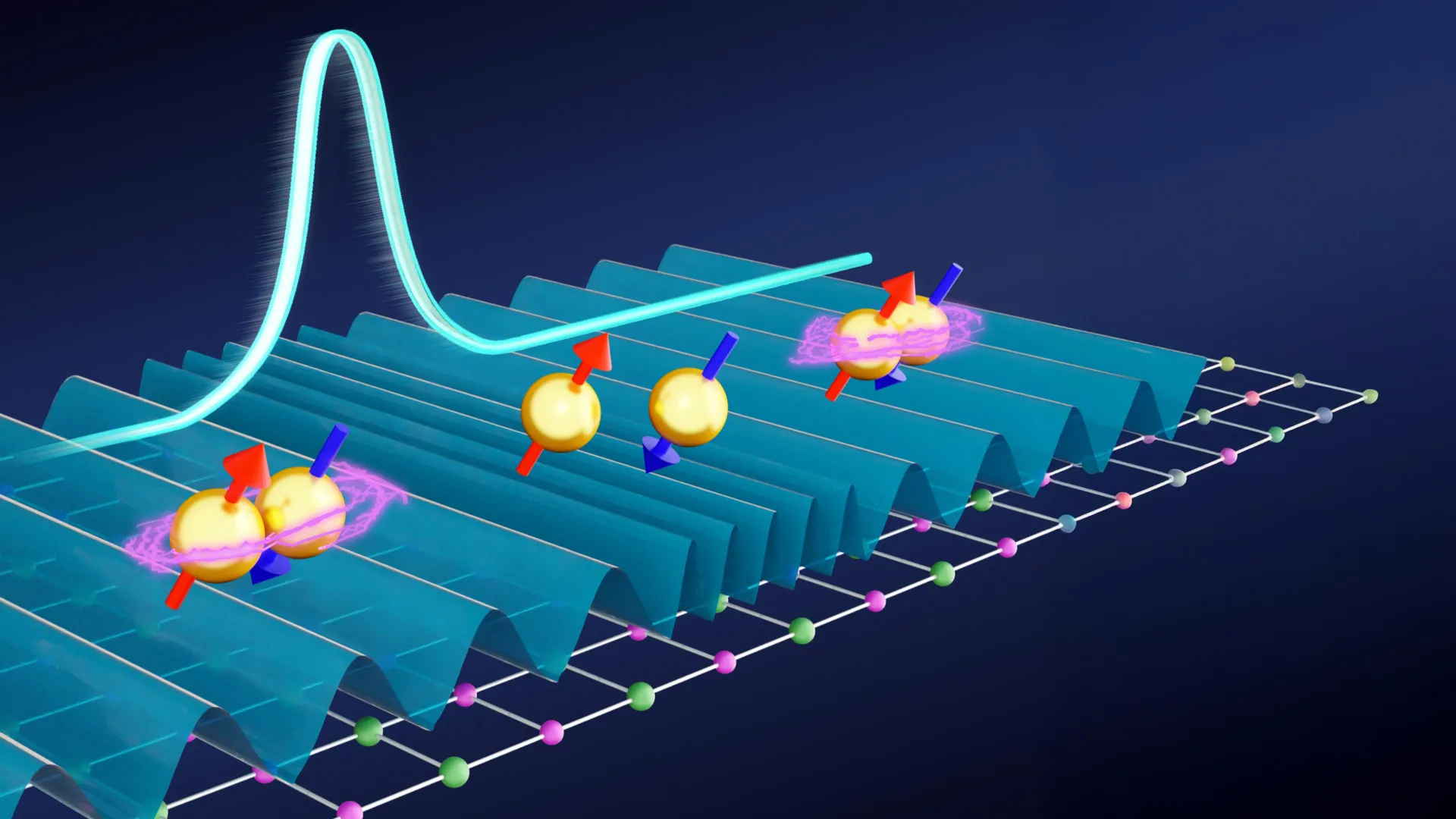
Here is the mechanism the team describes. When a photon is absorbed, it destabilizes the smooth phase gradient of the superconducting state and creates a pair of flux quanta. As they cross the film, phase slips occur, and through the Josephson effect each crossing produces a voltage signal of a fixed, quantized size. Count the signals and you have counted the photons.
The approach differs from the two leading superconducting detectors. Transition-edge sensors can tell one photon from several, but they measure energy as heat, which means waiting for the device to cool before the next measurement. That limits their speed. Superconducting nanowire single-photon detectors are very fast, but they cannot say how much energy arrived, so counting multiple photons means combining many detectors. The AIST method reads the phase dynamics immediately after absorption, before the heat spreads, so the researchers say it promises faster counting without that thermal wait.
Applications the team cites include optical quantum computing, quantum communication, the evaluation of single-photon sources and bosonic quantum computing. In optical schemes, knowing whether one, two or three photons are present is often the difference between a working gate and an error.
The report is a demonstration of direct observation, not a finished instrument. The article describing it does not give detection efficiency, speed figures or accuracy for the photon-number readout, and those will decide whether the technique can compete with detectors that labs already use. The next steps are likely to be building devices around the effect and testing how reliably they can tell, say, four photons from five.
Still, seeing the individual vortices that light makes is a result in itself. It ties a macroscopic quantum signal, a quantized voltage, to the arrival of single particles of light, and that link is the foundation of any counter built on it.