Lumina, the Largest Universe Simulation Yet, Needed 15,000 GPUs to Rebuild the First 2 Billion Years
Harvard-Smithsonian astronomers modeled a cube 1.5 billion light-years wide, capturing helium reionization for the first time, to give JWST and Roman a map of what to expect.

Astronomers at the Center for Astrophysics | Harvard & Smithsonian have built what they describe as the largest cosmological radiation-hydrodynamics simulation ever made, a digital rerun of the universe's first 2 billion years. It is called Lumina, and it ran on the Frontier supercomputer at Oak Ridge National Laboratory in Tennessee.
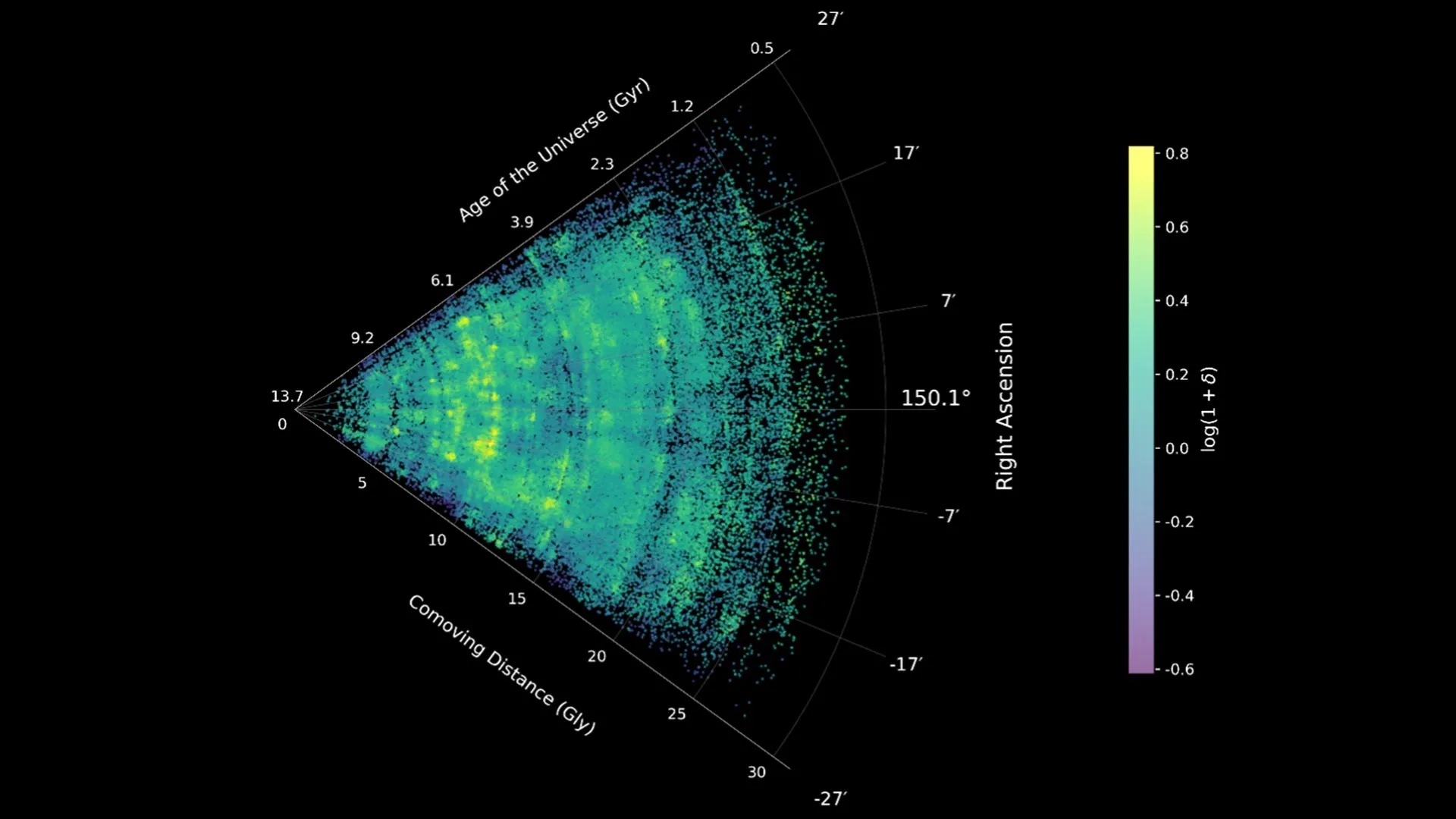
The numbers are large. Lumina follows ordinary matter, dark matter and radiation through a cube roughly 1.5 billion light-years on each side, more than 100 times the volume of previous comparable simulations. The run required more than 15,000 graphics processing units. A rendering of the cosmic web it produced spans about 650 million light-years.
The simulation tackles reionization, the era when light from the first stars and galaxies stripped electrons from the neutral hydrogen that filled space. Helium went through its own change later, and Lumina is the first simulation to capture helium reionization as it happened, letting its effects feed back into the evolving model universe. The results are described in a paper in Monthly Notices of the Royal Astronomical Society titled "Introducing the Lumina project: large-volume radiation-hydrodynamic simulations of the epochs of hydrogen and helium reionization."
Lead author Oliver Zier, a fellow at the center's Institute for Theory and Computation, said that with the James Webb Space Telescope "the early universe has become an exciting new frontier in astrophysics." He called it "incredibly rewarding to see the simulation results" and watch predictions come to life. Co-author Aaron Smith, an assistant professor of physics at the University of Texas at Dallas, said that "For the first time, we can follow along as both hydrogen and helium changed into their modern form" across a very large volume of the universe.
Size matters because the early universe is lumpy. Reionization did not happen everywhere at once. Bubbles of ionized gas grew around clusters of galaxies and merged over time, so a small simulation volume can give a skewed picture. A box this large averages over many such regions and still resolves the processes that shape galaxies.
Astronomers can now lay observations from Webb, the Nancy Grace Roman Space Telescope and other instruments over Lumina's predictions. If real data depart from the model, that would be a sign that something in the current picture of cosmic laws needs revising. The team plans to use Lumina to study how gas moves between galaxies, how radiation left over from the Big Bang shaped cosmic evolution, and how regions of intense star formation developed over time.
Simulations like this cannot replace telescopes, but they tell observers where to look and what a normal universe should look like. That gives any surprises from Webb and Roman a reference to be measured against.