James Webb Telescope Finds 200-Billion-Solar-Mass Galaxy That Refuses to Spin Less Than Two Billion Years After the Big Bang
XMM-VID1-2075, identified by a UC Davis–led team using JWST's NIRSpec integral-field spectrograph and published in Nature Astronomy on May 4, has a rotation-to-dispersion ratio below 0.3 — making it dynamically indistinguishable from fossil galaxies that should not exist for another five billion years.
Astronomers using the James Webb Space Telescope have discovered a massive galaxy from less than two billion years after the Big Bang that does not rotate at all, a finding that upends a decade of theory about how the largest structures in the universe acquire their angular momentum. The galaxy, catalogued as XMM-VID1-2075 and located roughly 12 billion light-years from Earth, contains several times the stellar mass of the Milky Way yet exhibits the disordered, pressure-supported orbits of stars normally seen only in much older, dynamically settled galaxies that have spent billions of years quenching and merging. The discovery was reported May 4 in the journal Nature Astronomy by a team led by Dr. Ben Forrest, a research scientist at the University of California, Davis.
"Every theoretical model says a galaxy of this mass at this redshift should be a rapidly rotating disk, like a young Andromeda," Forrest said in a UC Davis news release. "What we found instead is a giant ball of stars moving on random orbits — something we usually see only in fossil galaxies in the local universe that finished forming 10 billion years ago. Either our models of angular momentum are wrong, or this galaxy had a violent formation history we can barely imagine." The team used the JWST NIRSpec integral-field spectrograph to measure the line-of-sight velocities of stars across the galaxy and found that the so-called rotational velocity to velocity-dispersion ratio (V/σ) is below 0.3, the technical threshold below which astronomers classify a galaxy as a "slow rotator." By contrast, the modern Milky Way has a V/σ of roughly 2.4.
The finding is the latest in a series of JWST observations that have shaken the standard model of galaxy assembly. Since the telescope began science operations in July 2022, it has discovered surprisingly massive disk galaxies, mature spirals, and quiescent giants at epochs the Big Bang's hot, chaotic young universe was not supposed to allow. XMM-VID1-2075 now adds a new puzzle: a galaxy that finished its hierarchical assembly faster than physically possible under canonical lambda-cold-dark-matter cosmology. "We're seeing a kind of galaxy that should not exist for another five billion years," said co-author Dr. Adam Muzzin of York University in Toronto. "It's as if you walked into a maternity ward and found a 50-year-old patient."
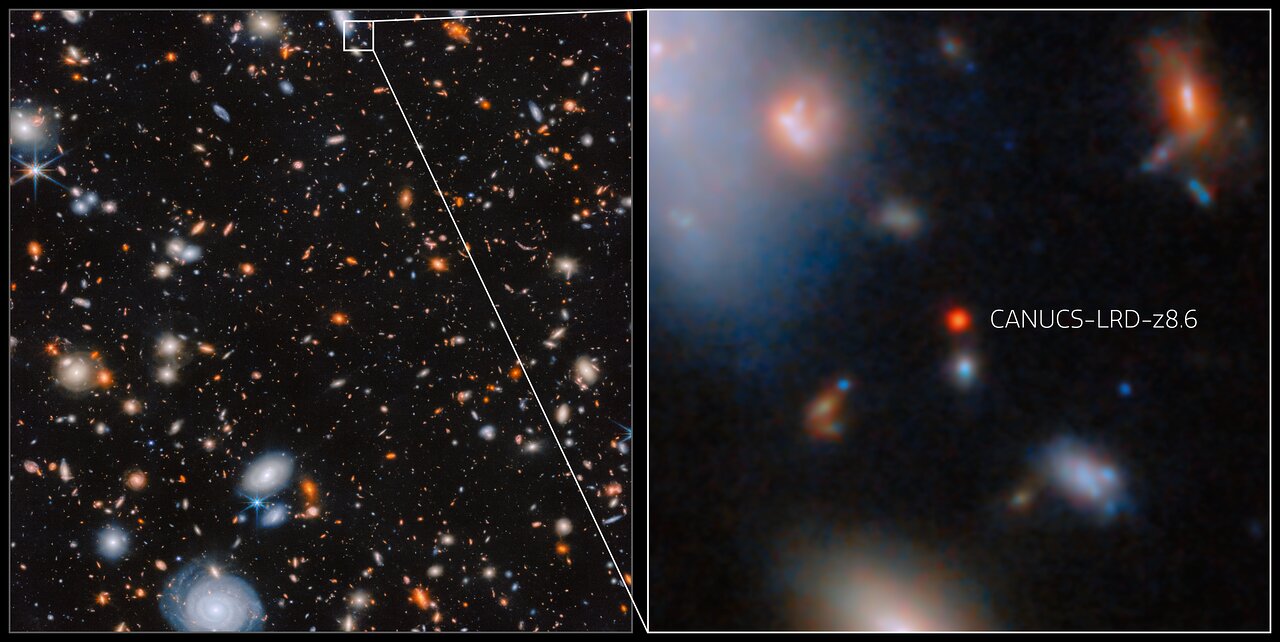
One explanation gaining traction among theorists is that XMM-VID1-2075 was assembled through a single catastrophic "wet-merger" event in which two or more gas-rich progenitor galaxies collided head-on and lost most of their net angular momentum, then rapidly formed stars in a burst that may have produced hundreds of solar masses per year for tens of millions of years. The team's stellar-population modeling suggests the galaxy formed roughly 200 billion solar masses of stars between 11.9 and 11.5 billion years ago — meaning it was building stars at the rate of a thousand modern Milky Ways at peak intensity. Such bursts would have been visible to JWST as a so-called "red monster" galaxy, several of which have been catalogued in the past two years.
The XMM-VID1-2075 discovery has immediate consequences for upcoming surveys with the Nancy Grace Roman Space Telescope, currently slated for a September 2026 launch, and with the Vera C. Rubin Observatory in Chile, which began operations in October. Both instruments will map tens of millions of galaxies in the same redshift range and will allow astronomers to determine whether non-rotating massive galaxies are vanishingly rare flukes or — more disquieting for theory — a substantial fraction of the early massive-galaxy population. "If even one in ten of these distant red monsters turns out to be a slow rotator, we are going to have to rewrite the chapter on early-universe physics," Forrest said. "This is the kind of result the telescope was built to deliver, and it's going to keep us busy for years."