James Webb Telescope Stitches 164,000 Galaxies Into the Clearest Map Ever of the Cosmic Web Just a Billion Years After the Big Bang
UC Riverside-led COSMOS-Web survey resolves filaments and voids that earlier maps smeared together, revealing that galaxy clusters were assembling much faster than the leading dark-matter simulations predict.
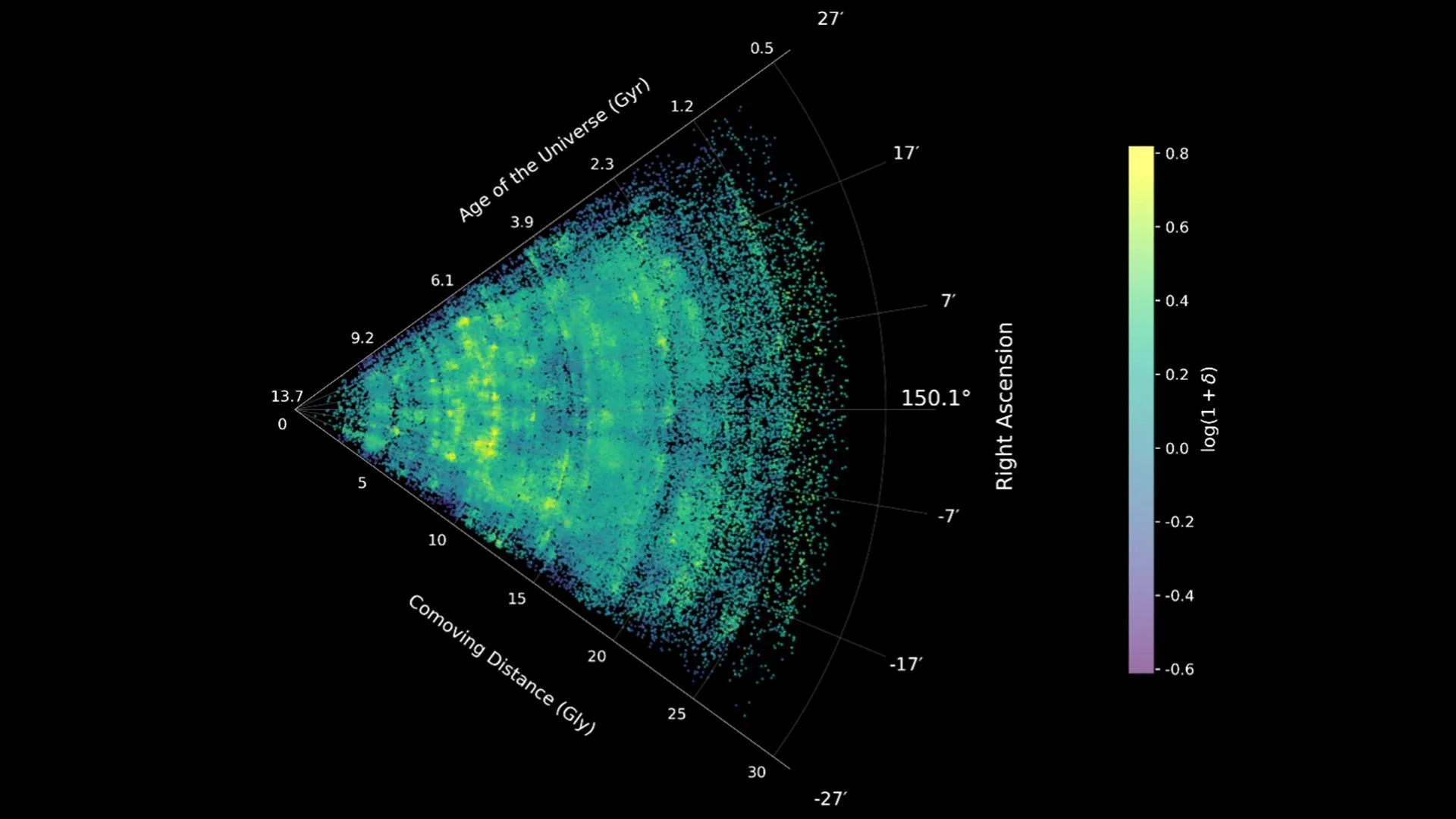
An international team of astronomers using NASA's James Webb Space Telescope has produced the clearest three-dimensional map ever made of the universe's "cosmic web" — the immense skeleton of dark-matter filaments, gas walls and near-empty voids that channels matter into the galaxies we see today — by stitching together infrared images of 164,000 galaxies and tracing the structure back to when the cosmos was only a billion years old.
The result, published this month in The Astrophysical Journal, comes from the COSMOS-Web survey, the largest General Observer program awarded time on JWST since the telescope launched in 2021. The map covers a patch of sky equivalent to roughly three full moons and resolves filaments only a few million light-years across at redshifts greater than 6, an era that was essentially unreachable for the Hubble Space Telescope. Lead author Hossein Hatamnia, a graduate student at the University of California, Riverside and the Carnegie Observatories, said the team can now see structures that earlier maps had smeared together. "What used to look like a single structure now resolves into many, and details that were smoothed away before, are now clearly visible," Hatamnia said.
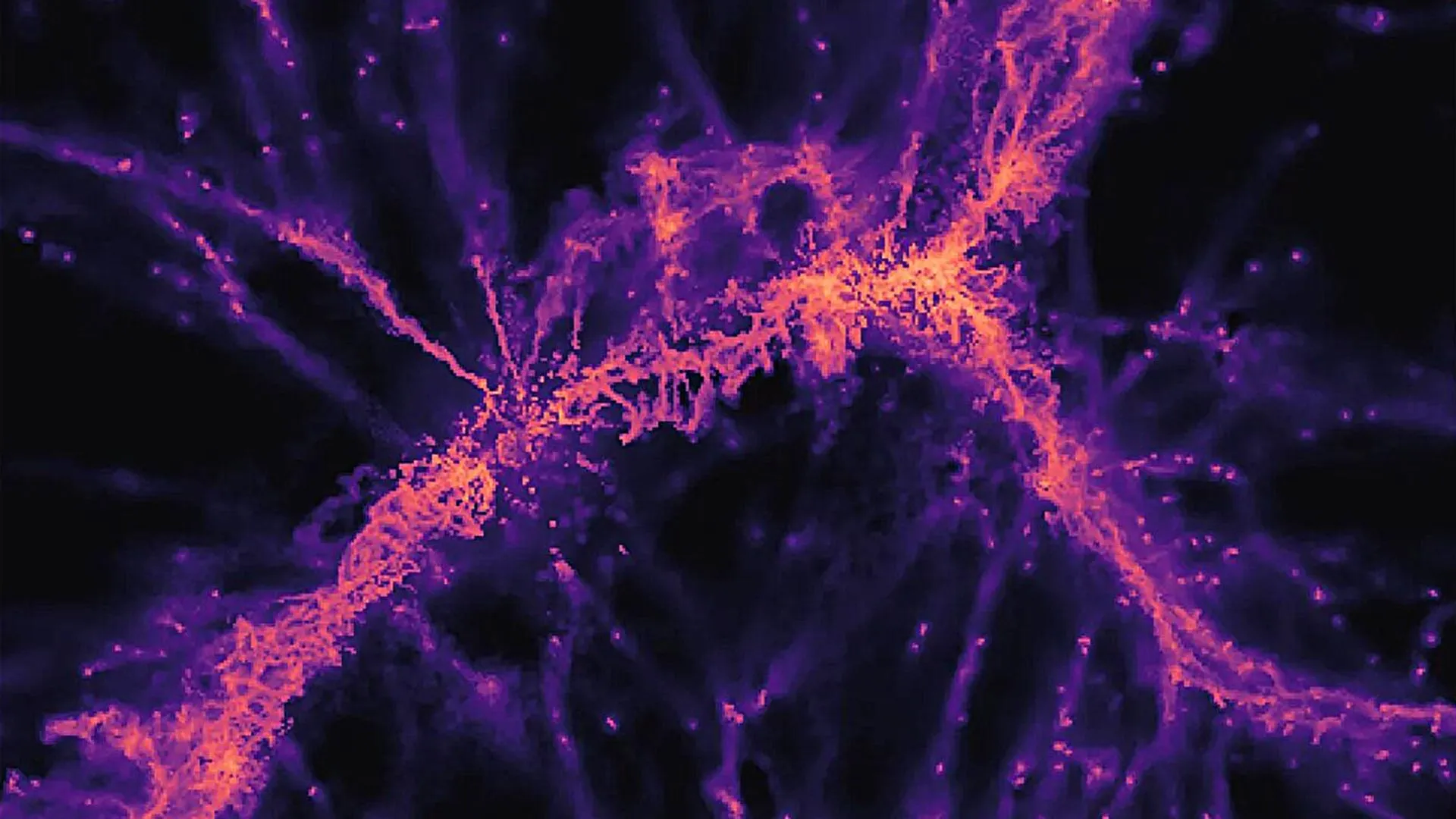
The cosmic web is the largest organized structure in the universe. Dark matter, which makes up about 27% of all mass-energy, condenses under gravity into a network of filaments separated by voids hundreds of millions of light-years across; ordinary gas falls along those filaments and ignites the first generations of stars and galaxies at their intersections. Before JWST, the highest-redshift maps of this scaffolding were derived indirectly from quasar absorption lines, with relatively coarse resolution. The new COSMOS-Web data, by contrast, uses photometric redshifts measured directly from the spectral energy distributions of every galaxy in the survey, producing what the team calls a "density tomography" of the first two billion years of cosmic time.
"This jump in depth and resolution is truly significant," said co-author Bahram Mobasher, a distinguished professor of physics and astronomy at UC Riverside, in a statement released by his university. "Astronomers can now see the cosmic web at a time when the universe was only a few hundred million years old." The dataset reveals that galaxy clusters were already beginning to assemble at intersections of dense filaments far earlier than the standard cold-dark-matter model had predicted, hinting that the first generations of dark-matter halos collapsed more quickly than simulations have been able to reproduce. The team measured a clustering signal — a statistic called the two-point correlation function — that is roughly 15% stronger at redshift 7 than in the leading Illustris-TNG cosmological simulations.
Following the open-science protocols increasingly required by NASA's Astrophysics Division, the COSMOS-Web team has released the full data pipeline, the catalog of 164,000 galaxies, the cosmic density maps and an animated evolution video on a public GitHub repository. The team is now using its catalog to hunt for the rare "dark galaxies" predicted by cold-dark-matter theory — gas-rich halos that never formed stars — and to look for evidence of the very first supermassive black holes seeding the densest knots of the web. The Vera C. Rubin Observatory, which begins science operations later this year, is expected to push the cosmic-web map even deeper by adding optical photometry from billions of galaxies.