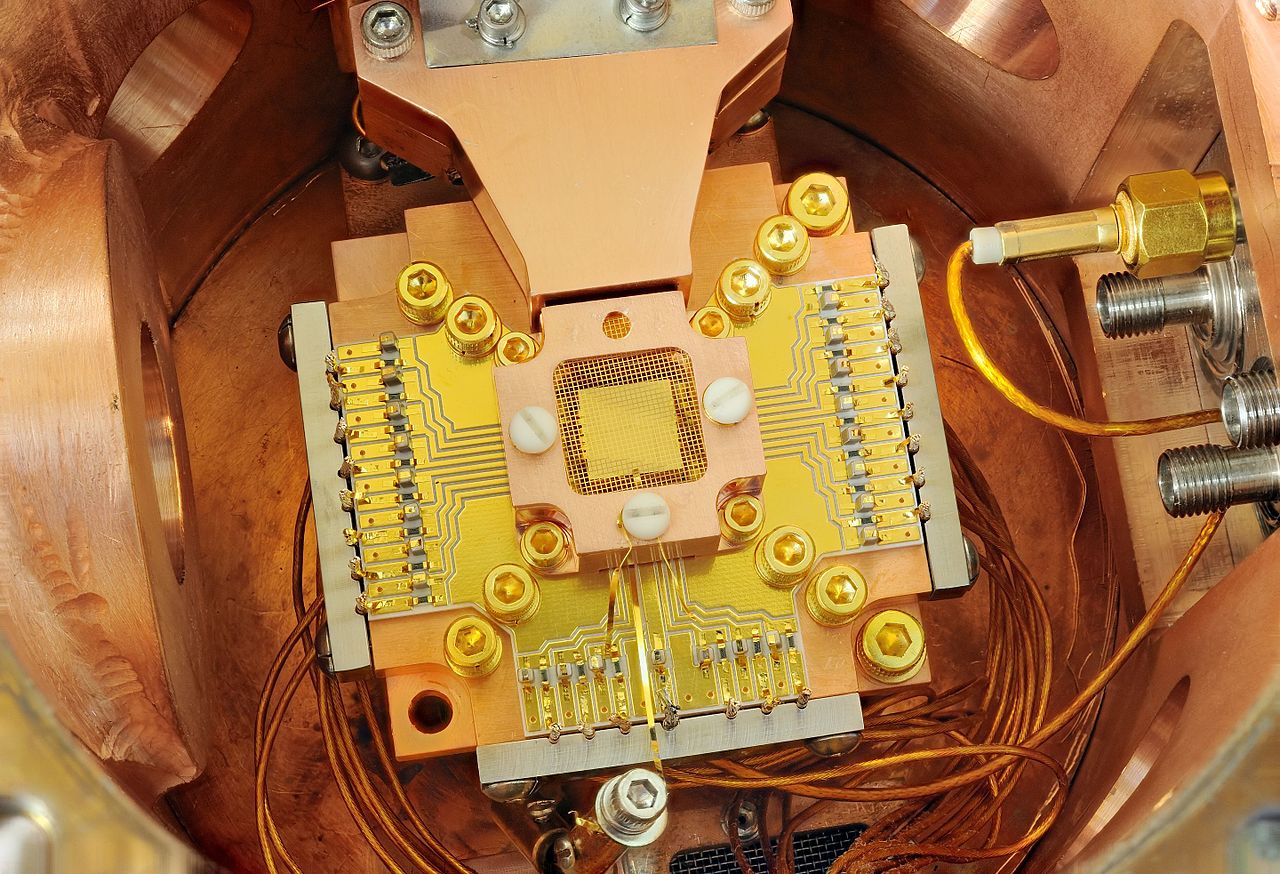
Adelaide Engineers Fix a Flaw in SQUID Quantum Sensors With 'Bare Loops'
The design swaps some superconducting loops for ones with no Josephson junctions, letting ultrasensitive magnetic detectors find true zero field without losing sensitivity.
Topic
18 stories from Planck Standard. Latest: October 29, 2026.

The design swaps some superconducting loops for ones with no Josephson junctions, letting ultrasensitive magnetic detectors find true zero field without losing sensitivity.

Japanese researchers used nitrogen-vacancy centers as atomic-scale sensors to measure several components of the stress around a dislocation for the first time.

Fraunhofer researchers put nitrogen-vacancy diamond inside a laser cavity and read the magnetic field from the laser's output instead of its faint glow.

Researchers held a 100-nanometer glass sphere in a laser trap and registered the momentum from individual krypton, xenon and sulfur hexafluoride hits, particles 10 million times lighter than the sphere.

Researchers in Scotland and Japan optically detected spin resonance in a metal-organic framework for the first time, opening a route to molecular-scale sensors.

Ultraviolet nanosecond pulses added fresh light-emitting flaws in a diamond crystal without disturbing the nitrogen-vacancy centers used in quantum sensors.

Guiding cesium atoms along a 420-nanometer fiber lets a quantum motion sensor keep working through jolts that would break a free-falling version. A new silicon-pinned membrane design solves the heat problem that stalled the idea for decades.

The levitated sensor can register a nudge one-hundredth the width of an atom. Over a month of quiet nights it saw nothing — and that silence rules out a swath of ultraheavy dark matter nine orders of magnitude wide.

The device hits 32 femtoteslas per root hertz at room temperature — no liquid helium, no shielded room. The trick was killing 70% of the thermal noise with a graphite plate.

University of Chicago researchers discovered an elegant way to generate complex entangled quantum states without complicated hardware, potentially advancing quantum computing and sensing technologies.

A University of Chicago team showed that giving paired atoms opposite energy shifts can conjure complex entangled states using only standard lab tools and tunable lasers.
A superconducting calorimeter at Aalto University detected just 0.83 zeptojoules — a sensitivity that could sharpen quantum computers and even help hunt for dark matter.
By combining two precisely controlled forces on a single trapped ion, researchers demonstrated an elusive way to manipulate quantum uncertainty that could expand quantum sensing and computing.

By layering two non-commuting forces on a single calcium ion, the team can flip a quantum oscillator between standard squeezing, trisqueezing and quadsqueezing in microseconds, unlocking a new toolkit for quantum sensing, simulation and bosonic error correction.

Breakthrough quantum sensing approach using Rydberg atom chains could dramatically improve measurement of low-frequency electric fields while enabling ultra-compact detectors.
Revolutionary quantum sensing approach using Rydberg atoms could lead to ultra-compact detectors with micrometer-scale resolution.
New quantum sensing method using Rydberg atoms could dramatically improve measurement capabilities while enabling compact detector designs.
Breakthrough quantum sensing approach using Rydberg atom chains could dramatically improve low-frequency electric field measurements with compact, highly accurate detectors.