Diamond Laser Magnetometer Hits 100% Optical Contrast, Boosting Sensitivity Up to 590-Fold
Fraunhofer researchers put nitrogen-vacancy diamond inside a laser cavity and read the magnetic field from the laser's output instead of its faint glow.

Researchers at the Fraunhofer Institute for Applied Solid State Physics in Germany have built a diamond magnetic-field sensor that reads its signal from laser light rather than from faint fluorescence, and they report a large jump in sensitivity.
The paper, "Laser-enhanced quantum sensing boosts sensitivity and dynamic range," appeared in Nature Communications. Florian Schall, a quantum-sensing researcher at Fraunhofer IAF, is the lead author. Phys.org covered the work on October 22.
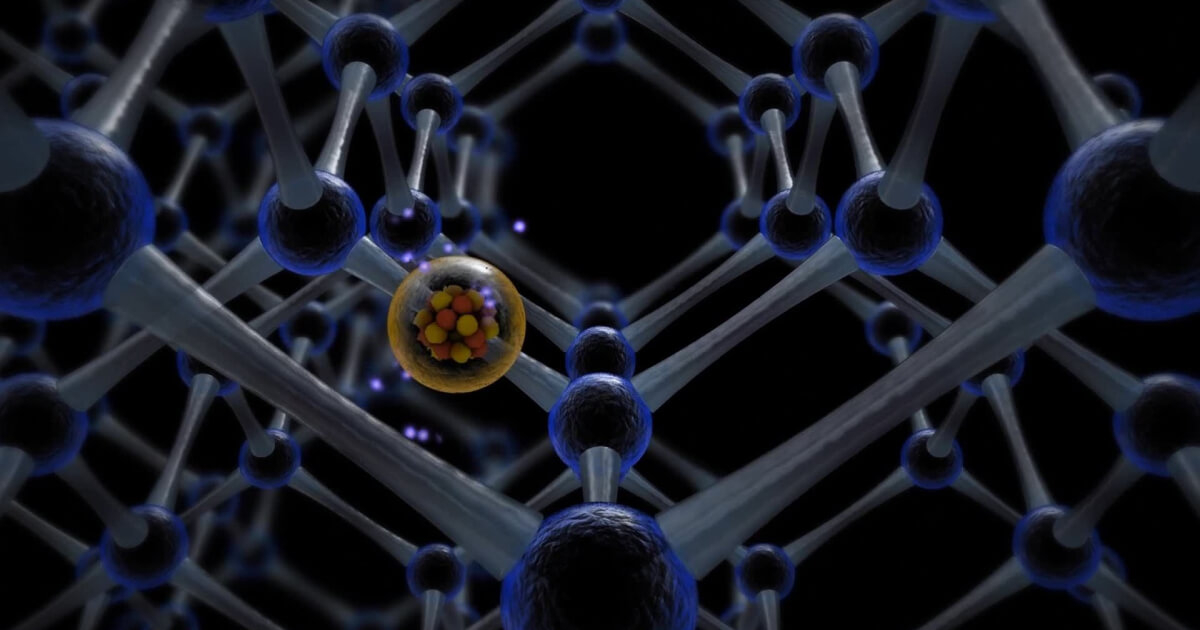
The sensors rely on nitrogen-vacancy centers, tiny atomic defects in diamond whose quantum properties shift with the surrounding magnetic field. In the usual approach, scientists shine light on the diamond and measure the fluorescence it gives off. The contrast between the bright and dark states is only a few percent, which limits how finely the sensor can resolve a field.
The Fraunhofer team instead placed the diamond inside a laser cavity, where the defects act as a loss channel that depends on the magnetic field. The sensor reads the laser output itself. The group, which is led by Jan Jeske, the head of the Quantum Sensing Group, uses a method called laser threshold magnetometry. Jeske developed the first theoretical model for this kind of magnetic-field-dependent diamond laser about a decade ago.
The reported optical contrast reaches 100 percent. Output power rises to as much as 50 milliwatts, well above conventional fluorescence readout. The sensitivity falls below 400 femtotesla per square root of hertz for each of the three vector components, assuming photon shot noise is the dominant source of error. The ratio of sensitivity to dynamic range improves by up to 590 times compared with conventional fluorescence-based diamond sensors and vapor-cell magnetometers, while the device keeps the ability to measure the field as a vector.
The paper also reports what the authors describe as the first experimental evidence that sensitivity improves faster than linearly as optical contrast approaches 100 percent. Schall said the approach "could resolve a trade-off that has long limited the development and application of magnetic-field sensors." Jeske said he was "very pleased that we have now experimentally demonstrated the magnetic-field-dependent shift" that his earlier theory predicted.
The trade-off Schall refers to is between sensitivity and dynamic range: sensors that detect very small fields tend to break down when the field is large, and vice versa. Recent diamond sensors have reached the sub-picotesla range, which matters for detecting heart signals.
The authors see uses in biomagnetic sensing of the heart, muscles and brain, in navigation that relies on magnetic fields, and in finding magnetic anomalies for resource exploration and security. These are projections rather than demonstrations, and the device is still a laboratory result.