Würzburg Physicists Built the First Semiconductor Maser That Runs Nonstop Above Room Temperature
By punching deliberate atomic holes in silicon carbide and exciting the leftover spins with a laser, the team made a coherent microwave source that needs no cryogenics — and doubles as a magnetometer sensitive to 20 trillionths of a tesla.

The maser came first. Charles Townes built one in 1953, five years before anyone made a laser, and it has spent the seven decades since as the laser's inconvenient older sibling — capable of producing microwave radiation of extraordinary purity, and almost always requiring liquid helium to do it. Physicists at Julius-Maximilians-Universität Würzburg have now reported the first semiconductor maser that runs continuously above room temperature.
The device is built from silicon carbide, a common industrial semiconductor, with atomic defects deliberately introduced into the crystal. Specifically, the team removes silicon atoms from the lattice, leaving vacancies. The electrons around each vacancy have a spin, and those spins behave like isolated quantum systems even while embedded in a bulk solid at ordinary temperatures — the property that makes silicon carbide defects attractive for quantum sensing.
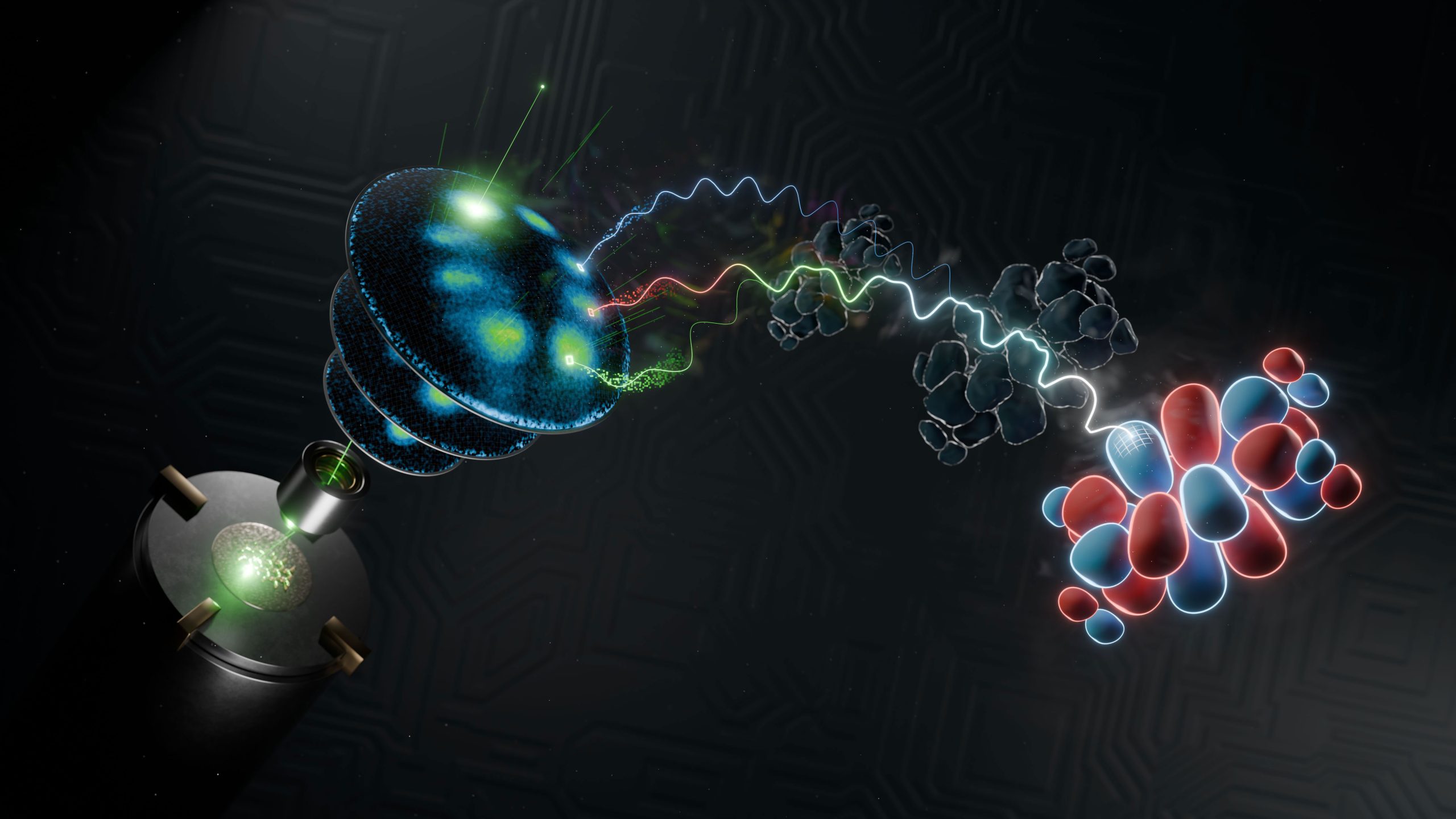
Shining a laser on the crystal drives those spins into an excited state. Placed inside a high-quality microwave resonator and held in a magnetic field, the excited spins dump their energy as coherent microwave radiation. "Using light, we can bring the spins into an excited state in which they emit coherent microwave radiation or amplify it," said Andreas Gottscholl, the study's first author. The work was carried out at the university's Chair of Experimental Physics 6 under Professor Vladimir Dyakonov and Privatdozent Dr. Andreas Sperlich, and published Wednesday in Nature Communications.
The word "or" in that sentence is doing real work. The same device operates in two modes: as a source that generates microwaves, and as an amplifier that boosts an incoming microwave signal while adding almost no noise of its own. Low-noise microwave amplification is the bottleneck in deep-space communication, radio astronomy and radar — the reason existing maser amplifiers are worth their cryogenic plumbing. A version that works on a bench at room temperature changes where those amplifiers can be installed.
The team also measured the device's sensitivity as a magnetometer and found it can resolve magnetic fields of roughly 20 picotesla — 20 trillionths of a tesla — at room temperature. That is fine enough to be interesting for navigation systems that work by reading the Earth's magnetic field rather than by receiving GPS signals, which matters anywhere satellite navigation is jammed, spoofed or simply unavailable.
Two constraints remain before this becomes a component rather than an experiment: the maser still needs an external magnetic field and a high-quality resonator, and it still needs a laser to pump it. The Würzburg group's stated target is an electrically driven maser diode fabricated directly on a chip — the same transition that turned the laser from a laboratory apparatus into something in every phone, disc drive and fiber-optic transmitter. Silicon carbide is already manufactured at industrial scale for power electronics, which means the material supply chain for that step exists.