Engineers Discover That Magnetic Films Obey Graphene's Laws — Opening the Door to Micrometer-Scale Microwave Circulators
A University of Illinois team etched hexagonal hole patterns into thin magnetic films and found that spin waves inside follow the same massless-particle equations as electrons in graphene, enabling a new class of micrometer-scale microwave devices that could transform 6G hardware and quantum computing control circuits.

Engineers at the University of Illinois Urbana-Champaign have discovered that thin magnetic films, when structured with a hexagonal pattern of holes mimicking graphene's famous honeycomb lattice, follow the same fundamental mathematical equations as electrons in graphene — and in doing so, exhibit the same exotic quantum behaviors that have made graphene one of the most scientifically productive materials of the past two decades. The findings, published in Physical Review X, open a new pathway for building miniaturized microwave devices at the micrometer scale using magnetic spin waves rather than electrons.
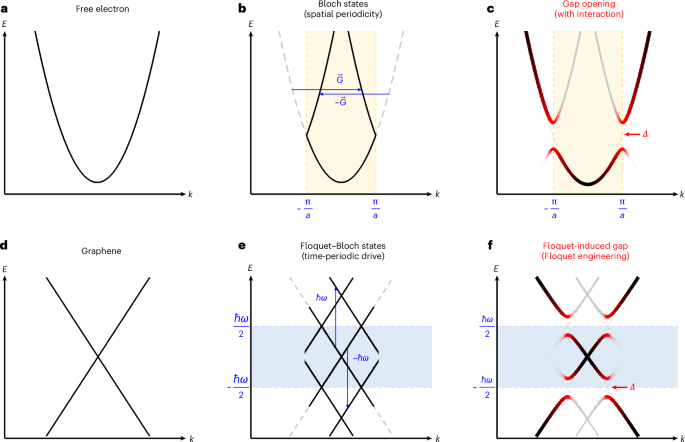
Graphene — the single-atom-thick sheet of carbon arranged in a hexagonal lattice — was first isolated by Andre Geim and Konstantin Novoselov at the University of Manchester in 2004, earning them the Nobel Prize in Physics in 2010. Its most famous property is that electrons within it behave as though they are massless, traveling at a significant fraction of the speed of light and following relativistic quantum equations rather than ordinary Newtonian physics. This makes graphene's electrons extraordinarily fast and nearly impossible to backscatter, giving the material its remarkable conductivity. The UIUC team, led by researchers in The Grainger College of Engineering, showed that spin waves — collective oscillations of magnetic moments in a ferromagnetic material, also called magnons — can be engineered to obey the same mathematical equations.
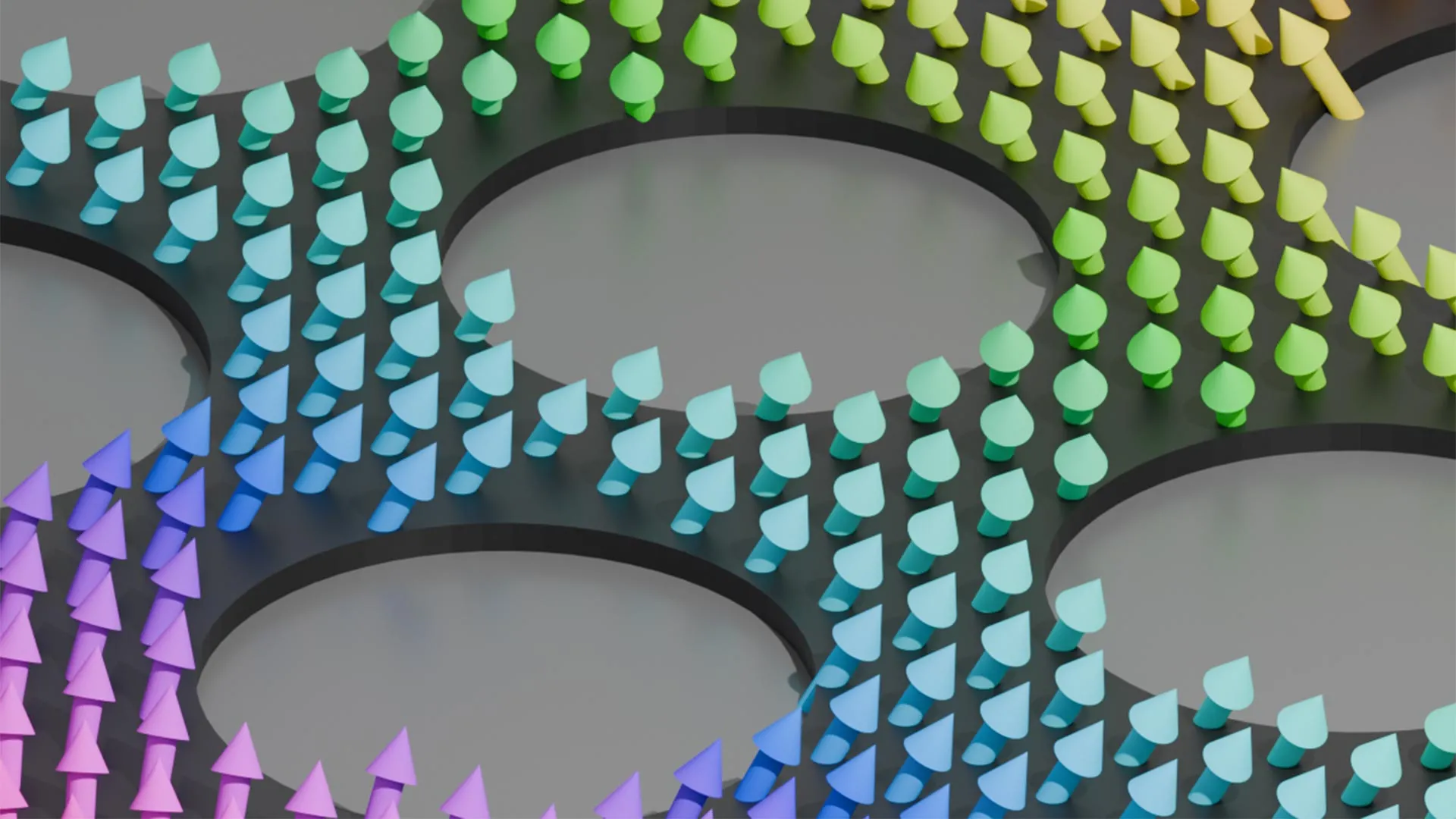
The key design insight was that the physical structure of the magnetic film, not its chemical composition, determines whether spin waves follow graphene-like equations. By etching a hexagonal array of holes into a thin cobalt or permalloy film — creating a two-dimensional magnonic crystal with the same spatial symmetry as graphene's honeycomb lattice — the researchers caused magnon energy bands to adopt the same mathematical structure as graphene's electronic bands, including a pair of touching Dirac cones at the K and K-prime points of the Brillouin zone. Magnons moving through this lattice then become effectively massless, just like graphene's electrons. The system exhibits nine distinct energy bands, enabling complex behaviors including topological edge states where spin waves propagate along the material's edges without scattering from imperfections.
The practical application with the most immediate commercial relevance is the microwave circulator — a device that allows microwave radio signals to propagate in only one direction, blocking them from traveling in reverse. Circulators are essential components in radar systems, cellular base stations, satellite communications, and quantum computing microwave control circuits, where they prevent signal reflections from disrupting qubit operations. Current circulators are made with bulk ferrite materials and are typically centimeter-scale devices; they are difficult to miniaturize and almost impossible to integrate directly onto semiconductor chips. The UIUC team's magnonic circulator design is inherently micrometer-scale and could, in principle, be fabricated directly on a silicon wafer alongside conventional electronics — a 100- to 1,000-fold reduction in device footprint.
The researchers plan to build and test a physical prototype of the magnonic circulator using standard nanofabrication techniques available at UIUC's Beckman Institute for Advanced Science and Technology. If the device performs as simulations predict, it would have major implications for next-generation wireless communication systems — including 6G networks, where component density and power consumption at the base station level are critical design constraints. The connection between condensed matter physics and magnonics remains largely unexplored, and the team noted that other graphene phenomena — including Klein tunneling and the anomalous quantum Hall effect — may also be reproducible in engineered magnonic systems, suggesting a broad new research program at the intersection of quantum materials and microwave engineering.