Harvard Physicists Wrapped a Diamond Qubit in a Continuous Sound Wave and Tripled How Long It Holds a Quantum State. The Same Vibrations Can Also Carry the Information Between Chips.
Marko Lončar's lab 'dressed' a silicon-vacancy spin with phonons instead of microwave pulses. The technique works inside the phononic cavities that would link nodes of a chip-scale quantum network, letting sound do both jobs at once.
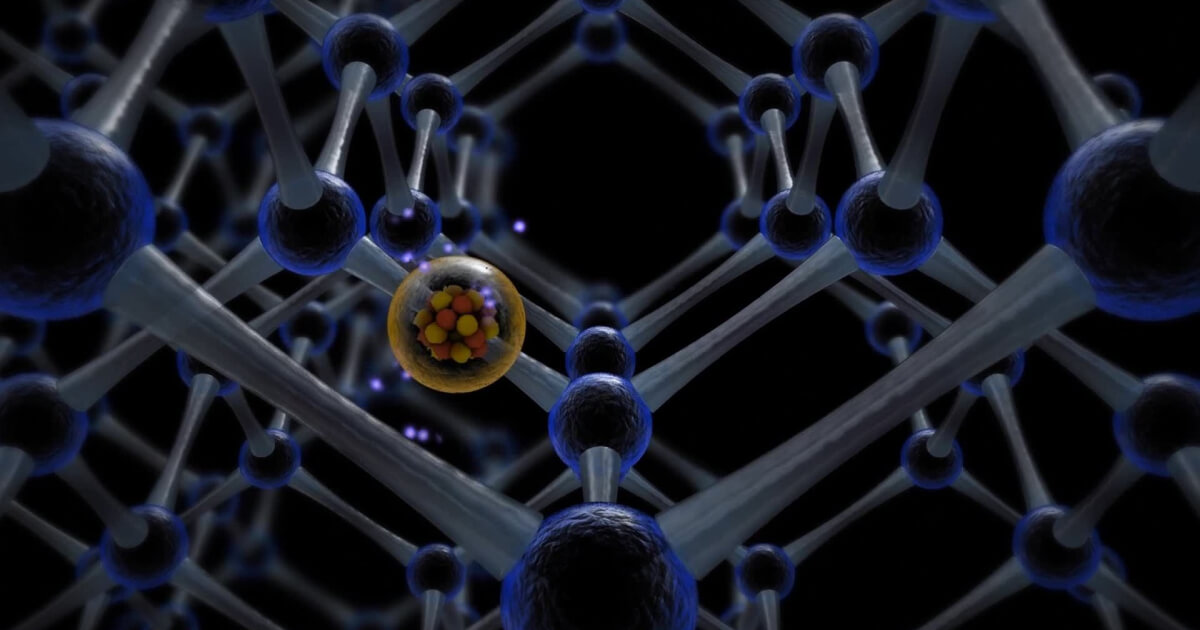
Physicists at the Harvard John A. Paulson School of Engineering and Applied Sciences have shown that a qubit made from a single defect in diamond can be protected from its noisy surroundings using nothing but mechanical vibration, extending the time it holds a quantum state by roughly a factor of three. The work, published in Nature Physics, comes from the lab of Marko Lončar, the Tiantsai Lin Professor of Electrical Engineering, and points toward quantum networks on a chip in which tiny sound waves both carry quantum information and keep it safe.
The qubit in question is a silicon-vacancy center, a spot in the diamond lattice where two carbon atoms are replaced by a single silicon atom, leaving an electron spin that can store a quantum bit. To move information between such spins, the Lončar group has for years used phonons, the quantum particles of sound, trapped in a structure called a phononic cavity that concentrates the vibrations around the defect so they interact strongly with the spin. Phonons have real advantages over light for this job. At a given frequency their wavelength is far shorter, so the components can be much smaller and packed more tightly, and they couple readily to both solid-state spins and electromagnetic fields, which makes them a natural bridge between different kinds of qubits.
The catch has been memory. A qubit sitting in a phononic cavity is exposed to low-frequency noise from its environment, and the standard defense, a sequence of microwave pulses that periodically decouples the spin from that noise, does not work well on a spin housed inside a mechanical cavity. That left researchers stuck choosing between strong coupling to phonons and long coherence times.
The Harvard team's answer was to drive the spin continuously with the mechanical field itself. Under a steady acoustic drive, the qubit becomes what physicists call a "dressed" state, one that is effectively wearing the sound field, and dressed states are far less sensitive to slow environmental fluctuations. Because the protection comes from the same kind of mechanical field the cavity already supports, it can operate inside the structures that would eventually link stationary nodes of a network. "We are solving two problems," said Eliza Cornell, who led the experiments as a Ph.D. student in the Lončar lab and is now a postdoctoral researcher at Boston University. "We want the spin to have strong interaction with phonons, and we want the spin to have a long coherence time. Our paper demonstrates a method of extending the coherence time that is compatible with the silicon-vacancy center being in a cavity."
The experiments were led by Cornell and Zhujing Xu, a former postdoctoral scholar in the group, with co-authors Zhaoyou Wang, Hana K. Warner, Eliana Mann, Michael Haas, Smarak Maity, Graham Joe, Liang Jiang, Peter Rabl and Benjamin Pingault. The measured threefold extension of coherence establishes that continuous-wave mechanical noise suppression works in a real device, not only in theory. The research was supported by the National Science Foundation, the Air Force Office of Scientific Research and Q-NEXT, a Department of Energy quantum research center, and Harvard's Office of Technology Development is pursuing patents on the technique.
The result gives phonons a dual role in any future sound-based quantum network: shuttling quantum information between spin memories and, at the same time, shielding those memories from the noise that would otherwise erase it. That combination is what a compact, hybrid quantum system built on a single chip would need.
Originally reported by Harvard SEAS.