A Diamond Keeps Terrible Time Because It Feels Temperature
Physicists Fixed That by Listening to the Nitrogen Nucleus Too.
Reading two quantum signals at once cut thermal drift by roughly a factor of ten. Over 2.3 days, the prototype beat a standard rubidium clock by about 200-fold.

A clock built out of a diamond has one great advantage and one disqualifying flaw. The advantage is that it is a solid chip — no vacuum chamber, no laser-cooled cloud of atoms floating in the middle of a room-sized apparatus. The flaw is that it notices the weather.
Researchers in the United States and Germany have now largely removed the flaw. Writing in Physical Review Applied, they describe a temperature-compensated diamond clock that reduces thermal drift by roughly an order of magnitude by reading two quantum signals from the same defect at the same time.
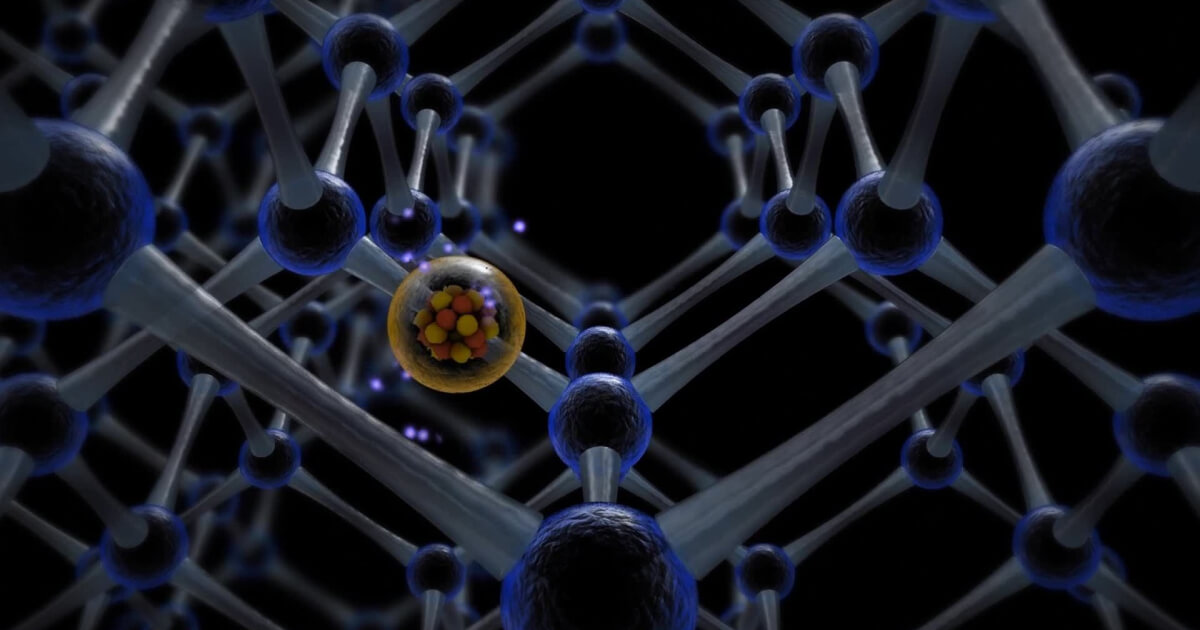
The defect is a nitrogen-vacancy center: a spot in the diamond lattice where a carbon atom has been replaced by nitrogen and its neighbor is simply missing. That pairing traps electrons whose spin states are separated by a very precise energy gap, and microwaves tuned to that gap give you a tick. It is an excellent tick with one problem. The energy splitting that defines it — the parameter physicists call D — shifts by 25.3 parts per billion for every millikelvin of temperature change. A room warming by a fraction of a degree is enough to knock the clock off.
The fix is to stop relying on that one number. The nitrogen nucleus sitting in the vacancy has its own structure, a nuclear quadrupole splitting known as Q, and it responds to temperature differently than D does. Measure both simultaneously and the temperature term can be solved for and subtracted out. The clock effectively carries its own thermometer, built from the same atom it uses to keep time, so there is no lag between the temperature changing and the correction arriving.
The prototype ran for 10 days at room temperature with no thermal shielding of the kind precision timekeeping normally demands. Fractional instability stayed below 5 × 10⁻⁹ at 200 seconds and below 1 × 10⁻⁸ out to 200,000 seconds — about 2.3 days. Against a standard rubidium vapor-cell clock using only the electronic transition, that is roughly a fourfold improvement on the short timescale and about 200-fold on the long one. The long-timescale number is the interesting one: drift over days is exactly where temperature normally dominates, and it is where the compensation does the most work.
The researchers' conclusion is blunt: temperature is no longer the dominant source of instability in this device. That reopens a design space. Rubidium clocks anchor GPS receivers, cell towers and financial timestamping systems because they are compact and cheap enough to deploy in volume, and their weakness is exactly the slow thermal wander this work targets. A solid-state clock in a diamond chip has no gas cell to leak, no atoms to lose and no warm-up ritual, and the same NV centers already serve as magnetometers and quantum sensors.
None of this competes with an optical lattice clock in a national metrology lab, where instabilities are twelve orders of magnitude smaller. The comparison that matters is with the clocks that go in the field, where the enemy is not quantum noise but a room that warms up in the afternoon.