Thorium-229 Settles Into Four Different Spots Inside a Crystal. Only Some of Them Can Keep Time
An Okayama University team adapted Mössbauer spectroscopy to use ultraviolet laser light instead of gamma rays, and mapped every seat the nucleus can take.

A team led by Takahiro Hiraki at Okayama University has taken a technique physicists have used since the 1950s and run it with visible-adjacent light instead of gamma rays, producing what amounts to a seating chart for the nucleus at the center of the race to build a nuclear clock. The work was published in Science.
The technique is Mössbauer spectroscopy. Inside a solid, atomic nuclei do not sit in perfectly uniform surroundings; neighboring atoms generate tiny electric fields that nudge nuclear energy levels by minute amounts. Measure those shifts and you can read the local structure around each nucleus. Chemists and geologists have relied on it for decades, using gamma rays to make the nuclei absorb and re-emit.
Nuclear clocks are the reason anyone wants to do this with thorium. Today's best timekeepers are atomic clocks, which track transitions between energy levels of an atom's electrons. Electrons sit on the outside of the atom, where stray electric and magnetic fields can reach them, and that sensitivity ultimately limits precision. A clock that ticks on a transition inside the nucleus would be far better insulated. The obstacle has always been energy: nuclear transitions normally require gamma-ray lasers, which do not exist.
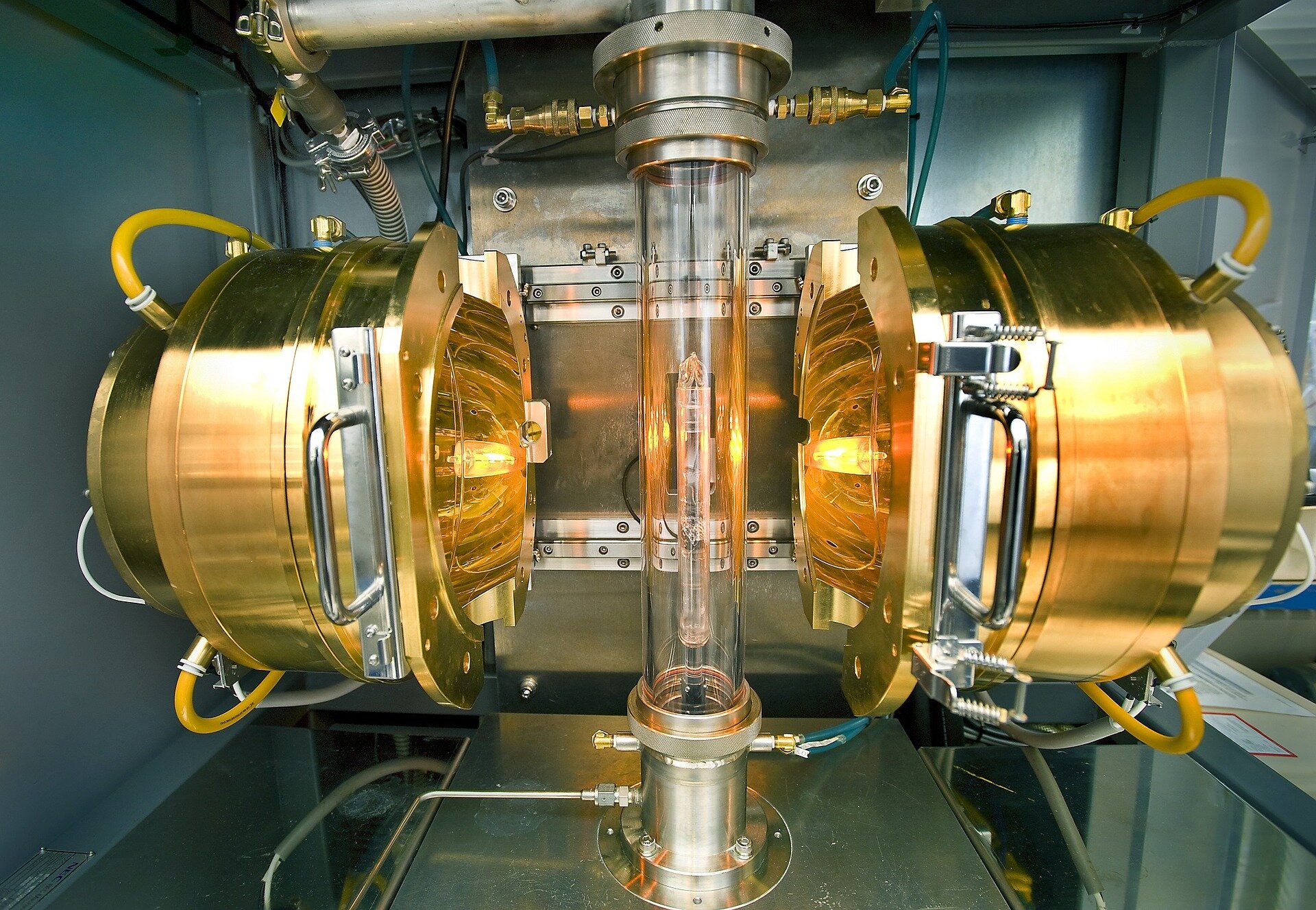
Thorium-229 is the exception. Its lowest nuclear transition sits at an unusually low energy, reachable with an ultraviolet laser. Hiraki's team doped thorium-229 into calcium fluoride crystals and probed it with a narrow, tunable vacuum-ultraviolet laser — Mössbauer-style analysis, but with light a laboratory can actually produce.
What they found is that the thorium ions do not all sit in the same place. The nuclei settle into four distinct positions within the crystal lattice, and each position leaves its own fingerprint in the surrounding electric field. By tuning the laser to address one site at a time, the researchers could selectively excite thorium nuclei at a chosen location, measure how long the excited state survived before decaying, and observe how laser light itself accelerated that decay.
That distinction matters more than it might sound. A working nuclear clock needs its thorium atoms sitting in a uniform, predictable environment; if different nuclei experience different local fields, they tick at slightly different rates and the clock's frequency smears. Some of the four sites produce lopsided electric fields that would introduce exactly that error. Others do not.
By characterizing the structure and behavior of each site, the team has effectively handed future clock builders a map: which crystal environments to target, and which to avoid. That is the practical bottleneck between the current state of the art — a nuclear transition that can be driven by laser — and a device precise enough to be useful.
The eventual payoff is not just better timekeeping. Clocks this precise become instruments for fundamental physics, sensitive enough to test whether constants of nature drift over time and to probe for new interactions. And because the thorium transition can be driven with ultraviolet light, a nuclear clock is a plausible candidate for something built on a single chip rather than filling a laboratory. The preprint is posted on arXiv as 2509.00041.