Physicists Filmed an Electron-Hole Pair Shrink by a Quarter in 400 Quadrillionths of a Second
A Graz-led team used time-resolved photoemission orbital tomography to reconstruct an exciton's wave function frame by frame — the first instants of light turning into electricity inside an organic semiconductor.

When light hits a solar cell, the first thing that happens is not electricity. It is an exciton — an electron knocked into an excited state, still bound by electrostatic attraction to the positively charged hole it left behind. Everything a solar cell does afterward depends on whether that pair can be pulled apart before it collapses back together. Until now, nobody had watched the pair itself change shape in real time.
A team led by Peter Puschnig at the University of Graz, working with colleagues at Marburg University and Forschungszentrum Jülich, has done exactly that, and published the result in Physical Review X. Working in an organic semiconductor, they found that a freshly created exciton initially spreads across roughly three molecules — and then contracts by about 25% within the first 400 femtoseconds. A femtosecond is a quadrillionth of a second; 400 of them is the time it takes light to cross about a tenth of a millimeter.
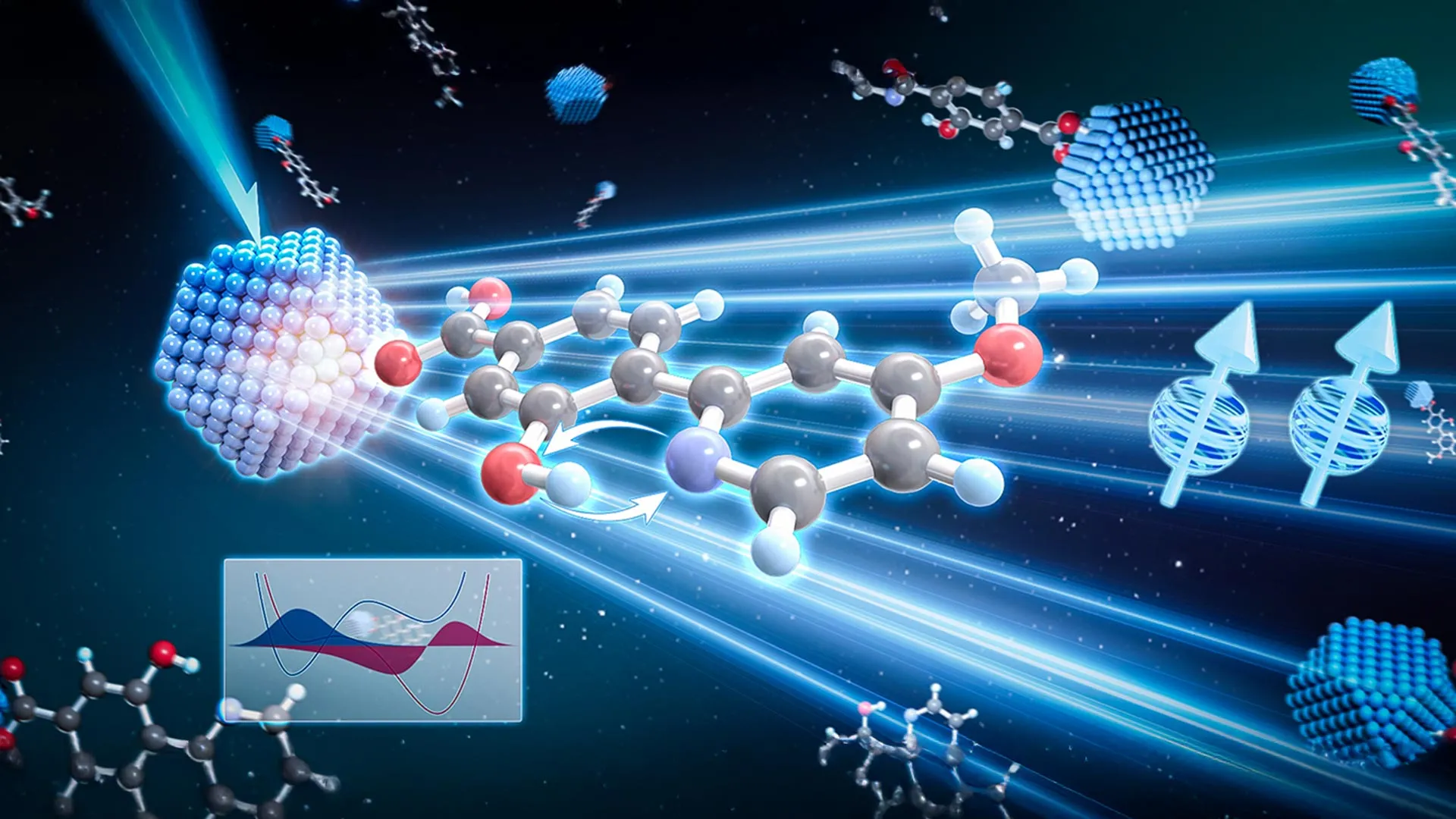
The technique is called time-resolved photoemission orbital tomography, or POT. An ultrashort light pulse creates the exciton. A second, higher-energy ultraviolet pulse then arrives and ejects an electron from the sample. By measuring that electron's energy and the direction it flew off in, and repeating the measurement across many events, the researchers reconstruct the quantum-mechanical wave function of the excited state at one instant.
Sliding the delay between the two pulses turns single frames into a sequence. "By varying the time delay between the excitation and the subsequent laser pulse, one obtains different snapshots of the exciton, which can be pieced together to form a video of the quantum world," Puschnig said. The samples themselves were grown by Stefan Tautz's group at Jülich, which has spent years learning to deposit organic molecular films flat and ordered enough that the emitted electrons carry clean angular information.
The contraction is the physically interesting part. An exciton that shrinks binds more tightly, which makes it harder to split into a free electron and a free hole — the step that actually produces current. Organic photovoltaics have long underperformed silicon in part because so much absorbed light ends up in excitons that recombine before they can be separated. Knowing that the window narrows measurably within the first few hundred femtoseconds tells device designers what timescale their charge-separating interfaces have to beat.
The work is part of "Orbital Cinema," an EU-funded effort to push imaging of electron dynamics to simultaneous sub-nanometer and sub-femtosecond resolution. The immediate applications are organic solar cells and OLED displays, where the same physics governs efficiency in reverse. The broader point is methodological: a wave function, a mathematical object with no direct classical picture, was reconstructed from experimental data at a series of moments and played back in order.