Strong Magnetic Fields Could Let White Dwarfs Grow to 2.4 Times the Sun's Mass, Simulations Show
Indian Institute of Science physicists followed a magnetized star from birth to white dwarf and found it can far exceed the famous 1.4-solar-mass Chandrasekhar limit, with consequences for the supernovae used to measure the universe.

When a dying star runs out of fuel and sheds its outer layers, its core can collapse into a white dwarf, an extremely dense remnant roughly the size of Earth. For a white dwarf that is neither spinning fast nor strongly magnetized, there is a well-known upper mass limit of about 1.4 times the mass of the sun, called the Chandrasekhar limit. Simulations by physicists at the Indian Institute of Science now show that a strong internal magnetic field can let a white dwarf grow well beyond it.
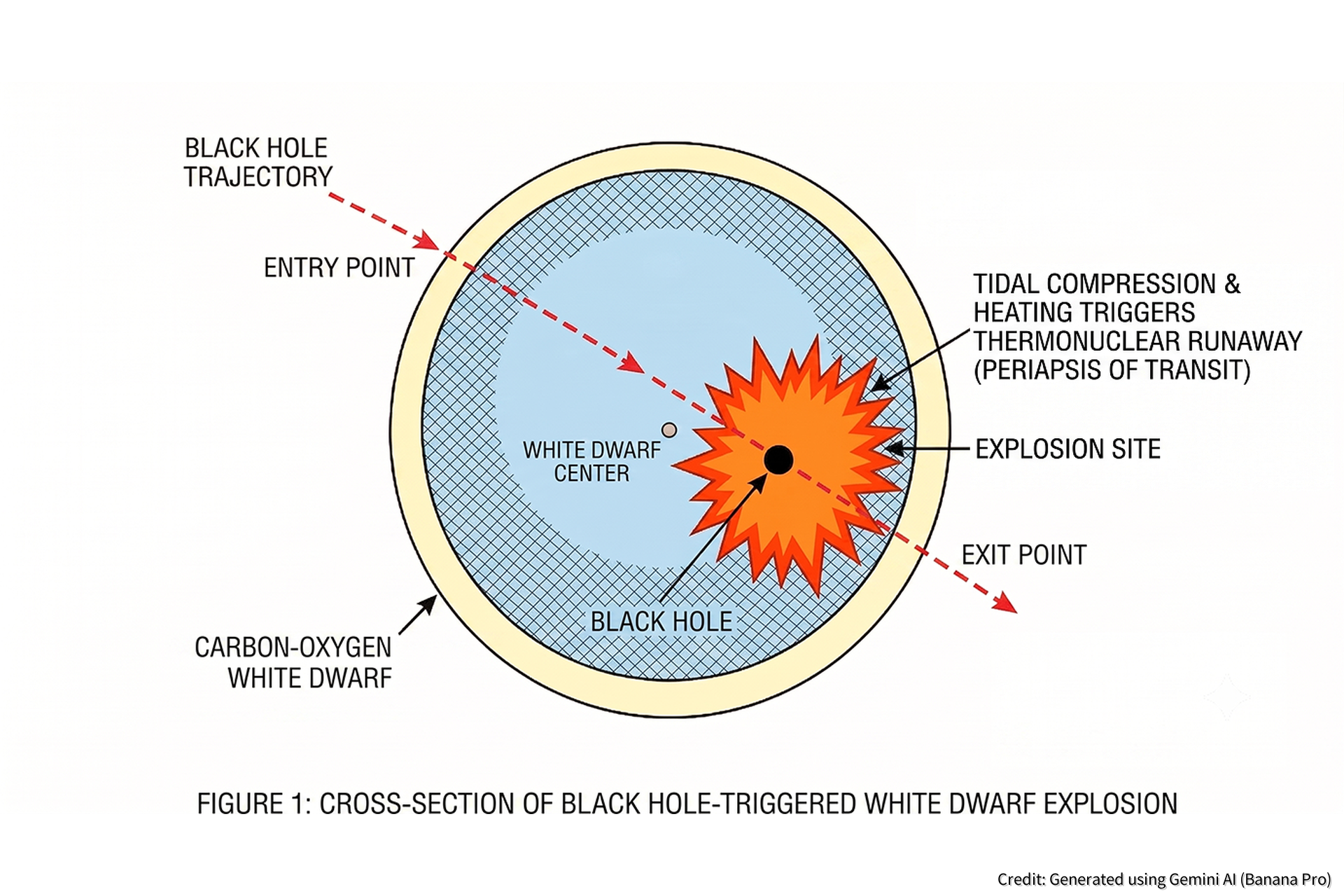
The limit matters because of what happens when a carbon-oxygen white dwarf creeps up to it. Its core can become dense enough to ignite carbon, setting off a thermonuclear explosion known as a Type Ia supernova. If the limit is fixed, the energy of those explosions is fixed too, and astronomers have used that constancy to treat Type Ia supernovae as standard candles for measuring the size and expansion of the universe.
The team, led by Banibrata Mukhopadhyay of the IISc Department of Physics, published the work in The Astrophysical Journal Letters. In one of their simulations, a magnetized carbon-oxygen white dwarf reached about 2.4 times the mass of the sun. "The idea started in 2011, when a summer student came to me and I gave him a problem quite casually: to check whether the Chandrasekhar limit can be violated by a magnetic field," Mukhopadhyay said.
Theorists have predicted such "super-Chandrasekhar" white dwarfs for decades, and unusually bright Type Ia supernovae have hinted at progenitors with masses as high as 2.8 solar masses. The harder question, said first author and Ph.D. student Zenia Zuraiq, was whether a star can actually evolve into one. "Our simulations allowed us to follow that evolutionary pathway from the main-sequence star to the white dwarf and show that under certain conditions, such a pathway is possible," she said.
To do that, the researchers modified STARS, a stellar evolution code developed at the University of Cambridge, adding magnetic field effects and white dwarf cooling. They followed magnetized stars from the long hydrogen-burning phase through to the white dwarf stage, then modeled a binary system in which the white dwarf pulls in matter from a companion star.
The key effect is a feedback loop. A magnetic field that starts out too weak to matter grows more important as the white dwarf gains mass, because the star becomes denser and contracts, which strengthens the field. The stronger field adds pressure inside the star that helps it resist its own gravity and carry more mass. In one model, a white dwarf of 1.02 solar masses, formed from an 8-solar-mass star, gained matter at a rate of one billionth of a solar mass per year. The magnetized version reached a limit of about 2.4 solar masses, while the same star without a magnetic field stopped near 1.4.
The simulations may also explain why some well-observed white dwarfs have larger radii than their low masses would predict, since the same magnetic effect changes the usual relationship between a white dwarf's mass and size. The result also touches cosmology. If some Type Ia explosions come from progenitors with substantially different masses and magnetic properties, that diversity would matter when scientists interpret supernova brightness to study the expansion of the universe. The work is simulation-based, so it shows a possible pathway rather than proof that such stars exist in nature.