A Dead Star Half the Width of Earth Weighs 1.23 Suns. Its Core Is Probably Oxygen and Neon, Not Carbon
Astronomers measured the gravitational redshift of SDSS J0608−0059 and found it sits on the wrong mass-radius curve for an ordinary white dwarf — evidence it came from a single massive star, not a merger.

White dwarfs are what ordinary stars leave behind: a burnt-out core, no longer fusing anything, held up against its own gravity by the quantum pressure of tightly packed electrons. The heavier one is, the smaller it gets. Push the mass high enough and the object stops being stable at all. SDSS J0608−0059 is one of the most massive known — about 1.226 times the mass of the Sun, packed into a sphere roughly half Earth's diameter — and a new analysis argues its interior is made of the wrong elements for a typical white dwarf.
Most white dwarfs are carbon and oxygen, the ash of helium burning in a star that was never massive enough to go further. A smaller population is thought to have oxygen-neon cores, formed when a star heavy enough to ignite carbon fusion still could not reach the mass needed to explode as a supernova. Telling the two apart from the outside is hard, because the surface of a white dwarf reveals almost nothing about what is underneath.
The team, led by Stefan M. Arseneau of Boston University, got at it through gravitational redshift. Light climbing out of a strong gravitational field loses energy, shifting toward the red end of the spectrum by an amount that depends on the ratio of the object's mass to its radius. Measure that shift precisely, combine it with photometry that constrains the radius independently, and the mass follows — without needing an orbit to weigh the star against.
The radius side of the calculation came from stacked photometric surveys: Gaia, SDSS, PanSTARRS and SkyMapper. With mass and radius both pinned down, the researchers compared the star against theoretical mass-radius relations computed for different core compositions. Denser cores sit on different curves, because the composition changes how efficiently the electrons resist compression.
The result favors oxygen and neon over carbon and oxygen, with a Bayes factor of 2.7 — a real preference, but not an overwhelming one. Roughly, the data are about three times more consistent with an O/Ne core than a C/O one, which supports the conclusion without closing the case.
The consequence is a statement about where the object came from. Ultramassive white dwarfs can be built two ways: from a single star of about 8 to 10 solar masses that lost its envelope and stopped just short of a supernova, or from two ordinary white dwarfs that merged. Mergers produce carbon-oxygen cores. An oxygen-neon core points to the single-star route.
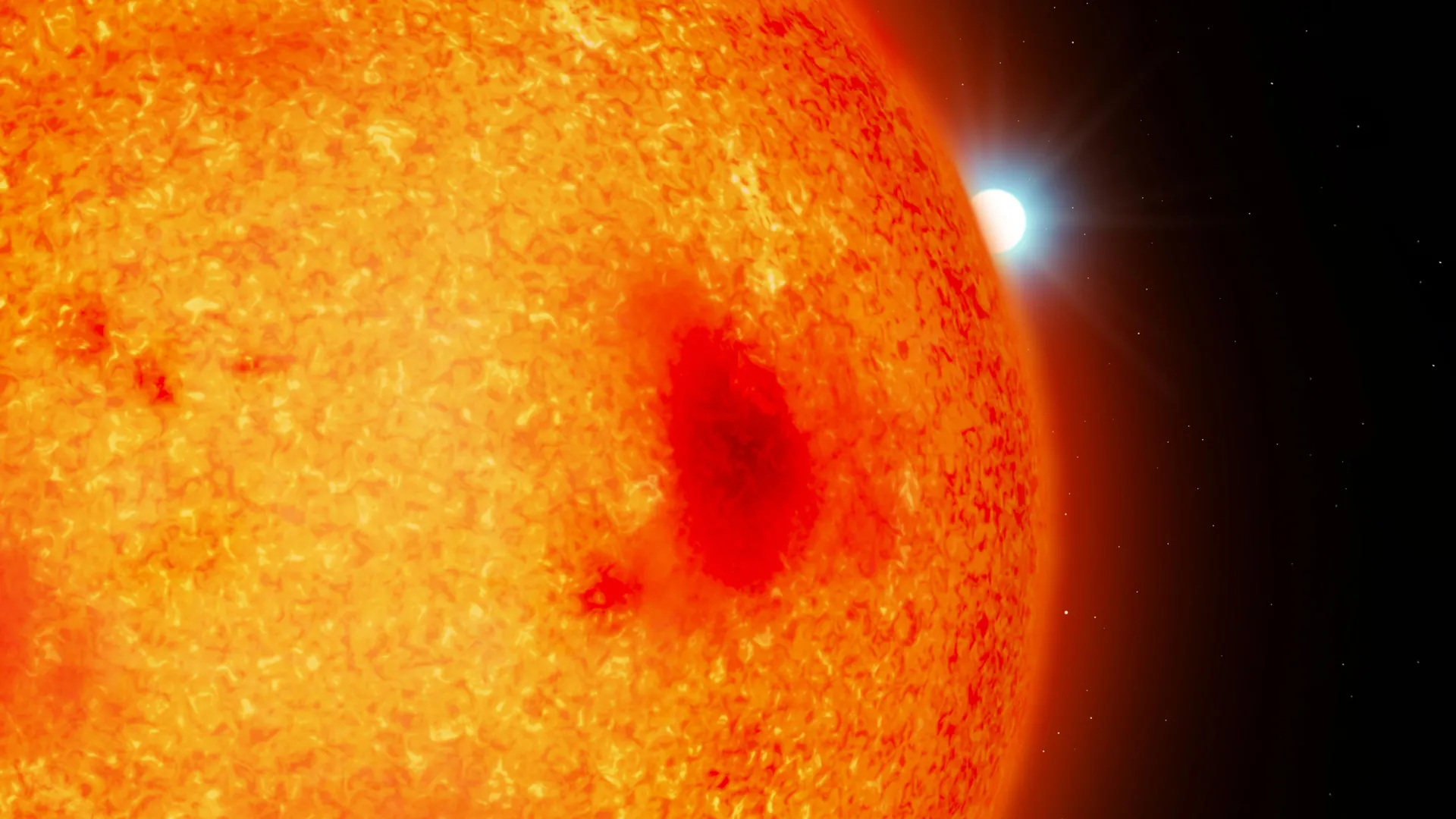
SDSS J0608−0059 has a companion star 2,684 astronomical units away — roughly 2,684 times the Earth-Sun distance — a binary so loosely bound it would not have interfered with the primary's evolution. The findings were published in The Astrophysical Journal.