Why Aging Stars Dim Briefly on the Way to Red Giant: A New Entropy Explanation
An astrophysicist at the Heidelberg Institute for Theoretical Studies proposes the first quantitative trigger for the 'luminosity bump' seen in red giant stars.
Topic
10 stories from Planck Standard. Latest: November 16, 2026.

An astrophysicist at the Heidelberg Institute for Theoretical Studies proposes the first quantitative trigger for the 'luminosity bump' seen in red giant stars.

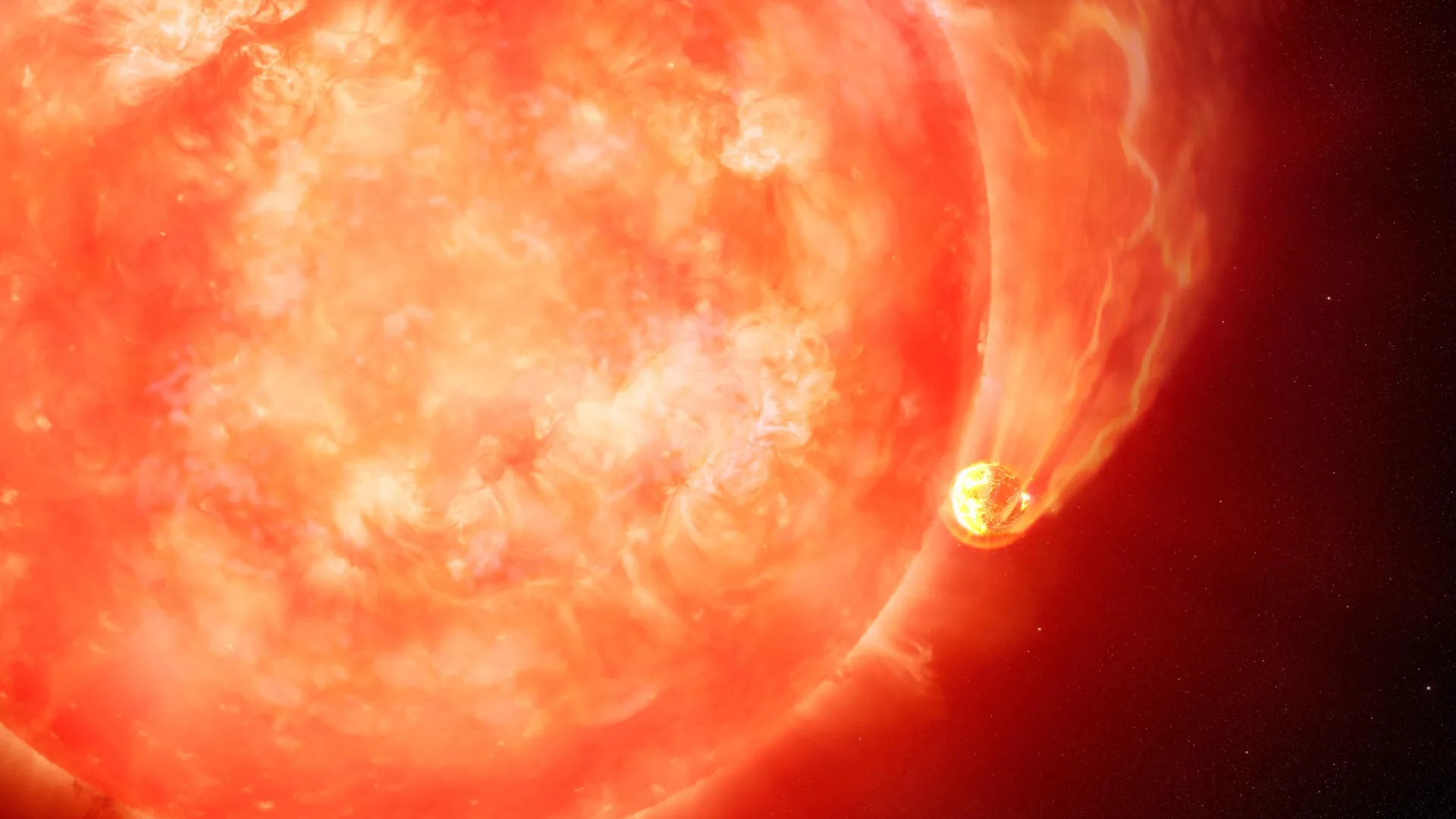
A Turkish astrophysicist ran the sun's evolution with and without an early super-Earth falling in. Only the version that swallowed one matches the sun's sound-speed profile, its convection depth and its missing lithium at the same time.

Astronomers measured the gravitational redshift of SDSS J0608−0059 and found it sits on the wrong mass-radius curve for an ordinary white dwarf — evidence it came from a single massive star, not a merger.

A Caltech astrophysicist calculates that lopsided eruptions from bloated, dying sun-like stars act like thousands of tiny rocket thrusts, nudging the stars to speeds of about a kilometer per second.

UCL and University of Warwick astronomers found that close-in giant planets are three times rarer around evolved red giants than younger post-main sequence stars, providing the strongest statistical evidence yet that aging stars systematically consume nearby worlds.

Advanced simulations reveal how stellar rotation drives material mixing in red giant stars, explaining decades-old chemical observations.
New simulations reveal stellar rotation drives material transport across previously unexplained barriers inside red giant stars.
New 3D simulations reveal how stellar rotation dramatically boosts element mixing across previously impenetrable barriers inside massive stars.
Advanced simulations reveal that stellar rotation dramatically amplifies element mixing, solving a decades-old puzzle about how material reaches star surfaces.
Scientists discover that stellar rotation dramatically boosts element transport in aging stars, explaining long-observed chemical changes at their surfaces.