Why Aging Stars Dim Briefly on the Way to Red Giant: A New Entropy Explanation
An astrophysicist at the Heidelberg Institute for Theoretical Studies proposes the first quantitative trigger for the 'luminosity bump' seen in red giant stars.

Stars look steady to the naked eye, but telescopes show that they change over long lifetimes. A new paper offers an explanation for a brief dip in brightness that has puzzled astrophysicists for years.
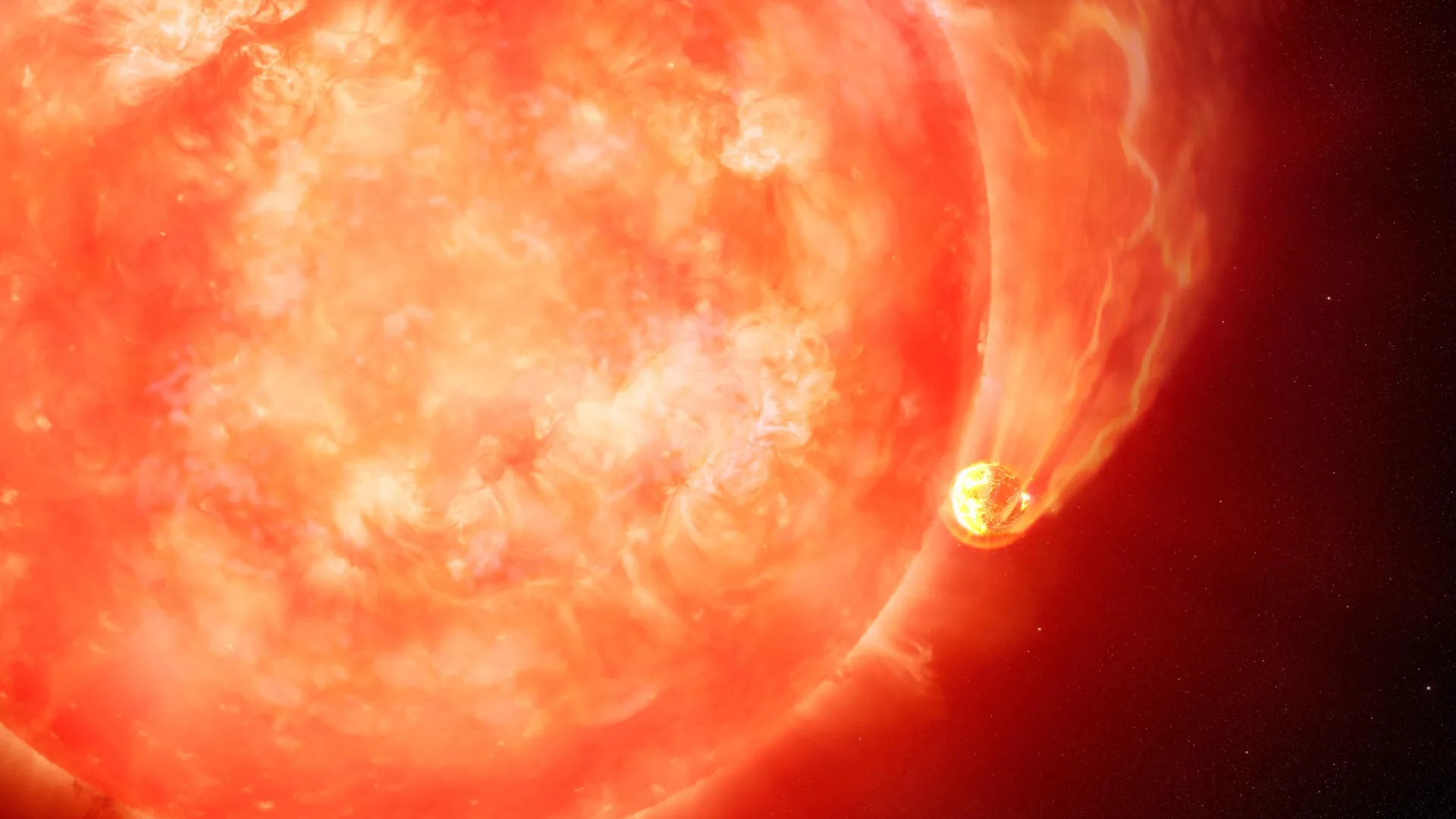
When low-mass stars like the sun run out of hydrogen in their cores, they become red giant branch, or RGB, stars. These are easy to study because they are bright and numerous. Arcturus, Aldebaran and Pollux are all RGB stars. As such a star ages and cools, it swells and gets more luminous in a fairly steady climb. But partway up there is a brief, abrupt pause in that climb, known as the RGB luminosity bump. The name comes from how it shows up as a feature in color-magnitude diagrams of star clusters.
Astrophysicists know why the bump ends. What starts it has been unexplained. The new work, published in The Astrophysical Journal Letters, is titled "The Role of Specific Entropy in the Onset of the Luminosity Bump." Its sole author is Saskia Hekker, a professor of theoretical astrophysics who leads the Theory and Observations of Stars Group at the Heidelberg Institute for Theoretical Studies.
The puzzle has a practical edge. In stellar models, the bump appears at higher luminosities than the one observed, meaning it comes later in the models than in real stars. "To understand why the bump appears later in the models than in observations, the physics of the bump needs to be unraveled," Hekker writes.
Her explanation starts with the star's layers. An RGB star has an inert helium core, a thin shell where hydrogen fusion occurs, and a convective outer envelope. As the star climbs the branch, the core contracts and the surface expands. That pushes the deepest layer of the convective envelope inward, into layers whose chemical makeup was changed by earlier burning, a process called dredge-up. The result is a shifting boundary deep inside the star, the base of the convective zone.
Hekker ties the bump to a property called specific entropy, which measures how disordered the gas is. As the boundary moves deeper, the entropy difference across it shrinks. Once it falls below a critical value, the luminosity bump begins.
Earlier explanations were mechanical: the hydrogen-burning shell reaches the boundary and something inside the star changes. In this picture the bump happens when an entropy threshold is crossed, not simply when layers meet. "This succinct explanation of the onset of the bump is the first quantitative description proposed so far," Hekker said.
Astronomers cannot look inside stars, so they test physics against the one part they can see, the surface. Hekker writes that the description could help modelers change the physics in stellar models, beyond adjusting a parameter called overshoot, so that the bump lands at the right luminosity while still matching measured surface abundances. The work will now go into the larger body of stellar theory for others to test.