Millions of Tiny Plasma Whirlpools May Be What Heats the Sun's Corona, New Paper Argues
An Embry-Riddle physicist calculates that Kelvin-Helmholtz vortices seen by the Inouye Solar Telescope carry enough energy to power the corona's million-degree heat.

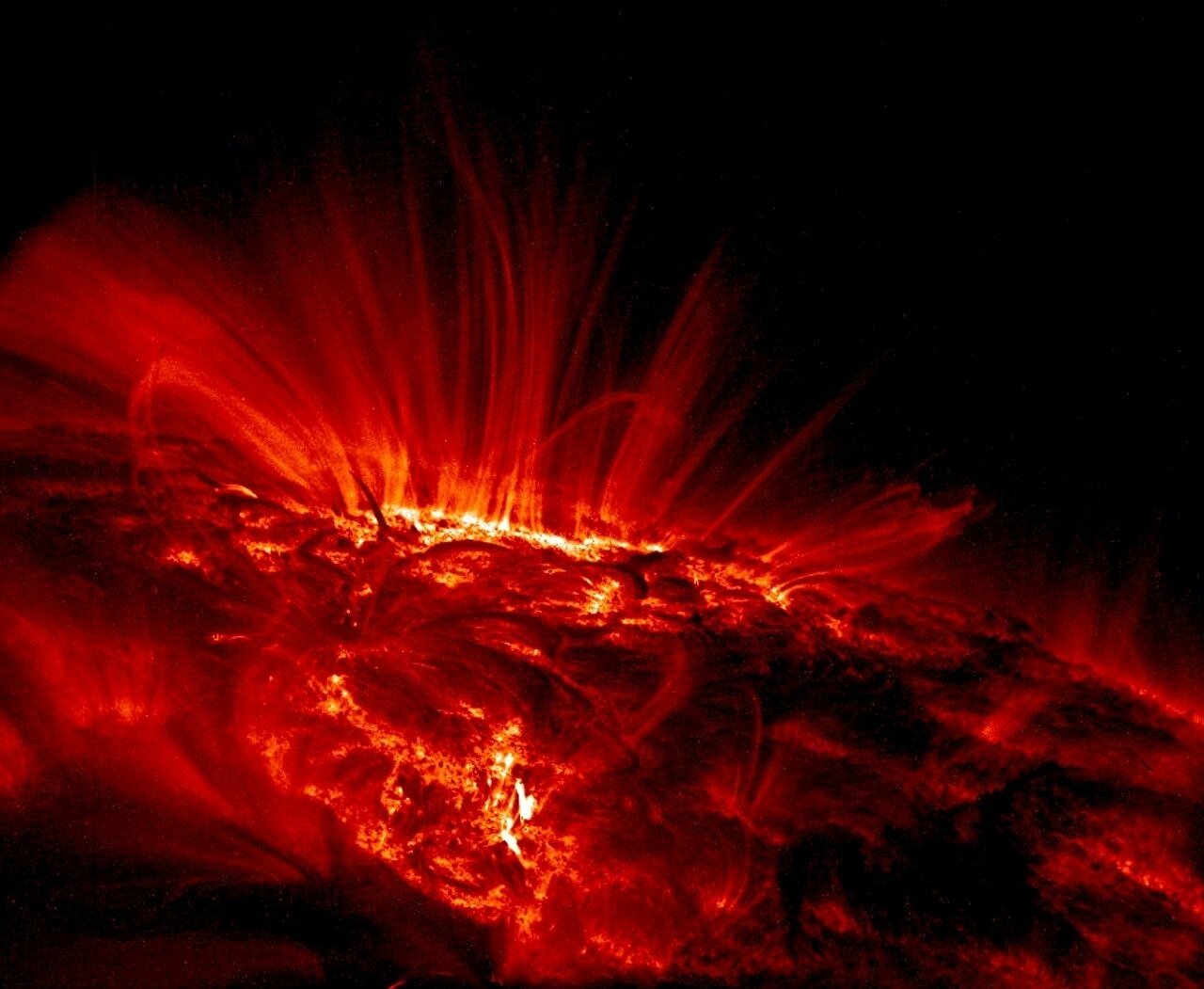
The sun's outer atmosphere is far hotter than its visible surface, a mismatch that has puzzled physicists for decades. A new paper argues that millions of tiny whirlpools of plasma, spinning across the solar surface at any moment, could supply the energy to close that gap.
The work comes from Katariina Nykyri of Embry-Riddle Aeronautical University and was published in The Astrophysical Journal Letters. It builds on images taken earlier this year by the Daniel K. Inouye Solar Telescope, atop Haleakala on Maui. At extremely high resolution, the telescope let scientists make out whirlpools of plasma only a few dozen kilometers across, dotted over the sun's surface. When that research was published in August, Nykyri had a "Eureka!" moment, according to an Embry-Riddle press release.
Her earlier research focused on Kelvin-Helmholtz waves. On Earth these show up as broken ocean swells or rippled clouds, and they also drive gas patterns on Jupiter. On the sun they form when fast-moving plasma slides past slower, magnetized plasma. The vortices those waves create are the structures the Inouye telescope resolved. As they churn, their motion transfers energy into the sun's magnetic fields, converting mechanical movement into magnetic stress.
Nykyri set out to calculate how much energy the vortices carry and whether it adds up to what the corona needs. Accounting for the velocity shear, density differences and heights of the vortices, she found that each one holds roughly 2 septillion ergs, a unit commonly used in solar physics. Millions of them spin up and dissipate every few minutes across the sun's surface.
When a vortex breaks down, its energy appears to flow into the corona through magnetic reconnection. Each spinning vortex squeezes nearby magnetic field lines together, forming ultrathin current sheets ranging from a few centimeters to meters across. Squeezed past a threshold, the field lines snap and rearrange, turning stored magnetic energy into heat and high-speed plasma jets. Solar physicists have long suspected reconnection plays a central role in coronal heating.
The paper also offers an explanation for why the corona ends up hotter than the surface even though vortices cause reconnection in both places. When a magnetic line snaps at the surface, the energy is split among trillions of neutral atoms, so each atom warms only slightly. In the corona, atoms are far less plentiful, so the same release raises the temperature of each particle by much more.
According to the paper, only 5 to 8 percent of the mechanical energy stored in the vortices has to travel upward to replace the heat the corona radiates away. Even in the cooler coronal holes, at most 21 percent would be enough. The result is a theoretical estimate, and it is not yet confirmed. Scientists still need to track how waves are transmitted and polarized through the chromosphere to check that as much energy reaches the corona as Nykyri's model requires. If it holds, part of the sun's extreme outer heat would trace back to small plasma tornadoes drifting across its surface. The paper is DOI 10.3847/2041-8213/aeb6c4.