Caltech Study: Dying Sun Could Wreck Outer Planets in 1 Billion Years
New simulations show the Sun shedding its outer layers in bursts could destabilize Jupiter, Saturn, Uranus and Neptune far sooner than the quintillion years once assumed.
Topic
10 stories from Planck Standard. Latest: October 17, 2026.

New simulations show the Sun shedding its outer layers in bursts could destabilize Jupiter, Saturn, Uranus and Neptune far sooner than the quintillion years once assumed.

A Nature Astronomy study finds the particle fingerprints point to 'interchange reconnection,' while waves and turbulence take over once the kink leaves the sun.

A Turkish astrophysicist ran the sun's evolution with and without an early super-Earth falling in. Only the version that swallowed one matches the sun's sound-speed profile, its convection depth and its missing lithium at the same time.

Max Planck and University of Colorado researchers tied the energy of the 300 strongest flares of 2010–2016 to the size of the active regions that produced them, then applied the relationship to 400 years of sunspot records. The biggest spot ever logged could, statistically, have fired a burst beyond anything ever measured on our star.

The vortices had never been resolved before. Researchers think they twist magnetic field lines tight enough to power nanoflares and move magnetic energy through the Sun's atmosphere faster than models allow.

The Inouye Solar Telescope in Hawaii imaged plasma vortices just 20 kilometers across, curling at the edges of granules like breaking ocean waves. They may be how the Sun twists its magnetic field.

A Swedish team rebuilt the physics of how silver atoms absorb sunlight and closed a stubborn gap between our star and the oldest rocks in the solar system.

Physicists at the University of Warwick identified a sudden turning point in the solar cycle that forecasts the strength of the next one, potentially giving satellite operators and power grids years of advance warning.

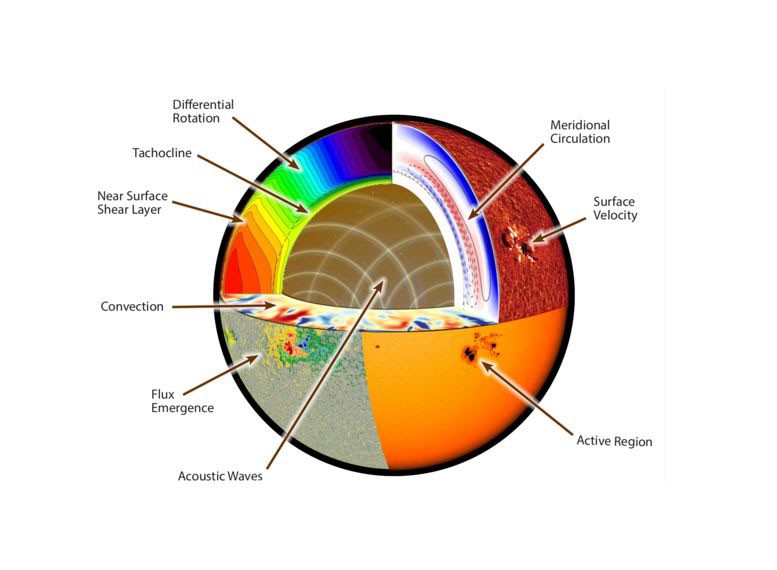
Refined simulations from a NASA science center suggest the Sun's own magnetic dynamo is what keeps the mysterious tachocline confined to a knife-edge, a key to forecasting solar storms.

NASA scientists traced the unprecedented Type IV burst to a vast magnetic 'helmet streamer' fed by three coronal mass ejections — a marathon outburst that could sharpen forecasts for the space weather that threatens satellites.