The Sun's 1947 Sunspot Was 40 Earths Across
A New Study Says a Spot That Size Can, in Rare Cases, Launch a Superflare.
Max Planck and University of Colorado researchers tied the energy of the 300 strongest flares of 2010–2016 to the size of the active regions that produced them, then applied the relationship to 400 years of sunspot records. The biggest spot ever logged could, statistically, have fired a burst beyond anything ever measured on our star.

The Sun has never been caught producing a superflare, the kind of eruption that releases more energy than trillions of hydrogen bombs and has so far been seen only on distant stars. A new study from the Max Planck Institute for Solar System Research (MPS) in Germany and the University of Colorado says that is not because it cannot. Analyzing the relationship between flare energy and sunspot size, the researchers conclude that the largest sunspots in the historical record, including the giant group of April 1947, were big enough to have launched a superflare in statistically rare cases. "Our Sun has superflare potential," said MPS scientist Natalie Krivova, the study's lead author. "It can produce massive sunspots that, in principle, can serve as the starting point for the most extreme bursts of radiation."
The problem the team set out to solve is one of time. Flare energies can only be measured directly from space, or inferred from spacecraft images, which means the record extends back roughly 70 years to the dawn of the space age, a blink in the life of a 4.6-billion-year-old star. No superflare has occurred in that window. Circumstantial evidence points the other way: in late 2024, MPS researchers showed that stars resembling the Sun in their key characteristics produce a superflare about once a century, and spikes of radioactive isotopes locked in ancient tree rings and Arctic ice cores indicate Earth has repeatedly been hit by unusually intense showers of high-energy solar particles. Whether those particle storms came with superflares is unknown; a flare, however violent, leaves no long-term trace. "According to the current state of research, extreme particle eruptions and particularly intense flares often, but not always, occur together," said MPS scientist Valeriy Vasilyev, lead author of a companion review published alongside the new study in Philosophical Transactions of the Royal Society A.
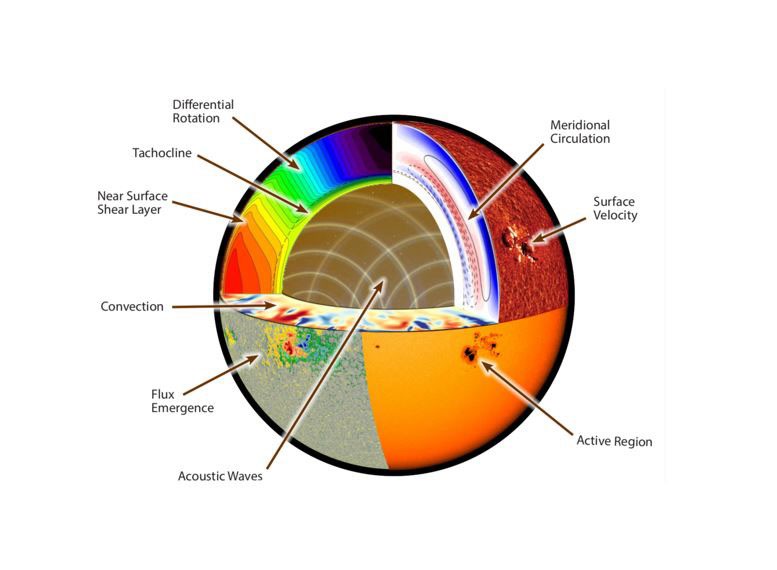
Krivova's team took a different route. Using observations from NASA's Solar Dynamics Observatory between 2010 and 2016, they correlated the energy released by the 300 strongest flares of that period with the size of the active region on the visible surface that produced each one. Active regions are patches where the magnetic field is unusually strong and tangled; they show up as sunspots and are the launch pads for eruptions. "Of course, we knew that no superflares had occurred during the observation period," Krivova said. "But the statistical relationship we found between the released energy and the size of the active region should hold true for more powerful events as well."
With that scaling law in hand, the researchers turned to the sunspot record, which has been kept systematically for about 400 years, according to co-author Theodosios Chatzistergos. From the size of a historical sunspot they could infer the size of its active region, and from that the largest eruption it could plausibly have produced. The outlier of outliers is the sunspot of April 1947, one of the largest ever observed. It covered about 0.6% of the visible solar disk and measured roughly 40 Earth diameters across. No superflare occurred then, but the new analysis shows that a spot of that size can trigger one in statistically rare cases; the paper's estimates put the 1947 group's typical ceiling at several times 10^33 ergs, and in the most extreme scenarios above 10^34 ergs, which is superflare territory.
The stakes are not academic. The most powerful solar storm in modern history, the 1859 Carrington Event, pushed auroras as far south as the Caribbean and threw sparks from telegraph receivers, and it was not a superflare. Today's grid of satellites, transformers and substations is far more exposed than the telegraph network was. A true superflare, if the Sun ever produced one, would sit an order of magnitude or more above anything the space age has recorded.
Whether it ever has remains, in Krivova's words, one of the star's mysteries. What the new work establishes is narrower and more useful: the Sun has grown sunspots big enough to do it, and the physics linking spot size to flare energy does not appear to stop at the largest event anyone has yet measured.