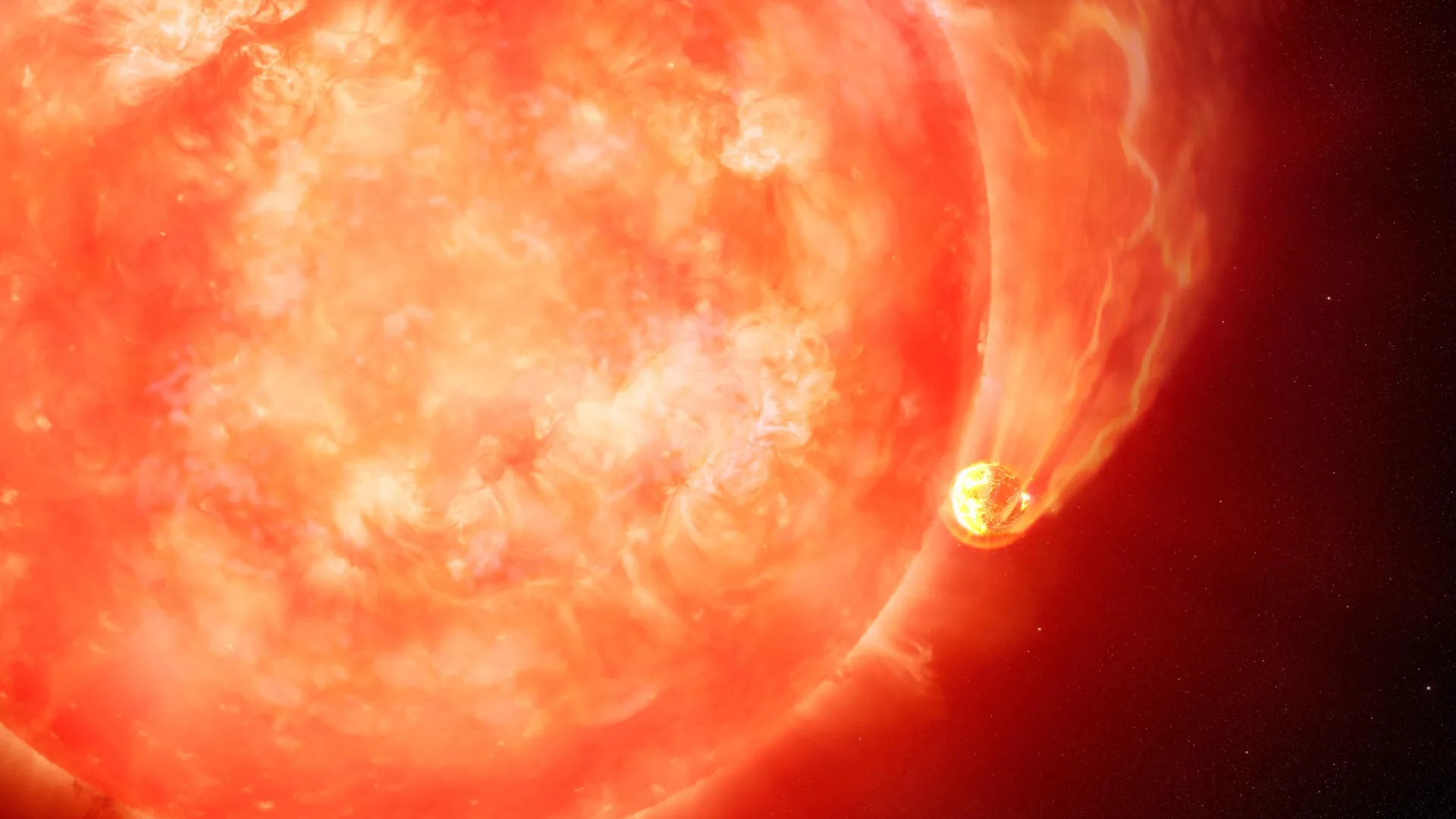
Red Giant's Record Superflares Traced to a Binary Companion and a Magnetic Dynamo
Hungarian astronomers say tidal forces left the star KIC 2852961 almost, but not quite, locked in rotation, and that gap powers the most violent flares in the Kepler field.

Astronomers in Budapest say they have figured out why one distant red giant is the most explosively active star in the entire field watched by NASA's Kepler space telescope. The answer, they report, lies in an interplay between a close stellar companion, giant dark starspots and an efficient magnetic dynamo inside the star.
The star, KIC 2852961, is not the largest or the brightest Kepler ever observed. It is, by a wide margin, the most violent. It produces superflares, eruptions so energetic that they dwarf even the strongest flares the sun can manage. The team, led by Zsolt Kővári of the Konkoly Observatory at the HUN-REN Research Centre for Astronomy and Earth Sciences, first drew attention to it in a 2020 paper in Astronomy & Astrophysics. That study cataloged 59 flares and superflares from the full Kepler data set and showed that flares across very different kinds of stars likely share the same physical mechanism.
The new paper, accepted for publication in Astronomy & Astrophysics, adds radial velocity measurements from ground-based spectroscopy. Together with Kepler's brightness record and data from the European Gaia mission, they confirm that KIC 2852961 is the primary component of a close binary system, with a faint dwarf star as its companion. "We wanted to find out what makes this particular star so extreme," Kővári said. "Is it the nearby companion star pulling on it? Or something happening deep inside? The answer turned out to be more nuanced than either option alone."
Tides are the link. The two stars pull on each other much as the moon raises ocean tides on Earth, only far more strongly. As the primary swelled into a red giant over tens or even hundreds of millions of years, its rotation slowed, but the companion's pull gradually synchronized that rotation with the orbit and made the orbit more circular. The time this takes scales steeply with the ratio of orbital separation to stellar radius, roughly as that ratio to the eighth power. Tidal forces that were negligible while the star was on the main sequence became overwhelming once it grew to about 12 solar radii. The researchers found that the star is nearly, but not completely, synchronized. That "almost" matters enormously.
Stars do not spin like solid balls. On the sun, the equator rotates faster than the poles, a pattern called differential rotation. In KIC 2852961, tides have strongly constrained that effect without erasing it. The leftover shear drives a powerful dynamo that amplifies magnetic fields. "Differential rotation plays a dual role," Kővári said. "On one hand, it helps generate and sustain huge starspots on the surface. On the other, it twists and shears the coronal magnetic field lines above those spots—and when these tangled, highly stressed magnetic field lines reconnect, the result is a superflare."
The star's brightness swings noticeably as it rotates because of those starspots, which cover a large fraction of its surface. The study finds that the spots serve as vast reservoirs of stored magnetic energy: the larger the spot coverage, the more energy is available and the stronger the flares. That supports an emerging picture in stellar physics in which spot size and flare energy are causally linked rather than coincidentally related.
The team also tested the more obvious idea that the companion triggers flares directly, for instance when the stars' magnetic field lines connect. They looked for flares clustering at particular points in the orbit and found no such pattern. The companion's role is indirect but foundational. It set up the near-synchronization that lets differential rotation work so effectively. In the researchers' phrasing, the companion helped build the engine, while the red giant holds the ignition key.
The result matters because red giants are often assumed to be magnetically quiet, their activity having faded with age. KIC 2852961 shows that a red giant spun up by a close companion can stay magnetically extreme.