Yale Physicists Show a 2% Change in Iron Flips a Memory Material's Magnetic State
Photoemission measurements of iron-doped niobium disulfide explain why the material's resistance switches with low current, a property prized for low-power spintronic memory.

A team of Yale researchers says it has solved a long-standing puzzle about a magnetic material that could one day help make computer memory faster and far less power-hungry. Their explanation, published in Physical Review Letters, comes down to a small change in how much iron the material contains.
The material is iron-intercalated niobium disulfide, written FeₓNbS₂. It is made by slipping iron atoms into the gaps between layers of niobium disulfide. Materials scientists have been interested in it because its electrical resistance can be switched between states by sending in pulses of electrical current. "This is a very surprising thing, because usually it's difficult to switch such states with electrical current at a low density," said Yu He, an assistant professor of applied physics at Yale who led the study.
That behavior makes the material a candidate for spintronics, a field that uses the spin of electrons, rather than only their charge, to store and process information. Spintronic memory could use significantly less energy than conventional memory. The researchers say it could also help advance quantum and neuromorphic computing. But no one knew exactly why FeₓNbS₂ behaved this way. Researchers knew it could easily switch magnetic states, but not what made it so flexible.
Earlier work relied on X-ray scattering to study the material's magnetic order. That technique runs into trouble in metallic magnets like this one, because mobile electrons dampen the signal and make it hard to pin down the strength of magnetic interactions. Wenxin Li, a Ph.D. student in He's lab and first author of the study, took a different route. She used angle-resolved photoemission spectroscopy, or ARPES, which measures the energy and momentum of electrons knocked out of a sample by light. It gives a direct view of the electronic behavior that determines both the electrical and magnetic properties.
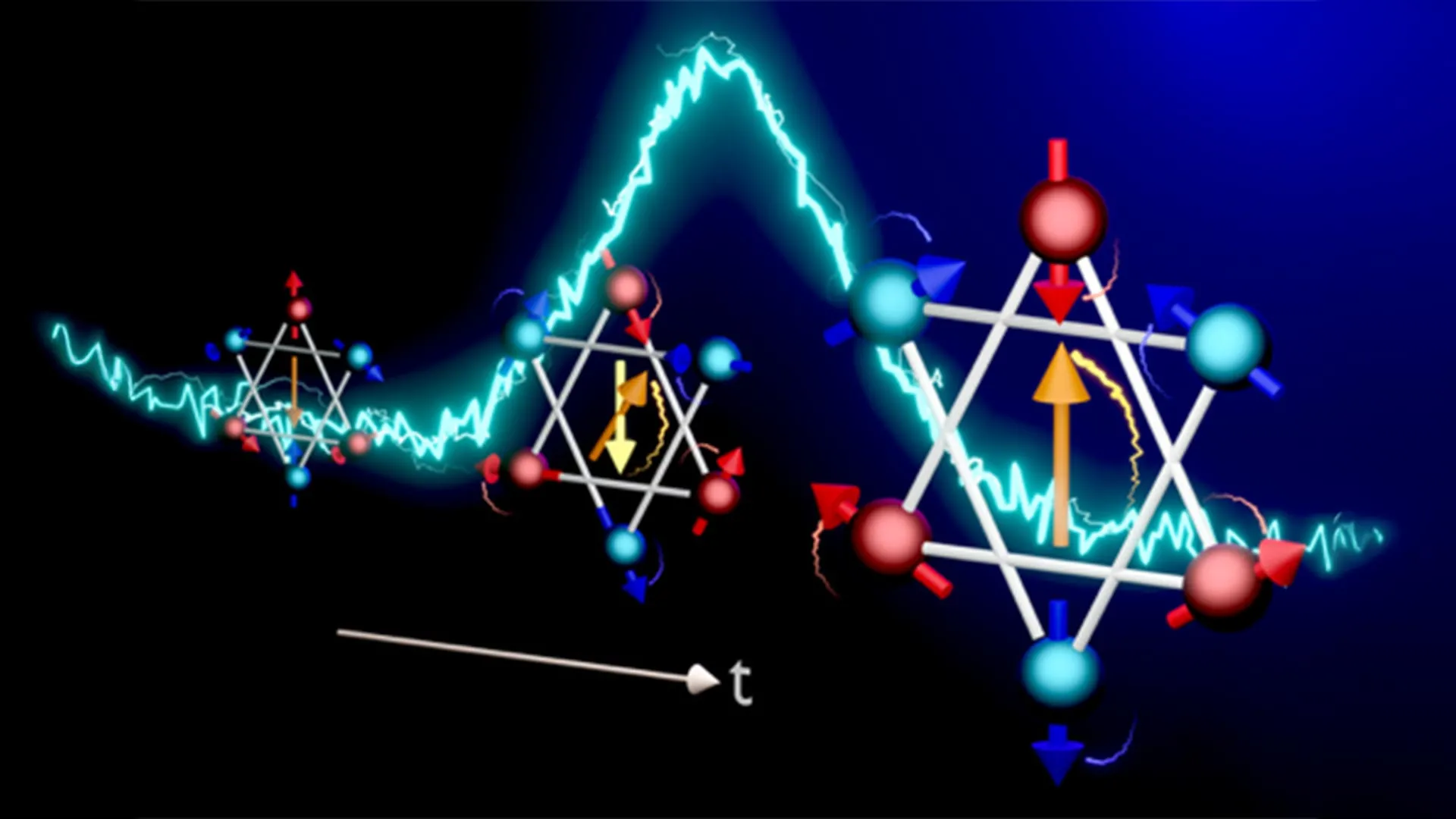
What the team found was that the ratio of iron to niobium disulfide controls how electrons from each interact. When the material contains one-third iron, narrow iron-derived electronic states mix strongly with niobium-derived states, a process called hybridization. Above that concentration, the iron-derived states lose coherence and with it their ability to hybridize with niobium. The weaker hybridization reduces the magnetic coupling between atomic layers, and that tips the balance between two competing magnetic states. The shift produces the material's characteristic resistance-switching behavior.
The sensitivity is striking. "You only need to change the iron-to-niobium atomic ratio by 2% to 3%, and then the magnetic state completely changes," He said. Li connected the result to a line from William Blake about seeing a world in a grain of sand. "We used photoemission to directly reveal how electronic states interact on the atomic scale and traced how those interactions shape the magnetic and electronic behavior of an entire crystal," she said.
The practical value reaches beyond one compound. The researchers say the same approach can be used to find the electronic origins of magnetism in other metallic magnets where X-ray and neutron scattering struggle. That could give materials scientists a way to design switchable magnets deliberately, instead of finding them by accident. The work is laboratory research on crystals, and the team did not report a working memory device. Still, knowing which knob matters, and how little it takes to turn it, is the first step toward engineering the effect.